

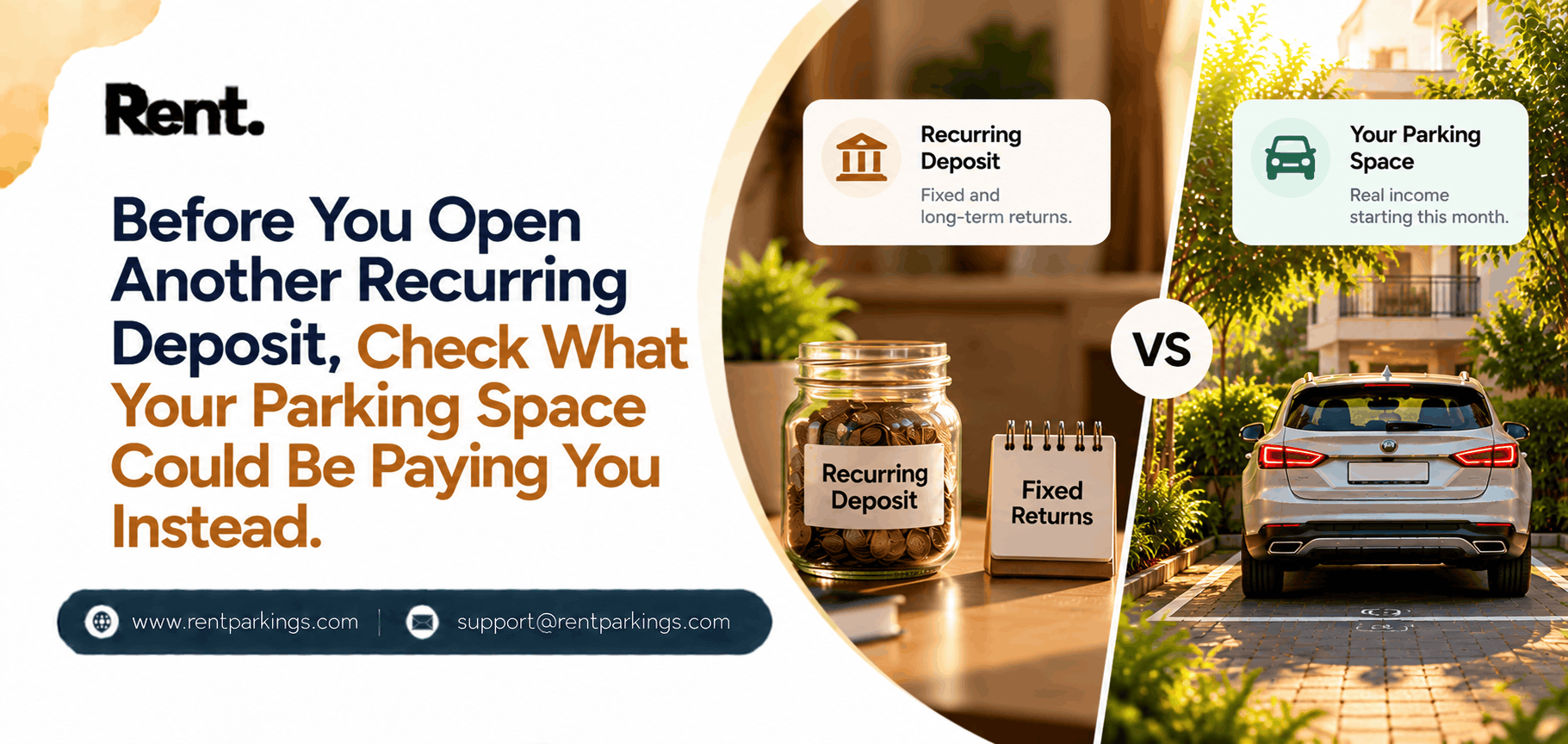
Before You Open Another Recurring Deposit, Check What Your Parking Space Could Be Paying You Instead
A recurring deposit is not the smartest way to grow your money this year. It's just the most familiar one, which is exactly why millions of Indians keep opening fresh RDs every festive season without ever checking what else might already be sitting in their own compound, quietly doing nothing.
Ask most RD holders what their deposit earns them each month and they'll tell you, without hesitation, down to the rupee. Ask the same person what their spare parking spot, unused basement bay, or vacant plot earns them each month, and the honest answer is usually nothing, because nobody ever asked that question before.
If you own a parking spot, a driveway, a basement bay, or even a vacant corner of a plot that sits unused for most of the day, you already hold an asset that can behave like income rather than an obligation. RentParkings exists for exactly this reason, connecting Indian property owners who have unused parking space with drivers and businesses who are actively searching for a place to park, hourly, daily, or every month.
None of this is an argument against recurring deposits. It's an argument for looking at your parking space the same way you'd look at any other idle asset, and asking whether it should keep doing nothing while your RD does all the heavy lifting.
What a Recurring Deposit Actually Does for You
A recurring deposit is built around one core idea: you promise the bank a fixed sum every month, and in exchange, you get a guaranteed interest rate at maturity. As of late 2026, most Indian banks and post offices offer RD interest rates somewhere between 6% and 7.5% per annum for a standard tenure, with small finance banks sometimes pushing slightly higher.
That's a reasonable, low-risk return. Nobody is disputing that an RD is safe. But notice the direction of the cash flow. Every month, money leaves your account and goes to the bank. You don't see a rupee of it again until the deposit matures, often three or five years later. Break it early, and you usually pay a penalty on the interest earned.
There's also an opportunity cost that rarely gets discussed around the dinner table. The money you're committing to an RD is money you can't use for anything else during that period. It's locked, by design. That's the whole point of the instrument, and for long-term goals, it works.
What Your Parking Space Does Instead
A parking space works on the opposite principle. There's no money going out. Instead, it simply puts an asset you already have, and barely use, to work for you.
Consider a covered parking bay in a mid-sized residential complex in a city like Pune or Coimbatore. Owners we've spoken with report earning somewhere in the range of ₹2,500 to ₹6,000 a month renting out a single covered spot to a nearby office-goer or a two-car household that only has one slot allotted. In commercial pockets of cities like Bengaluru or Gurugram, bays near IT corridors or metro stations have reportedly fetched noticeably more, since demand there runs higher throughout the working week.
Unlike an RD, there's no lock-in on your side. You decide whether to rent the space out for a few hours a day, for the full month, or only on weekends. You set the price. You choose the tenure. If your plans change and you need the space back for a new car, a visiting relative, or simply because you'd rather not rent it anymore, you can pause or close the listing.
And the money moves in the other direction compared to an RD. It comes to you, typically every month, through UPI or net banking, rather than leaving your account on a fixed date.
Running the Numbers Side by Side
Let's make this concrete with a simple scenario, not a promise of exact returns, just a way to see the shape of the two options.
Recurring Deposit: You commit ₹3,000 a month for three years. At a typical rate, you'll get back your principal plus accumulated interest at maturity, meaning the money is unavailable to you for three full years, and you've spent ₹1,08,000 of your own cash to get there.
Parking Space Rental: You list a basement or stilt parking bay you aren't using. If it earns even ₹3,000 a month, that's money arriving in your account starting this month, not three years from now, with zero cash committed on your end.
Over three years, the RD route means you've parted with roughly a lakh of your own savings to receive it back later with interest. The parking rental route means that same three years could have put a comparable amount into your pocket, earned from space that was otherwise sitting empty with nobody using it.
This isn't an argument to stop saving. It's a reminder that an idle asset and a monthly commitment are two very different things, and most owners only ever think about the second one.
Why This Isn't Really a Fair Fight, and That's the Point
An RD and a parking rental aren't actually competing for the same job. One is a savings discipline tool. The other is a way to monetise something you already own. What actually matters here isn't which one gives a better return. It's why you'd only use one of the two when nothing stops you from using both.
Plenty of hosts on RentParkings still run their RDs and SIPs exactly as before. The parking income simply becomes an extra stream that didn't exist a few months ago, often used to top up the very RD they're already paying into, which effectively means the parking space is now funding part of the savings commitment instead of their salary doing all the work.
The Objections Every First-Time Host Raises
"Nobody is going to pay to park in my building"
This comes up constantly, and it's almost always said by someone who hasn't checked what's actually happening three streets away. Indian cities have far more cars and two-wheelers than parking bays, particularly near offices, hospitals, coaching hubs, and metro corridors. A spot that feels unremarkable to its owner can be exactly what a nearby commuter has been searching for all week, as we found when looking at how metro-adjacent parking spots often turn into the most requested listings in the city.
"Listing it will cost me money or take forever"
It won't cost anything. Creating a listing on RentParkings is completely free, with no fee ever charged to a host for putting their space up. The entire process, from adding photos to setting your price, typically takes a few minutes once you have the basic details of your spot ready.
"What if someone damages my property or overstays?"
This is a fair concern, and it's one RentParkings takes seriously through renter verification and clear booking terms agreed upfront. The groundwork on handling disputes, overstays, and damage claims is something a related piece on this site walks through in detail when it looks at what actually happens when a vehicle is damaged inside a rented parking spot, including why a simple "park at your own risk" board doesn't hold up the way owners assume it does.
Beyond the Basic Parking Bay
A straightforward covered or open parking slot is the most common listing on the platform, but it isn't the only one. Owners with an EV charging point near their bay have started treating that socket as a separate, slightly premium offering, something explored at length in a piece on how a wall socket next to a parking spot has quietly become rentable real estate in its own right. Commercial landlords have discovered a similar opportunity, which came up when covering how companies near crowded tech corridors started leasing land directly from their neighbours simply because their own premises ran out of space.
The common thread across all of these is the same: an asset nobody was pricing suddenly started earning once somebody decided to list it.
Why This Beats Most "Side Income" Ideas People Try First
When Indian households look for a second income stream, the usual suggestions are things like freelancing on weekends, reselling products online, or driving a cab in spare hours. All of these demand your time, your energy, and often your evenings. A listed parking space asks for none of that once it's set up, a contrast covered in detail in an earlier piece on why renting out a parking space tends to outperform most side hustles people try first, mainly because it behaves like genuinely passive income: it keeps earning while you're doing something else entirely, including sleeping.
You still stay in control throughout. You set the hourly, daily, or monthly rate. You decide the rental terms. You can revise the price, pause the listing during a family event, or shut it down altogether whenever it no longer suits you.
Getting Started This Festive Season
If you're filling out an RD form this month, there's nothing wrong with that. But before you seal the envelope, it's worth spending ten minutes checking whether the parking space sitting under your building, beside your shop, or on your vacant plot could start paying you back faster than that deposit ever will.
Listing takes a few details: the location, the type of space, the hours you're willing to rent it out, and the price you think is fair for your area. Everything else, from fielding enquiries to collecting monthly payments through UPI, is designed to be handled with minimal back and forth once the listing is live.
Frequently Asked Questions
1. Is listing my parking space on RentParkings really free?
Yes. There is no listing fee, no subscription, and no hidden charge for putting your space up on the platform. Hosts only deal with the rental amount they agree to with a renter; RentParkings does not charge owners to create or maintain a listing.
2. How is a parking space better than a recurring deposit if an RD guarantees a fixed return?
An RD guarantees a return on money you commit upfront, but that money is locked away until maturity. A parking space doesn't require you to commit any cash at all; it simply starts earning from an asset you already own, with no waiting period and no penalty for changing your mind.
3. Can I rent out my parking space and still keep my RD running?
Absolutely. Most hosts don't choose between the two. The rental income from parking often ends up covering part or all of an existing RD instalment, effectively letting an idle asset fund a savings goal instead of your monthly salary doing all of it.
4. Do I need to be present every time someone parks in my space?
No. Once your listing terms are clear and a booking is confirmed, most hosts don't need to supervise each visit personally, particularly for daily or monthly arrangements where the renter has agreed terms in advance.
5. What if nobody in my area is looking for parking?
Demand varies by locality, but most Indian neighbourhoods near offices, hospitals, markets, metro stations, or residential clusters with limited allotted parking have more cars than available bays. It's worth listing and seeing the response before assuming there's no demand.
6. How much can I realistically earn from a single parking spot?
It depends heavily on location, but owners have reported figures ranging from a few thousand rupees a month for a residential bay to considerably more for spots in high-demand commercial or transit-adjacent areas. You set the price, so you can test and adjust it based on enquiries.
7. Is there a minimum rental period I have to offer?
No. You choose whether to offer your space hourly, daily, monthly, or any combination of these. Nothing locks you into one rental format forever.
8. What happens if I want my parking space back for personal use?
You stay in control of your own listing. You can pause it, edit the available hours, or take it down entirely whenever your own needs change, without any penalty for doing so.
9. Does renting out my parking space affect my housing society rules?
This depends on your specific society's bylaws, so it's worth a quick check with your RWA if you live in a managed complex. Many owners have been able to rent out their allotted bay without issue once it's clear the arrangement is between the owner and the renter.
10. How do I actually get paid once someone books my space?
Payments are handled digitally, typically through UPI or net banking, so the money reaches your account without you needing to collect cash in person or chase payment after the booking ends.
The Takeaway
A recurring deposit rewards patience with your own money. A parking space rewards you for simply noticing that you already own something worth more, right now, than it's currently earning. Neither has to replace the other, but only one of them asks nothing of your bank balance to get started.
If you've got a driveway, a basement bay, a stilt slot, or a vacant corner that's done nothing but collect dust this year, this festive season is as good a time as any to change that. List your parking space for free on RentParkings and find out what it could be earning you before your next RD instalment is even due.
Share This post
Search
Recent Post

Coimbatore's Cotton Mills Built the City...
22 Oct, 2026
Your PPF Account Takes 15 Years to Matur...
20 Oct, 2026

Three People Are Circling for Parking in...
19 Oct, 2026
Rent Out Parking Without Tech Skills: An...
16 Oct, 2026
Is It Actually Legal to Rent Out the Par...
15 Oct, 2026

Jaipur's Wedding Season Isn't Just Pink...
14 Oct, 2026
Ahmedabad Has Two Very Different Parking...
12 Oct, 2026
Nobody Talks About Kolkata's Parking Mar...
09 Oct, 2026