

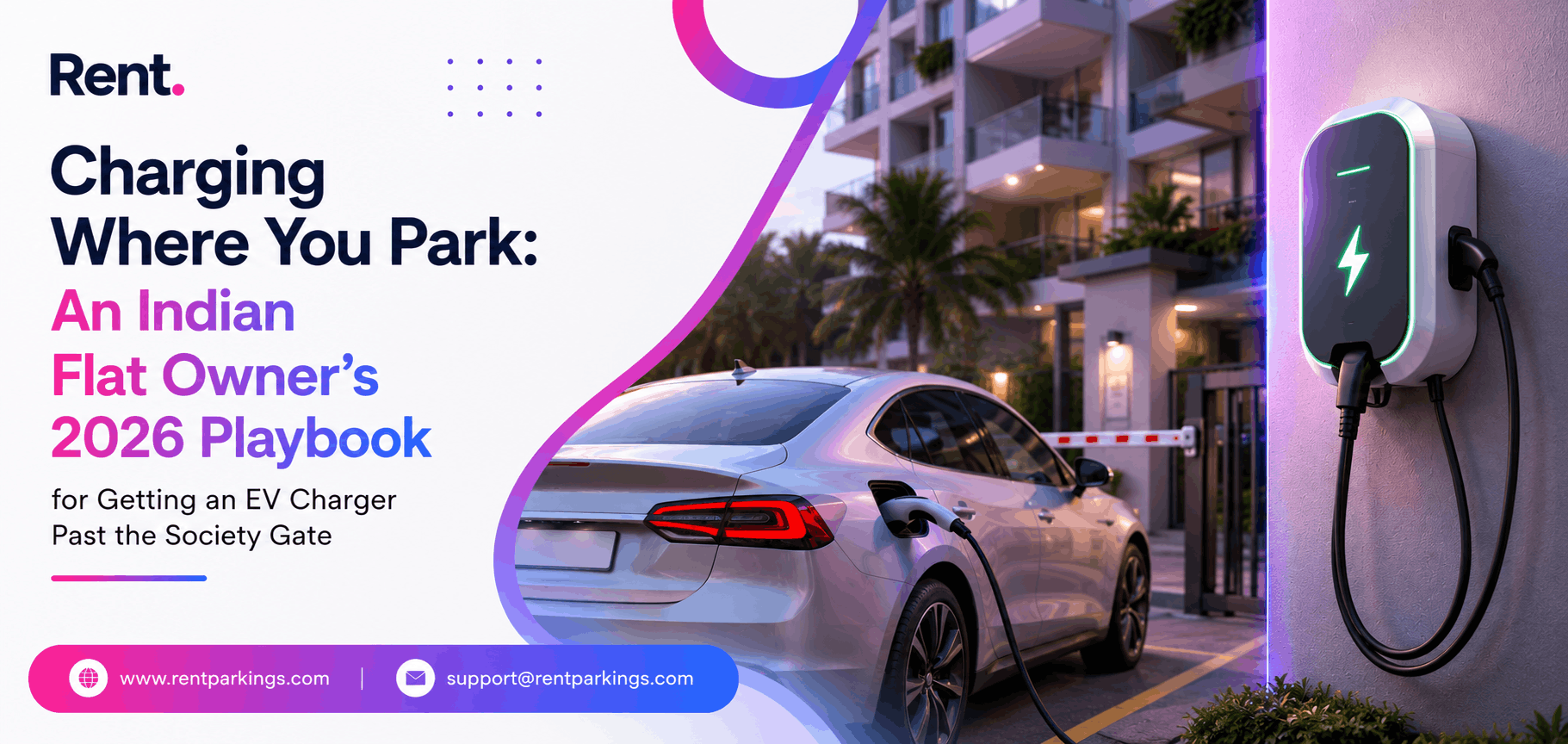
Charging Where You Park: An Indian Flat Owner's 2026 Playbook for Getting an EV Charger Past the Society Gate
The booking is done. Maybe it is an electric hatchback, maybe a scooter, and delivery is only days away. The numbers made sense, the test ride sealed it, and you are already mentally spending the petrol savings. Then you drop the news in the building group chat and the response arrives like a pothole you never saw coming: the society, someone says, does not permit EV chargers in the parking area.
For anyone renting or owning a flat in Bengaluru, Pune, Mumbai, Hyderabad, Chennai or Delhi NCR, this exchange has quietly become a fixture of apartment life. India sold somewhere near 24.5 lakh electric vehicles in FY2025-26, total EV share sat around 8.5%, and electric two-wheelers alone touched 6.5% penetration. Put simply, the vehicles are reaching homes faster than the buildings can adapt. The thing holding people back is no longer driving range or upfront price. It is a parking bay, a power point, and a managing committee that genuinely does not know what the rules allow it to say.
Parking is what we think about all day at RentParkings, so we put this guide together for the flat-owning EV buyer who is done with hand-wavy answers. Over the next few sections we will lay out what the law actually permits in 2026, where your society's authority begins and ends, how charging really behaves inside an Indian building, what the whole thing costs, and how to win a "yes" without lighting up your next general body meeting.
Why Committees Resist, and What Is Really Behind It
It pays to understand the pushback before you challenge it, because most of it comes from worry rather than spite. Strip away the noise and there are four recurring fears, each of which has a clean answer.
One is the power supply. For a committee used to fretting over whether the lift and the borewell pump might already strain the connection, the words "vehicle charger" instantly conjure up blown fuses and a blacked-out building. Another is fire, a fear that grew sharper after a run of EV battery fire stories, especially in covered basements. A third is money, since some members assume one resident will quietly charge on shared common-area billing and stick everyone else with the cost. And the fourth is the laziest of all: there is no policy on file, and "we have no policy" has become the standard Indian reply to anything unfamiliar.
Every one of these can be settled. The real shift since 2024 is that you no longer have to win on charm alone. The regulations now tilt firmly toward the EV owner.
The Legal Position in 2026, Spelled Out Clearly
This is where most society circulars get it backwards, so go slowly here.
The central 2024 charging guidelines made home charging the default assumption
The Ministry of Power's charging infrastructure guidelines, issued in 2024, reach into private parking and openly encourage chargers inside group housing societies. The rules let a resident put a personal charging point in their own allotted bay, and they oblige the local distribution utility (the DISCOM) to provide the supply, either off your existing connection or through a separate sub-meter kept only for charging. Read it plainly and the message is obvious: national policy expects you to charge at home and instructs the utility to enable it.
A 2025 Bombay High Court order tipped the scales
The case of Amit Dholakia versus the State of Maharashtra, heard in January 2025, involved a resident whose cooperative society had refused him a No Objection Certificate for a charger. The court's response mattered in two ways. It pushed the Registrar of Cooperative Societies to hurry up and finalise the framework for charger installation in cooperative societies and to make societies amend their by-laws accordingly. And it affirmed, in principle, that a resident has the right to fit a charger in their allotted bay so long as safety and structural conditions are met, sending an unmistakable signal that a society cannot say no on flimsy grounds like the absence of a rulebook.
That detail is the crux, because "we have no policy" is exactly the sentence most committees reach for. Following this order, a missing policy is the society's gap to close, not a lawful excuse to stop you.
Some states have added hard deadlines
A few states have tightened things further. In Maharashtra, once the safety standards and the state's charging procedure are satisfied, the society is meant to hand over a no-objection certificate inside seven days. In Karnataka, a resident can run a charger off their existing domestic connection as long as the load can take it, with no extra sanction fuss for a simple setup. And the Model Building Bye-Laws were updated as far back as 2019 to demand EV-ready provisioning in parking zones, which is why fresher projects in Bengaluru, Pune and Gurugram often arrive with conduit and spare capacity already built in.
The bottom line for you: the society gets a say in how the charger goes in, covering the spot, the cable run, the safety sign-off, and who foots the bill, but it cannot flatly stop you from charging your own vehicle in your own bay.
A Fair Caveat: The Basement Safety Debate
In fairness to the worriers, one area is still genuinely unsettled. In October 2025, the Bureau of Indian Standards floated changes to the National Building Code that could limit parking and charging of EVs and hybrids in the basements of homes and commercial buildings, citing fire risk.
This is not a ban on charging at home. But it does mean that if your bay sits in a deep basement, talking through ventilation, smoke detection and where the charger is mounted is a reasonable conversation rather than an obstruction. Most buildings handle it with a properly rated unit, a dedicated circuit fitted with an MCB and RCCB, fire-resistant cabling, and a charger placed where heat or smoke would be picked up. If the committee raises basement safety specifically, treat it as an engineering question with a solution, not as a wall.
The Electrical Truth: Can Your Building Actually Handle It?
Here is the calming fact that takes the air out of most committee panic. Charging at home asks far less of a building than people fear.
A standard home AC unit, usually called a wall box, draws about 3.3 kW. That is roughly what a powerful geyser or an air conditioner pulls. Most city homes already carry a 5 kW sanctioned load, which generally runs a 3.3 kW charger with no upgrade needed, particularly if you top up overnight while the AC, geyser and kitchen are idle. The typical 10-amp or 15-amp service in an apartment copes with a basic charger without complaint.
An electric two-wheeler asks for even less, often nothing more than a portable charger in an ordinary 15-amp socket, pulling less than an electric kettle.
The few technical points worth nailing down with your society and electrician are straightforward. Check that your sanctioned load has room to spare, and approach the DISCOM for an upgrade only if you are putting in a faster charger. Insist on a dedicated circuit so the charger is not sharing a line with heavy appliances. And settle the metering question, choosing either your existing home meter or a separate sub-meter so the unit billing is beyond dispute. That sub-meter, as it happens, is frequently the one move that kills the "who pays for the power" row before it begins.
The Real Numbers for 2026
This is where vague dread meets actual figures, and the figures are tame.
A 3.3 kW AC wall-box setup usually runs ₹15,000 to ₹35,000, taking in the unit itself, the wiring work and the labour. A basic 3.3 kW charger, installed, often lands around ₹15,000 to ₹25,000. For an electric two-wheeler, the portable charger tends to ship with the vehicle, so you may only be paying for a decent socket and a short cable run.
The running costs are where the case for an EV stops being an argument. Charging at home in India typically works out to around ₹6 to ₹10 a unit, depending on your DISCOM and slab, with domestic tariffs broadly spanning ₹4 to ₹10 a unit. Drive roughly 1,000 km a month and the home-charging bill comes to about ₹1,200 to ₹1,600, going by consumption near 15 to 18 kWh per 100 km. Set that beside a petrol car over the same distance and the saving pays back the charger inside a few months.
A couple of city-level snapshots make it concrete. A Pune professional topping up a small EV overnight on a home tariff is paying single-digit rupees a unit and recovering the whole setup within a year of fuel saved. A Bengaluru rider covering 40 km a day burns less on a full month of electricity than one tank of petrol used to demand. These are not glossy showroom claims. They drop straight out of today's Indian tariffs and ordinary driving habits.
How to Land a "Yes" Without Going to War
Knowing the law is only half the battle. The other half is keeping the peace with neighbours you will share a lift with for years. The residents who get this right tend to move in a calm, paper-backed sequence instead of opening with threats.
Put the request in writing, not in the group chat
Send a written note to the managing committee. Say clearly that you want a charger in your own allotted bay, point to the 2024 central guidelines, confirm that you will cover every cost, and attach the charger's specifications and safety features. A reasonable written ask is far harder to brush aside than a passing verbal one, and it leaves a trail you may be thankful for later.
Hand over an electrician's load check
Nothing settles a nervous committee faster than a qualified electrician confirming on paper that the supply can carry a 3.3 kW charger on a dedicated, properly protected circuit. It turns a vague fear into a closed item and shows you are being careful rather than cavalier.
Offer the sub-meter before they ask
Volunteer up front to fit a separate sub-meter, or to charge on your own meter, so the society pays nothing toward your electricity. Taking the money question off the table early removes the objection committees raise most often.
Aim for a general body resolution or a by-law change
For lasting calm, the real prize is not just your own NOC but a clear society-wide charging policy any resident can lean on. Float a simple framework at the meeting: residents may install chargers in their own bays at their own expense, on dedicated circuits, with sub-metering and safety compliance. This is precisely the direction the courts and the Registrar of Cooperative Societies have been steering societies toward, and it spares the building this argument every time another neighbour goes electric.
If they still say no, escalate without drama
Where a society refuses with no real safety or structural reason, you have proper recourse. Cite the 2025 Bombay High Court order, take it to the Registrar of Cooperative Societies or your state's cooperative authority, and in Maharashtra lean on the seven-day NOC expectation. More often than not, simply demonstrating that you know where you stand ends the matter.
The Wider View: Why This Is the Decade's Mobility Question
Pull back from your single bay and a national shape appears. India's EV surge is led overwhelmingly by two-wheelers, close to 58% of all EV sales, and by city buyers in exactly the metros and Tier-2 towns where most people live stacked in flats rather than standalone houses. The PM E-DRIVE scheme and steadily cheaper batteries keep pulling adoption forward, with penetration tipped to climb toward 9.5 to 10% in FY2026-27.
So the next wave of EV owners will not be bungalow residents with private driveways. They will be flat owners in Hyderabad's Gachibowli towers, Mumbai's redeveloped high-rises, Pune's IT-corridor townships, and the spreading apartment belts of Kochi and Coimbatore. For all of them, the make-or-break question on whether to go electric narrows to one line: can I charge where I park?
This is where India's larger urban story joins up, and where RentParkings sees mobility heading. The Smart Cities Mission and EV-ready building rules point to a future where a charging point is just another standard amenity, no more remarkable than a lift or a water line. But that future lands one building at a time, one meeting at a time, one resident at a time. Every society that adopts a sensible charging policy lifts the brake off EV adoption for dozens of households at once. The ordinary parking bay has quietly turned into one of the most important pieces of infrastructure in the country's shift to clean energy.
Quick Practical Takeaways
If only one thing sticks, make it this. Your society cannot arbitrarily block a charger in your own allotted bay, and both the 2024 central guidelines and the 2025 Bombay High Court order back you. A standard 3.3 kW home charger is easy on the building's supply and usually needs no load upgrade. The cost is modest, roughly ₹15,000 to ₹35,000 to install and ₹1,200 to ₹1,600 a month to run a car. The smartest route is a written request supported by an electrician's check and an upfront sub-meter offer, ideally turned into a society-wide policy at the general body meeting. And if you are stonewalled without a real safety reason, the Registrar of Cooperative Societies and your state's rules give you usable, practical recourse.
Conclusion
For a long stretch, talk about electric vehicles in India circled two anxieties: how far they would go and how much they would cost. Both are fading from the conversation. The new battleground, the one that will really set the pace at which India's flat-living majority switches over, is the low-key tug of war between a resident and a committee over a charger and a plug in a parking bay.
The encouraging part is that the ground has moved decisively toward the EV owner. The law no longer frames home charging as a favour a society may grant on a whim. It treats it as a right to be enabled within sensible safety limits. What is left is the human work of carrying your neighbours with you, calmly, with documents in hand and a fair offer to pay your own way.
If you are standing in a showroom wondering whether your building will let you charge the EV in front of you, the 2026 answer is increasingly plain: yes, and here is how. The vehicle is ready. The law is ready. And as parking and charging grow inseparable across Indian cities, RentParkings will keep watching how that future takes shape. The only thing still waiting to be updated is the by-law sitting in your society's drawer, and that, at last, is a problem with a fix.
FAQs
Can my housing society legally refuse to let me install an EV charger?
Not on a whim. Under the 2024 central charging guidelines and a 2025 Bombay High Court order, a society cannot turn down a charger in your own allotted bay just because it "has no policy." It is allowed to set safety and installation terms, but it cannot block you without a real structural or safety reason.
Do I need an NOC from my society to install an EV charging point?
If the work touches or affects common property, then yes, you usually need the society's NOC or a general body resolution. In Maharashtra, once safety norms and the state procedure are met, the society is meant to issue that NOC within seven days. Charging inside your own clearly allotted bay on your own meter clears a far lower hurdle.
Will an EV charger overload my apartment building's electricity supply?
Almost never. A standard 3.3 kW home charger pulls about as much as a geyser or an AC. Most city homes on a 5 kW sanctioned load run one without any upgrade, especially if you charge overnight on a dedicated circuit.
How much does it cost to install an EV charger at home in India?
A 3.3 kW AC wall-box setup usually runs ₹15,000 to ₹35,000, covering the charger, wiring and installation. A basic installed unit often lands around ₹15,000 to ₹25,000. Two-wheeler portable chargers generally come with the vehicle.
How much does it cost per month to charge an EV at home?
Drive about 1,000 km a month and you are looking at roughly ₹1,200 to ₹1,600, based on home tariffs of around ₹6 to ₹10 a unit and consumption near 15 to 18 kWh per 100 km. Two-wheelers cost far less, often a few hundred rupees a month.
Can I charge my EV using my regular home electricity connection?
Yes. In states such as Karnataka, residents can charge off their existing home connection as long as the load can handle it. The central guidelines also allow supply through your existing meter or a dedicated sub-meter for charging.
Should I install a separate sub-meter for EV charging?
In an apartment, it is usually the smart call. A dedicated sub-meter keeps your charging units cleanly separate from common-area billing, which clears away the objection societies raise most about who pays for the power.
Is it safe to charge an EV in basement parking?
Generally yes with the right precautions, though basement charging is the one area still openly debated. In October 2025, the Bureau of Indian Standards proposed National Building Code changes that could restrict basement EV charging on fire-safety grounds. A properly rated charger, a dedicated protected circuit and good ventilation address most of the concern.
What can I do if my RWA blocks my EV charger without a valid reason?
Send your request in writing, cite the 2024 central guidelines and the 2025 Bombay High Court order, and offer to bear every cost with a sub-meter. If you are still refused with no safety or structural reason, take it to the Registrar of Cooperative Societies or your state's cooperative authority.
Do new apartment buildings in India come EV-ready?
More and more, yes. The Model Building Bye-Laws were amended in 2019 to require EV-ready provisioning in parking areas, so many newer projects in cities like Bengaluru, Pune and Gurugram already include the conduit and electrical capacity for chargers, which makes installation simpler.
Share This post
Search
Recent Post
Parking Space vs. Renting Out a Room to...
05 Oct, 2026
Think Parking Rental Only Pays in Mumbai...
02 Oct, 2026
Your Mumbai Parking Space Is Worth More...
01 Oct, 2026
Hyderabad's Real Estate Boom Left One As...
30 Sep, 2026
What Your Parking Space in Chennai Could...
29 Sep, 2026
Your Plans Changed After Listing Your Pa...
28 Sep, 2026
Parking Space vs SIP: Which Idle Asset A...
25 Sep, 2026
What Your Parking Space in Pune Could Ac...
24 Sep, 2026