

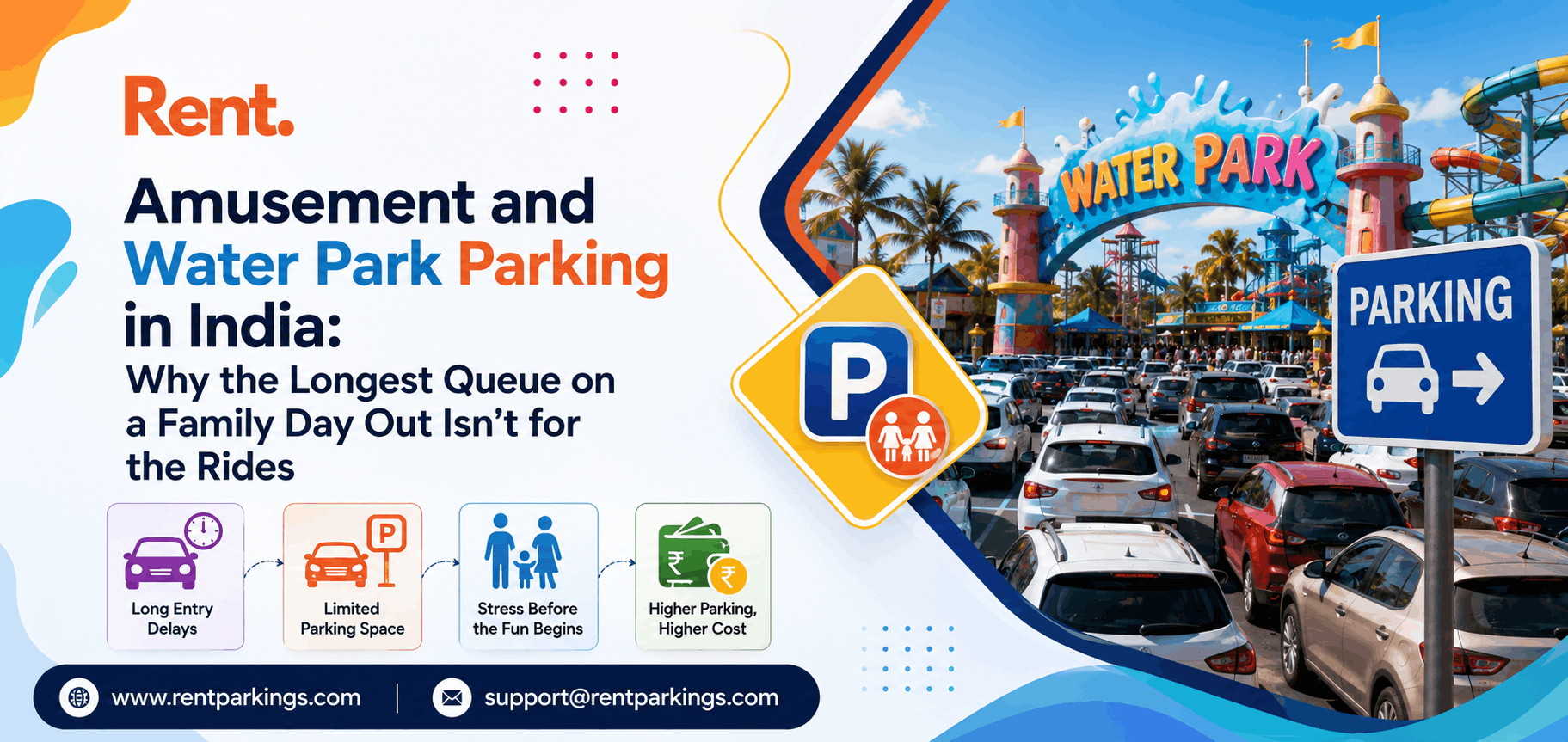
Amusement and Water Park Parking in India: Why the Longest Queue on a Family Day Out Isn't for the Rides
The most stressful part of a family trip to Wonderla or Essel World rarely happens inside the gates. It happens forty minutes before that, somewhere on the approach road, when a car full of excited kids is still hunting for a place to leave the vehicle while the ticket counter closes in on its cutoff time.
Ask any parent who has done the Saturday-morning drive to a water park with two children buckled in the back and a cooler bag wedged between them, and they will tell you the ride queues were never the problem. The problem was the half kilometre of stationary traffic before they even reached a barrier, followed by a man waving a torch who wanted cash for a patch of dusty ground with no shade.
This is a strange gap for an industry that has grown as fast as India's leisure and entertainment parks have. Wonderla now runs properties in Bengaluru, Kochi and Hyderabad. Essel World and its water park sibling pull in Mumbai families every weekend. Adlabs Imagica sits off the Mumbai-Pune expressway drawing visitors from both cities. Nicco Park anchors Kolkata's family outing calendar, and Chennai has its own cluster along the East Coast Road. Yet almost none of these destinations were built with parking capacity that matches their actual weekend footfall.
RentParkings, India's trusted parking marketplace, has been tracking this pattern across dozens of high-footfall destination categories, and amusement and water parks turn out to be one of the sharpest mismatches between demand and available legitimate parking anywhere in the country.
A Demand Curve That Almost No Park Was Designed For
Most Indian amusement and water parks were planned around a steady daily crowd. What they actually get is closer to a spike graph. Weekday footfall might be light enough that the parking lot never fills. Then Saturday and Sunday arrive, or a school holiday week begins, and the same lot needs to absorb three to four times as many vehicles in the space of a few hours.
Summer vacation is the sharpest version of this. Between late April and June, water parks in particular see families booking group outings, corporate teams planning bonding days, and school batches arriving in chartered buses, all converging on the same gate within the same morning window. A parking area sized for an average Tuesday simply cannot flex to meet a peak Sunday in May.
Festivals compound the problem in their own way. Long weekends around Holi, Diwali or Republic Day pull in visitors from neighbouring towns who would not otherwise make the trip, adding out-of-town vehicles to an already stretched lot.
Who Actually Bears the Cost of This Gap
It is easy to assume this is only an inconvenience. In practice, the people absorbing the real cost are quite specific.
- Families with young children, who cannot easily walk an extra fifteen minutes from an overflow lot while carrying bags, floats and a toddler who has already decided the day has been too long.
- First-time visitors unfamiliar with the property, who often arrive later than regulars because they underestimate how far the last legitimate parking stretch actually is.
- School and college groups on chartered transport, where a bus needing turning space can lose twenty minutes just manoeuvring near a congested gate.
- Senior citizens accompanying grandchildren, for whom a long walk in peak summer heat from an overflow lot to the entrance is not a minor annoyance but a genuine physical strain.
Property owners along the approach roads to these parks see the same crowd every weekend, and most of them have no formal way to participate in it.
The Informal Parking Economy Filling the Gap
Where official capacity runs out, an unofficial one usually appears. Roadside operators, sometimes with no more authority than a hand-painted board and a length of rope, start directing cars into vacant plots, half-built compounds and dried-up fields near the entrance.
Pricing in this informal layer is rarely fixed. A family might pay a modest amount on a quiet Tuesday and triple that on a peak Sunday, with no receipt and no real accountability if the vehicle is scratched, its mirror is clipped, or worse, it simply is not where it was left when the family returns hours later, sunburnt and tired.
This is not a criticism of the individuals doing this work, many of whom are simply responding sensibly to unmet demand. It is a structural gap: property near a high-footfall destination generates a predictable, recurring need for parking, and the market currently meets that need through improvisation rather than a proper, listed, priced arrangement.
What Good Parking Near These Parks Actually Looks Like
Compare that scattered scene with what happens near destinations that already have organised leisure-crowd parking figured out, and the difference is obvious. Anyone who has read our earlier piece on how weekend shoppers routinely get turned away at mall and multiplex gates will recognise the same underlying pattern here: a fixed structure trying to absorb a variable crowd, and losing that battle every weekend without fail.
The fix at both kinds of destinations tends to look similar. A landowner within reasonable walking distance, or a short shuttle ride, formalises their plot as parking. They set clear per-hour or per-visit rates instead of negotiating on the spot. They mark the boundary, keep the surface reasonably level and drained, and post a visible price so nobody has to haggle at the gate with a cranky toddler in the back seat.
None of this requires major construction. A vacant residential plot two streets from the park entrance, a commercial shed's forecourt that sits empty on weekends, or a farmhouse compound along the approach road can all work, provided access is safe and the surface can take repeated vehicle traffic.
The Income Side: What Owners Near These Parks Can Actually Expect
Owners of land near amusement and water parks are sitting on an asset that behaves almost exactly like the seasonal opportunities we've explored elsewhere on this blog, where recurring high-footfall events turn quiet plots into working assets. The dynamics are the same weekend-and-holiday spike pattern described in our look at how owners quietly earn from empty spots on India's biggest calendar days, just repeating every Saturday and Sunday instead of a handful of times a year.
What tends to make the arrangement work smoothly is treating it as a real, listed offering rather than an informal side gig. Setting a transparent per-hour or per-visit rate, accepting UPI alongside cash so families don't need to carry exact change, and being upfront about walking distance from the gate all build the kind of trust that gets repeat weekend traffic rather than one-off visitors who never return.
Pricing itself varies a great deal by city and by how close the plot sits to the actual entrance. A spot a two-minute walk from a Bengaluru or Kochi park gate commands a premium over one requiring a ten-minute walk, and weekend and holiday rates typically run higher than weekday ones given the demand spike. Owners weighing what to charge often find it useful to see how comparable plots are priced across other Indian cities, which our city-by-city look at parking rental rates breaks down in more detail.
Getting the Legal Basics Right Before Listing
Before turning a plot near a park into paid parking, it is worth being clear about what a property owner can and cannot do with the land, especially if any part of it touches a public road or municipal easement. Confusion here is common, and our earlier explainer on what Indian property owners can and cannot legally reserve along a public road is a useful starting point if the plot in question borders one.
Beyond that, owners renting out private land they fully control still have a handful of basics worth sorting out early: a simple written understanding with regular weekend users, some form of liability coverage or at least a clear disclaimer about vehicle safety, and a record of income for tax purposes once the arrangement starts generating steady weekend cash flow. Our broader guide on the legal, tax and safety side of renting out a parking space in India walks through these fundamentals in full.
Smart Parking Features That Actually Matter Here
Amusement and water park crowds bring a specific set of practical needs that a generic parking listing often misses.
- Shade or partial cover matters more than usual, since vehicles often sit for six to eight hours in peak sun while families spend a full day inside.
- A clearly marked, level surface reduces the risk of a scraped bumper when dozens of families are manoeuvring in and out within the same short window.
- Digital payment options speed up entry and exit dramatically compared to cash-only counting, which matters when fifty cars are trying to leave within the same fifteen minutes at closing time.
- Basic lighting is essential for water parks especially, since many families stay until dusk and walk back to a poorly lit plot after dark.
- A simple token or ticket system, even a handwritten one, gives families something to point to if there is ever a dispute about which vehicle belongs to whom.
None of these require significant investment. They require intent, and a willingness to treat the plot as a small, serious operation rather than an occasional favour to whoever happens to ask.
Why This Gap Will Only Widen
India's organised leisure and entertainment sector is expanding steadily, with new water parks and family entertainment centres opening around Tier 2 cities like Coimbatore, Madurai, Jaipur and Lucknow, not just the metros. Weekend car ownership keeps rising in these cities too, which means more families arriving by private vehicle rather than shared transport.
Parks themselves are unlikely to solve this by expanding their own parking footprint. Land near an existing entertainment property is expensive, and most operators would rather use that land for another attraction than a parking lot. That leaves the surrounding neighbourhood, and the property owners within it, as the most realistic source of additional capacity for years to come.
Frequently Asked Questions
1. Why is parking so much harder to find at Indian amusement and water parks on weekends compared to weekdays?
Most of these parks were built with parking capacity sized for average daily footfall, not the three to four times spike that weekends, school holidays and festival long weekends regularly bring. The official lot simply cannot flex to absorb that surge, which is why overflow spills onto surrounding roads and informal plots.
2. Is it legal for a private landowner to rent out their plot as paid parking near a water park?
Yes, as long as the land is privately owned and does not encroach on a public road, footpath or municipal easement without permission. Owners should be clear about their property boundary and, where the plot touches a public road, understand local rules before charging for parking there.
3. How much can a property owner near a popular amusement park realistically earn on a good weekend?
Earnings depend heavily on city, proximity to the gate and how many vehicles the plot can safely hold, so there is no single figure that applies everywhere. Owners typically see meaningfully higher per-vehicle rates on weekends and holidays compared to quiet weekdays, reflecting the sharper demand spike.
4. What makes a plot suitable for parking near a park entrance?
A level, reasonably drained surface that can handle repeated vehicle traffic, safe and clear access from the approach road, and a walking distance families are comfortable with are the main practical requirements. Shade and basic lighting are strong bonuses, especially for water parks where visitors often stay until evening.
5. Do families actually prefer paying for a listed, verified parking spot over cheaper informal roadside options?
Many do, particularly families with young children or elderly members, because a listed spot usually means a marked boundary, a transparent price agreed before payment, and some accountability if something goes wrong with the vehicle. Price alone rarely wins against that peace of mind on a day meant to be stress-free.
6. Should owners charge different rates for weekdays versus weekends near these parks?
It generally makes sense to, since weekday demand near most parks is light while weekend and holiday demand spikes sharply. A tiered rate structure reflects the real difference in vehicle volume and lets owners capture fair value during the busiest hours without overcharging on quiet days.
7. What safety precautions should a family look for when parking near an amusement or water park?
A clearly marked boundary, some form of attendant or supervision during peak hours, basic lighting if staying until evening, and a simple token or receipt system are reasonable things to expect. If a plot has none of these and is asking for cash upfront with no marking at all, it is worth being cautious.
8. Can commercial land, like a shed forecourt or empty shop plot, be used for park-adjacent parking on weekends only?
Yes, and this is actually one of the more efficient uses of such land, since many commercial plots near park approach roads sit unused on weekends anyway. Renting the same space for weekend parking lets owners monetise dead time without disrupting weekday commercial use.
9. How does digital payment help at high-turnover locations like these?
UPI and similar digital payments speed up both entry and exit considerably compared to cash, which matters most during closing time when dozens of vehicles are trying to leave within the same short window. It also removes the friction of needing exact change and gives both sides a digital record of the transaction.
10. Is this kind of weekend parking opportunity limited to big metro cities, or does it apply to Tier 2 cities as well?
It applies increasingly to Tier 2 cities too. New water parks and family entertainment centres are opening steadily around cities like Coimbatore, Madurai, Jaipur and Lucknow, and these newer properties often have even tighter parking planning than established metro parks, which means the opportunity for nearby landowners can be just as strong, sometimes stronger.
Conclusion
The gap between how many families want to visit an amusement or water park on a good weekend and how many vehicles that park's own lot can actually hold is not shrinking. If anything, it is widening as more parks open in more cities and more families make the drive in their own car rather than a shared bus or train.
For a property owner sitting on land near one of these gates, that gap is not just a traffic headache to watch from the balcony. It is a recurring, weekend-shaped income opportunity that a formal, well-run listing can capture far more reliably than an informal arrangement with whoever happens to knock. List your parking space on RentParkings and start turning those Saturday and Sunday crowds into steady, predictable income, on your own terms, at your own price, whether that means opening the gate for a few peak hours or renting it out for the whole day.
Share This post
Search
Recent Post
Parking Space vs. Renting Out a Room to...
05 Oct, 2026
Think Parking Rental Only Pays in Mumbai...
02 Oct, 2026
Your Mumbai Parking Space Is Worth More...
01 Oct, 2026
Hyderabad's Real Estate Boom Left One As...
30 Sep, 2026
What Your Parking Space in Chennai Could...
29 Sep, 2026
Your Plans Changed After Listing Your Pa...
28 Sep, 2026
Parking Space vs SIP: Which Idle Asset A...
25 Sep, 2026
What Your Parking Space in Pune Could Ac...
24 Sep, 2026