

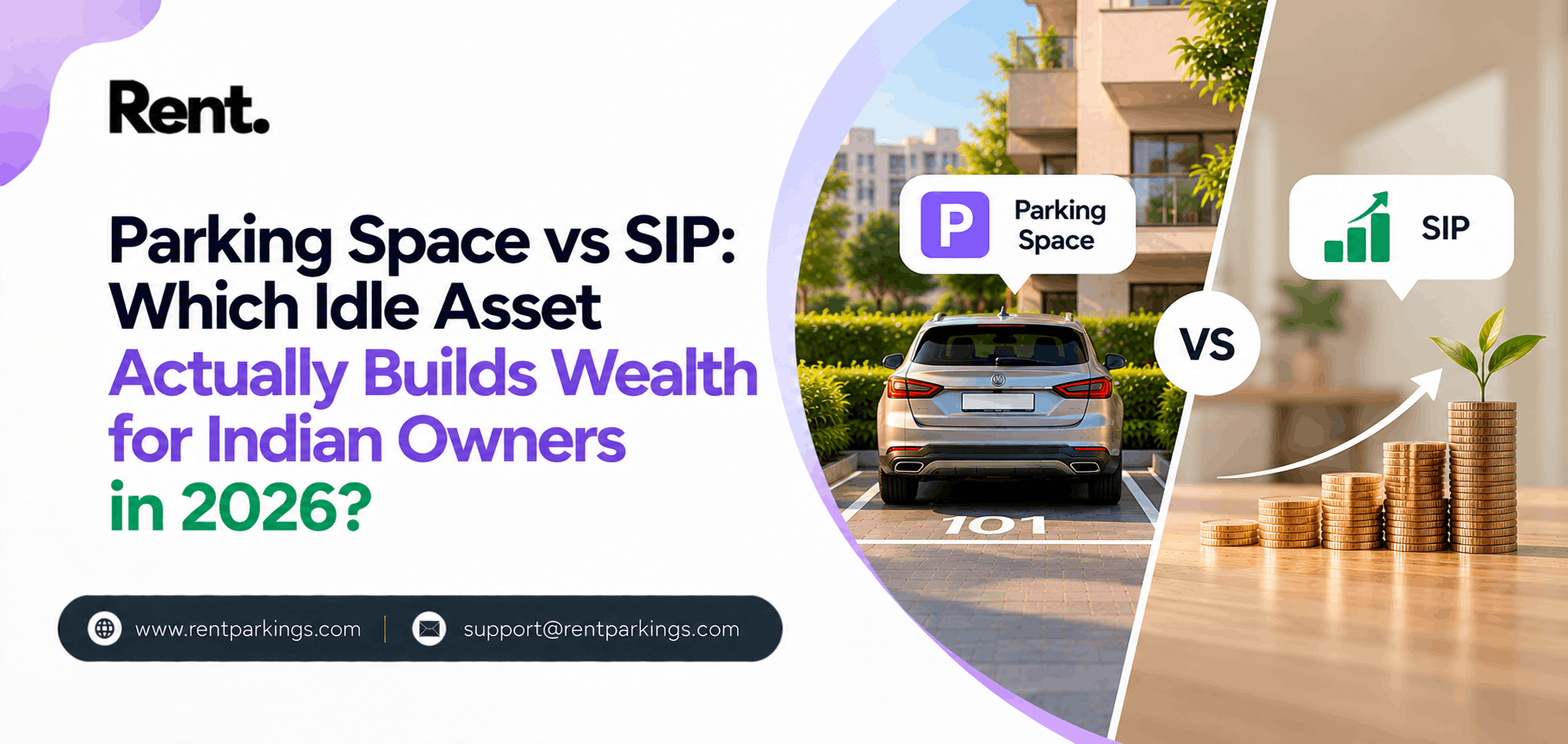
Parking Space vs SIP: Which Idle Asset Actually Builds Wealth for Indian Owners in 2026?
Two neighbours in a Bengaluru apartment block started the same month with two very different plans. One set up a monthly SIP of ₹5,000 into an equity mutual fund, the kind every finance influencer on Instagram seems to be pushing this year. The other did something almost nobody thinks to do: she listed her unused covered parking slot on RentParkings, India's parking marketplace, and started renting it to a delivery company that needed overnight space for two of its vans.
A year later, both had "invested" roughly the same amount of effort. One checks a fund NAV every few weeks and hopes the market cooperates. The other gets a fixed monthly transfer, rain or shine, market crash or market rally, for a slot that used to sit empty collecting dust and the occasional stray cat.
This isn't an argument against SIPs. Mutual funds have their place, and long-term equity investing has made real wealth for a lot of Indian households. But if you own a parking space and have never seriously weighed it against your other "idle asset" options, this comparison is worth five minutes of your time.
The Comparison Nobody Really Makes
Ask most property owners how they think about wealth building, and you'll hear the usual list: fixed deposits, gold, mutual funds, maybe a second flat. Parking spaces rarely make that list, because most owners don't think of it as an asset at all. It's just... there. Something that came with the flat or the plot.
That's the gap. A parking space is a physical asset sitting on your balance sheet whether you use it or not. The only question is whether it's working for you or just occupying square footage.
How an SIP Actually Grows, and Where It Can Fall Short
A Systematic Investment Plan works by averaging your purchase cost over time. You put in a fixed amount monthly, the fund buys units at whatever the current price happens to be, and over a long enough horizon, market ups and downs tend to smooth out.
The catch is the word "tend to." SIP returns aren't guaranteed. A fund that's compounded at 12% annually over the last decade can still hand you a flat or negative year, especially in the short-to-medium term. If you need that money in three years instead of fifteen, timing becomes a real risk, not just a textbook disclaimer.
Nobody really talks about the psychological side of it either. Watching a portfolio dip during a correction and resisting the urge to pull out early is harder than most first-time investors expect, and plenty of SIPs get discontinued at exactly the wrong moment out of panic.
What a Parking Space Delivers That an SIP Never Will
Rental income from a parking space works on a completely different logic. Someone pays you to use a physical spot, on terms you set, for as long as you're comfortable renting it out. You don't need to track a fund manager's decisions or wait for a quarterly report to know whether the arrangement is working.
We've written before about how a parking space stacks up against a fixed deposit, and the core argument holds here too: a rented parking space produces income you can see and touch every month, without locking your money away for a fixed tenure or accepting whatever interest rate the bank happens to be offering that quarter.
The bigger difference with an SIP specifically is that a parking space isn't "invested" in the traditional sense at all. You already own it, so there's nothing to put in and nothing tied up in a fixed tenure. You're simply putting an existing asset to work instead of letting it sit unused.
The Real Numbers: What Parking Income Looks Like Across Indian Cities
Rates vary a lot depending on location, demand, and whether the space is covered or open. Based on what owners on the platform have reported, here's a rough sense of monthly ranges for a single four-wheeler slot:
- Bengaluru and Gurugram (near IT corridors): higher demand from commuters and delivery fleets, often on the upper end of the local range
- Mumbai and Delhi NCR: space is scarce enough that even modest slots attract steady interest
- Chennai, Hyderabad, Pune: strong demand near business districts, tech parks, and residential clusters with limited visitor parking
- Tier-2 cities like Jaipur, Lucknow, Coimbatore, and Madurai: lower absolute numbers but often less competition for available spots
Owners near apartment complexes, especially those with stilt or covered parking that never gets used, tend to see the steadiest bookings, since covered spots are in short supply almost everywhere.
None of these numbers are guaranteed, and they shouldn't be treated as promises. But unlike a market-linked return, the income here is set by an agreement you make directly with a renter, not by external market forces you can't influence.
To Be Fair: Parking Income Isn't Risk-Free Either
A balanced comparison has to include the honest downsides. A parking space can sit unbooked for a stretch if demand in your locality is thin. You'll want basic verification of who's using it, and there's a small amount of coordination involved compared to a fund that runs entirely on autopilot.
The difference is that these are manageable, practical concerns, not market-wide risks you have no control over. You can adjust your price, change the rental terms, or pause the listing whenever you like. Try doing that with a mutual fund mid-correction without locking in a loss.
You Don't Have to Pick One. Most Owners End Up Doing Both
This isn't really an either-or decision, and framing it that way misses the point. The owners who come out ahead tend to keep their SIPs running for long-term goals like retirement or a child's education, while treating parking income as a separate, more immediate cash flow that covers a maintenance bill, an EMI, or simply gets reinvested somewhere else entirely.
Some owners go further and diversify what they rent out beyond just a car spot. If you have room, two-wheeler bays, EV charging points, or short-term event parking can add a second income stream from the same piece of land.
Treating a parking space as one line item in a broader wealth plan, alongside an SIP, an FD, or gold, tends to produce a steadier overall picture than betting everything on any single option.
Getting Started Costs You Absolutely Nothing
Here's the part that surprises most first-time hosts: listing a parking space on RentParkings is completely free. There's no listing fee, no subscription, and no cut taken just to put your space in front of potential renters.
You set the price, choose whether it's hourly, daily, or monthly, and decide who gets to book it and for how long. Nobody else has a say in those terms, unlike a fund where the manager, the market, and the fine print all weigh in on your outcome.
If you're unsure about the legal side of things, verification, or how payouts actually work, our guide to renting out a parking space in India covers the practical, day-to-day details of taxes, safety, and what a written agreement should include.
Who This Comparison Actually Matters For
This isn't only for owners with a spare driveway. It applies just as much to flat owners with an allotted-but-unused society slot, commercial property owners with bays that sit empty after office hours, and even weekend-home owners whose parking space is idle five or six days out of seven.
If any of that sounds like you, it's worth reading through our complete guide to renting out parking space in India before you decide how to price your first listing.
Frequently Asked Questions
1. Is it really free to list my parking space on RentParkings?
Yes. There's no cost to create a listing, no subscription fee, and no charge just to make your space visible to renters. You only deal with money once someone actually books your space, and even then, you're the one who set the price.
2. Can I really set my own rental rate, or does the platform decide?
You set the rate entirely. Whether it's an hourly rate for short visits, a daily rate, or a monthly arrangement with a regular renter, the pricing decision stays with you at every step.
3. How does parking income compare to SIP returns over the long run?
SIPs are built for long-term compounding and can outperform rental income over a 15 to 20-year horizon under favourable market conditions. Parking income is more modest but steadier, and it doesn't carry the same market-timing risk in the short and medium term.
4. What if I want to stop renting out my space?
You're in control of that too. You can pause or remove your listing whenever your plans change, whether that's because a family member needs the space or you simply want a break from hosting.
5. Do I need to declare parking rental income for tax purposes?
Rental income of any kind is generally treated as taxable income under Indian tax law, and it's worth keeping basic records of what you earn. It's sensible to check with a tax professional about how it should be classified for your specific situation.
6. Is renting out a parking space safe from a liability standpoint?
Most listings run smoothly with a simple, clear agreement in place before someone starts using your space. Verifying who you're renting to and keeping communication through the platform helps reduce the usual concerns owners have going in.
7. Will an SIP always beat parking income if I invest long enough?
Not necessarily. Market-linked returns depend heavily on when you invest and when you need the money. A parking space produces income independent of stock market cycles, which is exactly why many owners treat the two as complementary rather than competing options.
8. Does my housing society need to approve me renting out my parking slot?
This depends on your society's specific bylaws, and it's worth a quick conversation with your RWA if you're unsure. Many societies have no objection at all, especially when the slot is privately allotted to you.
9. How much effort does managing a parking listing actually take?
Far less than most owners expect. Once your listing is live and your terms are set, most of the day-to-day coordination happens through the renter directly, making it genuinely low-effort compared to actively managing an investment portfolio.
10. What kind of spaces qualify, beyond a standard driveway?
Covered garages, stilt parking in apartments, commercial building bays, vacant plots, and even farmhouse or weekend-home spaces can all be listed. If it's unused for stretches of time, it's worth listing.
Conclusion
An SIP and a parking space aren't really competing for the same job in your finances. One is a long-term market bet that needs years to prove itself. The other is an asset you already own, sitting there right now, waiting to be put to work without a single rupee of new investment.
If you've been meaning to start an SIP but keep putting it off, that's a separate decision worth making on its own terms. But if you also have a parking space doing nothing, there's no real reason to leave both opportunities on the table. Start earning from Your Parking Space on RentParkings today, list it for free, set your own price, and let an asset you already own start paying you back.
Share This post
Search
Recent Post
Parking Space vs. Renting Out a Room to...
05 Oct, 2026
Think Parking Rental Only Pays in Mumbai...
02 Oct, 2026
Your Mumbai Parking Space Is Worth More...
01 Oct, 2026
Hyderabad's Real Estate Boom Left One As...
30 Sep, 2026
What Your Parking Space in Chennai Could...
29 Sep, 2026
Your Plans Changed After Listing Your Pa...
28 Sep, 2026
What Your Parking Space in Pune Could Ac...
24 Sep, 2026
Exam Season Is Coming. Is Your Empty Par...
23 Sep, 2026