

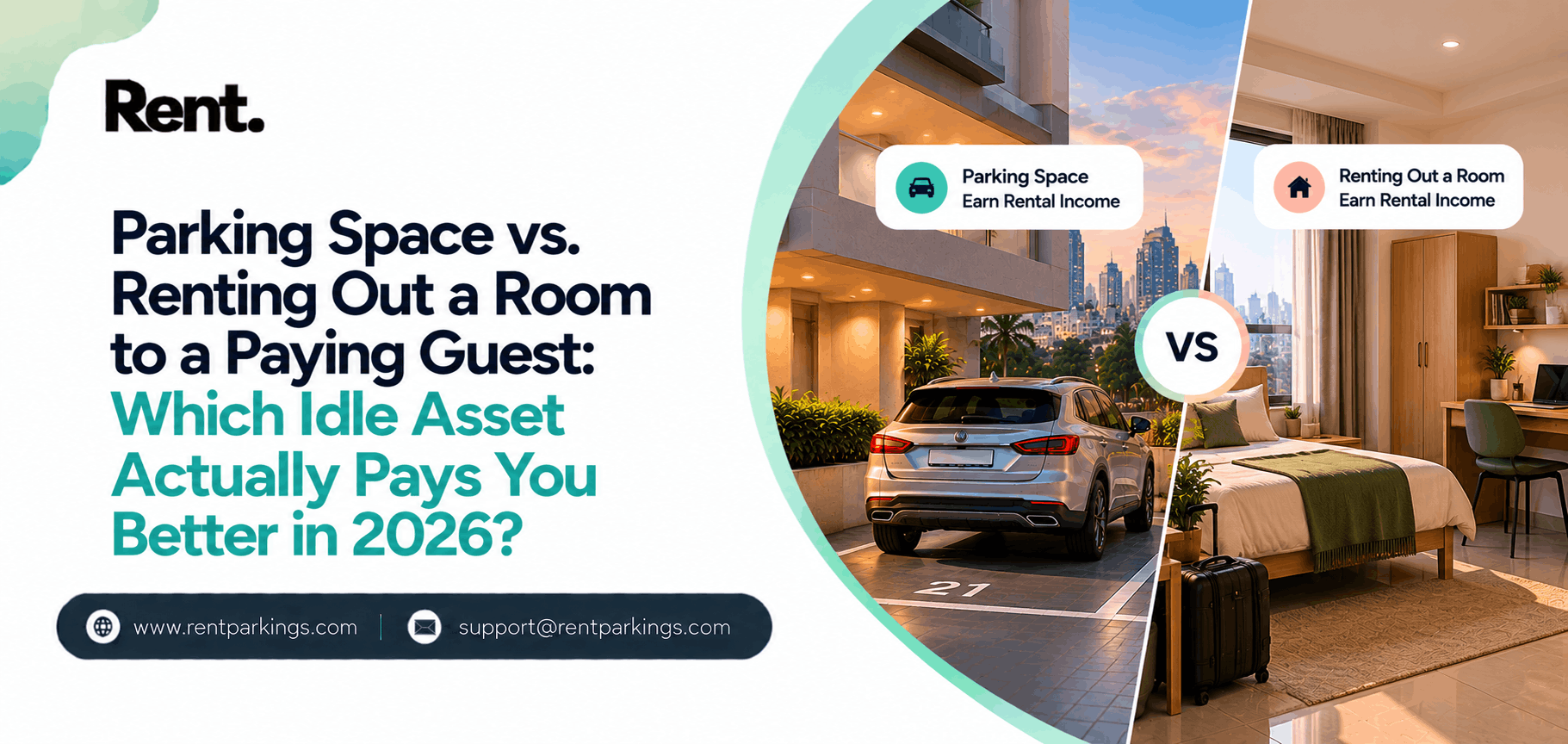
Parking Space vs. Renting Out a Room to a Paying Guest: Which Idle Asset Actually Pays You Better in 2026?
A reader from a housing society in Thane wrote in last month with a very specific dilemma. His son had moved abroad, the spare room was sitting empty, and a cousin kept insisting he take in a paying guest to cover the maintenance bills. At the same time, his basement parking slot had been unused since he sold his second car two years ago.
He wanted to know which one was worth his time. That question turned out to have a more interesting answer than either of us expected, and it applies to a lot more owners than just him.
If you own both an empty room and an empty parking slot somewhere in India, this comparison is for you. We're not here to tell you paying guests are a bad idea everywhere. We are here to walk through, honestly, what each option actually costs you in effort, risk and ongoing attention, and what each one realistically pays. Once you see the numbers side by side, the parking slot usually wins for a reason that has nothing to do with rent itself. You can list that slot for free on RentParkings in the time it takes to read this article, so keep that in mind as we go through the comparison.
The Paying Guest Route: What It Actually Involves
Renting a room to a paying guest is not a passive decision. It is closer to running a small, informal hospitality business inside your own home.
Here is what owners typically take on when they go this route:
- Screening a stranger well enough to feel comfortable sharing walls with them, often without any formal background-check tool.
- Furnishing the room: a bed, storage, sometimes a cooler or AC, because an empty room rarely rents as-is.
- Drafting or getting a rent agreement made, and in several states registering it, which means time at a sub-registrar's office or paying someone to handle it.
- Collecting a security deposit and actually remembering the terms under which it gets returned.
- Dealing with electricity and water usage disputes, kitchen access arguments, and the occasional late-night knock when something in the house breaks.
- Giving up a meaningful slice of your own privacy, since this person is now living inside your home, not just parked outside it.
None of this makes a paying guest arrangement a bad choice. For a large spare room in a city with strong rental demand, it can bring in solid monthly income. But it is work, ongoing work, and it touches your personal life in ways that an unused parking slot never does.
The Parking Route: What It Actually Involves
Compare that to listing a parking slot. Nobody steps inside your home. Nobody uses your kitchen or your water heater. There is no furnishing required, no registration drama, and usually no face-to-face negotiation at all.
When you list on a marketplace built for this specific purpose, the process looks more like this:
- You create a free listing with photos, your location and your price.
- You decide whether you want hourly, daily or monthly bookings, and you can offer more than one.
- Drivers in your area see the listing and book it, often with ID or vehicle details captured on the platform before they ever show up.
- You get paid through UPI or net banking, on terms you set.
- If your plans change, you pause or edit the listing in a couple of taps.
The entire relationship with the renter can stay at arm's length. You are not sharing a roof, a kitchen or a bathroom with anyone. You are renting out a slab of concrete that was doing nothing anyway.
Comparing the Two, Honestly
Owners we've spoken with tend to describe the numbers in rough ranges rather than fixed figures, since so much depends on the city, the locality and the specific space. Still, a pattern shows up clearly enough to be useful.
| Factor | Paying Guest Room | Parking Slot |
|---|---|---|
| Typical monthly income | Often higher in absolute rupees, especially in metro cities with strong PG demand | Usually more modest, but highly consistent across most localities |
| Upfront cost to get started | Furnishing, possibly repainting, agreement costs | Close to zero in most cases |
| Ongoing effort | High: disputes, maintenance requests, move-in and move-out cycles | Low: mostly automated once the listing is live |
| Privacy impact | Significant, since the person lives inside your home | Minimal to none |
| Flexibility to pause | Hard; a tenant has notice periods and legal protections | Easy; you set your own terms and can edit or pause the listing anytime |
| Risk if something goes wrong | Higher: property damage, disputes over deposits, difficult exits | Lower: a car causing damage is a far smaller problem than a bad tenancy |
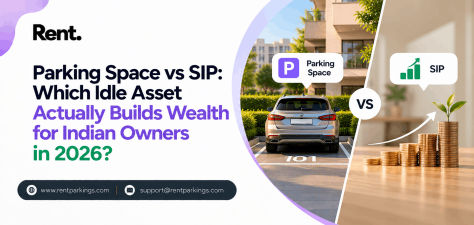
Put another way: a paying guest might out-earn a parking slot in raw rupees per month. But measured against the hours you actually spend managing it, and the stress that comes with sharing your home, the parking slot usually wins on a per-hour-of-your-life basis. We looked at a similar trade-off recently when we compared Parking Space vs SIP: Which Idle Asset Actually Builds Wealth for Indian Owners in 2026?, and the conclusion was similar: the asset that demands the least from you often ends up being the one you're glad you kept.
Why the Effort-to-Income Ratio Usually Favors Parking
Most owners don't actually sit down and calculate an hourly return on their time. If they did, the parking slot would look a lot better than it feels on paper.
A paying guest room might net you an extra ₹8,000 to ₹15,000 a month in a decent locality, but that number comes bundled with phone calls, WhatsApp messages about the geyser, and the occasional awkward conversation about noise or guests. A parking slot, booked on your own terms, might bring in less in absolute terms, but it rarely interrupts your evening.
For an owner who already has a full-time job, an ageing parent to look after, or simply no appetite for managing another person's daily life inside their house, that difference in mental bandwidth matters more than the extra few thousand rupees.
There's also a seasonal dimension worth mentioning. Parking demand doesn't stay flat through the year. During periods like exam season, when students and parents descend on coaching hubs and test centres, nearby parking slots can see a real spike in bookings, something we broke down in Exam Season Is Coming. Is Your Empty Parking Space Ready to Cash In? A paying guest room doesn't have that kind of upside; the rent stays the same whether it's exam season or not.
Getting Started Costs You Nothing
This is the part that surprises a lot of first-time hosts: listing your parking space on RentParkings is completely free. There is no fee to create a listing, no commission taken just for showing up, and no catch buried in the fine print.
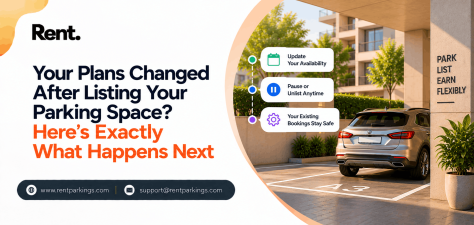
You decide the price. You decide whether it's an hourly rate for someone running errands nearby, a daily rate for a commuter, or a monthly rate for someone who parks there every day. Nobody assigns you a rate card. If you change your mind next month, you go in and edit it, exactly the way we walked through in Your Plans Changed After Listing Your Parking Space? Here's Exactly What Happens Next.
Compare that to a paying guest arrangement, where changing your mind midway through a tenancy can mean notice periods, awkward conversations, and sometimes even legal friction if things go badly. A parking listing you can switch off this afternoon if you suddenly need the space back.
What About the Compliance Side?
Owners who are cautious about paying guests are usually cautious for a reason: liability. A tenant inside your home carries legal weight that a parked car simply doesn't.
It's a fair question to ask about parking too, and the honest answer is that the exposure is much smaller. We covered this in detail in Does Renting Out Your Parking Space Affect Your Home Insurance in India?, and the short version is that most standard household policies aren't disrupted by a parking rental the way they can be by taking in a long-term tenant. There's no change of occupancy, no new resident on record, nothing that touches the structure of your home.
That alone removes a big chunk of the worry that keeps owners stuck between "I should earn something from this space" and "I don't want the complications."
When a Paying Guest Still Makes Sense
None of this is an argument that paying guests are a mistake. If you have a genuinely large room, live in a city with strong PG demand (think Bengaluru's tech corridors or Pune's student belts), and you don't mind the extra involvement, the income can be meaningfully higher than what a parking slot alone would bring in.
Some owners do both: a paying guest upstairs and a parking slot downstairs, neither one competing with the other for attention. There's no rule that says you have to pick just one idle asset to monetise.
And this earning opportunity isn't limited to India's biggest metros either. As we explored in Think Parking Rental Only Pays in Mumbai or Bengaluru? Jaipur, Lucknow and Kochi Owners Are Proving That Wrong, owners in smaller cities are seeing genuine, steady demand too.
The real decision isn't "parking versus paying guest" as a forced choice. It's "how much of my time and privacy am I willing to spend to earn how much more." For a lot of owners, once they actually weigh it out, the parking slot is the easier yes.
Frequently Asked Questions
1. Is it really free to list my parking space on RentParkings?
Yes. Creating a listing costs nothing, and there's no hidden fee for simply having your space visible to potential renters. You only deal with money when a booking actually happens, and even then, the rate is one you set yourself.
2. Who sets the price for my parking slot, me or the platform?
You do. RentParkings doesn't impose a fixed rate card. You choose hourly, daily or monthly pricing based on what feels fair for your locality, and you can adjust it whenever demand or your own circumstances change.
3. How much can a parking slot realistically earn compared to a paying guest room?
It varies by city and space, but owners generally report parking bringing in a more modest figure than a PG room, while demanding far less time and involvement. Many find the lower income easier to justify once they account for the hours a paying guest arrangement actually consumes.
4. Do I need to furnish or prepare my parking space before listing it?
No. Unlike a room for a paying guest, a parking slot usually needs no preparation beyond making sure it's accessible and the listing photos are accurate.
5. Will renting out my parking space affect my home insurance the way a tenant might?
Generally, no. A parked vehicle doesn't change your occupancy status or add a resident to your home, which is a key difference from taking in a paying guest. It's worth checking your specific policy, but most standard coverage isn't disrupted by a parking arrangement.
6. What if I need my parking space back after I've listed it?
You can pause or edit your listing whenever you need to. There's no tenancy-style notice period to navigate, which is one of the biggest practical advantages parking has over renting out a room.
7. Is verifying who's parking in my space as complicated as screening a paying guest?
No. The platform captures renter and vehicle details as part of the booking process, which gives you a basic layer of accountability without the kind of in-person vetting a paying guest arrangement usually requires.
8. Does parking rental income attract less scrutiny than taking in a paying guest?
Both forms of income should be reported honestly, but a parking arrangement doesn't carry the same registration or tenancy-law obligations that a long-term paying guest setup can in several states.
9. Can I rent out both a spare room and a parking slot at the same time?
Absolutely. Plenty of owners monetise more than one idle asset at once. The two don't compete with each other, and listing your parking space adds income on top of whatever else you're already doing with the property.
10. Is this opportunity only worthwhile in big cities?
Not at all. Owners in tier-2 and smaller cities are seeing consistent demand too, often because fewer formal parking options exist locally, which can actually work in a host's favour.
So Which Idle Asset Should You Actually List?
A paying guest room can earn more in raw rupees. A parking slot earns less drama, less risk to your privacy, and almost none of the ongoing management a tenancy brings with it. For most owners sitting on an idle space they're unsure what to do with, that trade is worth making.
If you've been putting off listing your parking slot because the paying-guest route felt like "doing something" and parking felt like "not enough," it's worth reconsidering what "enough" actually means once your time is factored in. Publish Your Parking Space for Free and find out what your idle slot could be earning you this month, without touching a single wall inside your home.
Share This post
Search
Recent Post
Think Parking Rental Only Pays in Mumbai...
02 Oct, 2026
Your Mumbai Parking Space Is Worth More...
01 Oct, 2026
Hyderabad's Real Estate Boom Left One As...
30 Sep, 2026
What Your Parking Space in Chennai Could...
29 Sep, 2026
Your Plans Changed After Listing Your Pa...
28 Sep, 2026
Parking Space vs SIP: Which Idle Asset A...
25 Sep, 2026
What Your Parking Space in Pune Could Ac...
24 Sep, 2026
Exam Season Is Coming. Is Your Empty Par...
23 Sep, 2026