

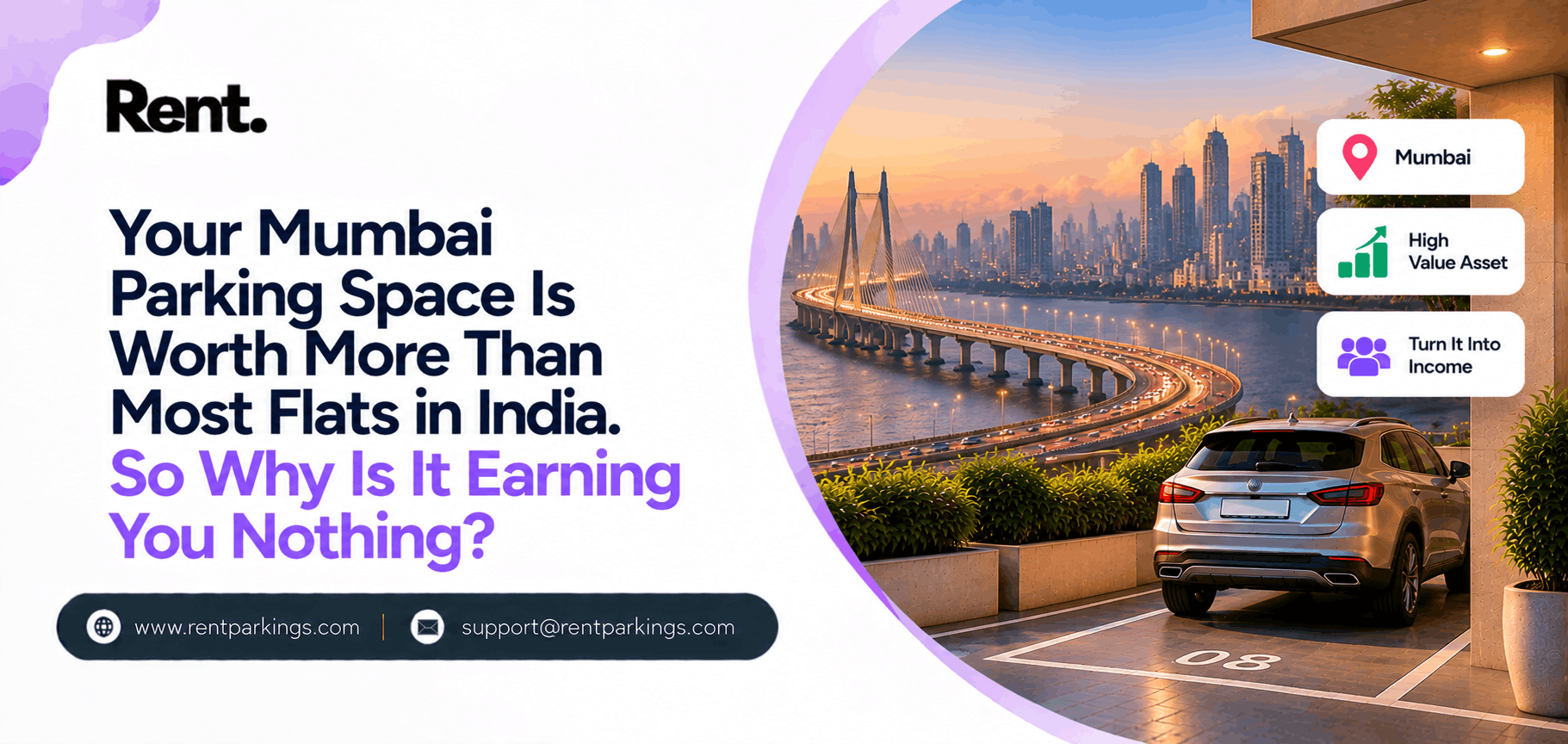
Your Mumbai Parking Space Is Worth More Than Most Flats in India. So Why Is It Earning You Nothing?
Ask anyone who has bought a flat in a redevelopment project in Lower Parel or Worli what a single covered parking slot cost them, and the number will surprise you. In many Mumbai buildings, a bare stretch of concrete big enough for one hatchback sells for more than an entire two-bedroom flat in a tier-two city.
That is not an exaggeration. Owners across the city routinely report paying anywhere from eight lakh to well over twenty-five lakh rupees for a stilt or basement slot bundled with their flat, depending on the locality and the builder.
And for most of the day, that slot does nothing at all. The car leaves for office at nine. The slot sits empty, a patch of ground that costs more per square foot than the living room above it, earning its owner exactly zero rupees while it waits.
On RentParkings, that math stops making sense the moment you realise someone else across the city would happily pay for that exact square footage. Thousands of Mumbai owners have simply never been asked the obvious question: why isn't your parking space working for you the way the rest of your property does?
The Most Expensive Empty Asset in the City
Mumbai real estate is priced like nowhere else in India. Pockets of Bandra, Worli, and Malabar Hill sit among the costliest per square foot anywhere in the country, and even further out in Mulund, Andheri, or Thane, land is never cheap.
Owners we've spoken with describe a strange disconnect: they treat their flat as an appreciating asset worth tracking every quarter, yet never think of the attached parking slot the same way. It is property too. It just happens to be property shaped like a rectangle a car sits in.
Every other idle asset in a Mumbai household eventually gets a second look, from a spare room rented out to a second car sold off. The parking slot is usually the last thing anyone considers, mostly because nobody ever told owners it was an option in the first place.
Why Mumbai Behaves Differently From the Rest of India
Local trains shape this city's daily life in a way few others experience. Commuters routinely drive from home to the nearest station, whether that's Andheri, Ghatkopar, Mulund, Borivali, or Vashi, then switch to the train for the rest of the journey. Legal parking near these stations has never kept pace with that demand.
The same gap shows up around commercial hubs. BKC, Lower Parel, Powai, and the Andheri MIDC belt pull in lakhs of office-goers every working day, and in-building parking allotments rarely stretch far enough to cover everyone who drives.
Redevelopment adds its own layer of chaos. Hundreds of Mumbai buildings are mid-redevelopment at any given time, which means owners sometimes hold a parking slot in a half-finished tower they haven't moved into yet, or sit in a transit flat with a slot back home that nobody is using in the meantime.
There's also the quieter, more common case: a flat where the car was sold years ago, or the children who drove it moved out, and the allotted slot has sat untouched ever since. Nobody is doing anything wrong. The space is just sitting there, unclaimed by anyone who needs it.
What a Mumbai Parking Slot Can Actually Earn in 2026
Rates vary sharply across the city, and owners should treat the following as realistic ranges rather than guarantees, since location, demand, and how the slot is listed all move the number:
- A covered or stilt slot in a residential society in Andheri, Malad, Mulund, or similar suburbs: roughly ₹2,500 to ₹6,000 a month
- A slot within walking distance of a busy railway or metro station such as Ghatkopar, Vashi, or Thane: ₹3,000 to ₹8,000 a month, or ₹25 to ₹40 an hour for commuters who only need it during office hours
- A slot near a commercial pocket like BKC, Lower Parel, Powai, or Nariman Point, where scarcity is at its worst: ₹6,000 to ₹15,000 a month
- A slot in a fast-growing corridor in Navi Mumbai or Thane, where new societies routinely undersell parking allotments relative to how many residents actually own cars: steady mid-range demand, often from neighbours within the same complex
Owners sitting on an unused basement or stilt slot elsewhere in the country describe a similar pattern once they list it, something covered in detail in Your Garage Hasn't Parked a Car in Months. It Could Be Covering Your EMI Instead. Mumbai numbers simply tend to sit higher because space here is scarcer than almost anywhere else in India.
Where the Demand Is Actually Coming From
It helps to picture the actual people paying for these slots, rather than thinking of it as an abstract market. Local train commuters who need somewhere safe to leave a car for nine or ten hours make up a large chunk of it.
Delivery riders and cab drivers working long shifts in dense neighbourhoods look for a reliable spot during breaks, something that's become harder to find as more buildings restrict outside vehicles from their compounds.
Visitors to the city's major hospitals, families attending weddings at banquet halls with no real parking of their own, and new car owners in redevelopment towers who haven't yet received their official allotment all add to the same pool of demand.
Mumbaikars have tried plenty of other ways to put spare resources to work, and parking rental tends to be a steadier earner than several of them, a comparison laid out well in Why Renting Your Parking Space Beats Most Side Hustles.
None of this requires spending a rupee upfront, either. Owners elsewhere in the country have shown what's possible starting from nothing but an empty slot, a story told in How to Turn Your Empty Parking Space Into ₹6,000/Month — No Investment Needed, and Mumbai's higher rates only make that starting point more generous.
"My Society Will Never Allow This"
This is the objection nearly every Mumbai owner raises first, and it's worth untangling properly instead of guessing at the answer. Most cooperative housing society bylaws restrict subletting of the flat itself. They were written with tenants in mind, not a car parked in a bay for a few hours a day.
In practice, informal cash-in-hand parking arrangements already happen quietly in plenty of Mumbai buildings, usually between a watchman and a neighbour's driver, with no record of who's actually there or when they'll leave. What RentParkings changes is simply making that same activity visible, verified, and traceable, rather than pretending it doesn't already exist.
A quick, informal word with the society secretary before listing tends to resolve most concerns in minutes, especially once owners explain that renters are verified on the platform and that nothing changes about who legally occupies the flat. This exact pattern, including how Mumbai-style housing societies tend to react, gets explored at length in Apartment Owners Profiting from India's Parking Crisis.
Listing Takes Less Time Than Your Morning Commute
Here is what actually changes once an owner decides to list a Mumbai parking slot. Nothing about it costs money, and nothing about it requires giving up control of the space.
- Listing on RentParkings is completely free, with no sign-up fee and no cost at any stage.
- The owner decides the rate, whether that's hourly, daily, or monthly, and can change it whenever demand shifts.s
- Payments move through UPI or net banking, so there's a clear digital record of every transaction
- The listing can be paused, edited, or switched off entirely whenever the owner needs the slot back.
The exact steps, from photographing the slot to setting the first rate, are laid out step by step in How to Rent Out Your Empty Parking Space in India: A Complete Guide. Most owners finish the whole process faster than it takes to drive from Andheri to Bandra on a weekday evening.
Frequently Asked Questions
1. Is it actually free to list a parking space on RentParkings?
Yes, there is no charge at any point to create a listing. Owners don't pay a sign-up fee, a listing fee, or a commission just to make the space visible to renters in their area.
2. Who decides the rental rate, RentParkings or the owner?
The owner sets the price. RentParkings doesn't impose a fixed rate card, so an owner in BKC can charge differently from one in a quieter Thane suburb, and either can adjust the rate at any time based on demand.
3. My housing society has never allowed outside vehicles in the compound. Can I still list my slot?
Most society bylaws restrict subletting the flat itself rather than hourly or daily use of a parking bay. A short conversation with the secretary beforehand usually clears up any confusion, and many Mumbai societies already tolerate informal arrangements of exactly this kind.
4. Can I rent my space by the hour instead of committing to a monthly tenant?
Yes. Owners choose hourly, daily, or monthly terms, and can offer all three at once if that suits the slot's location, such as hourly rates for office-hour commuters and monthly rates for a longer-term neighbour.
5. How do I actually receive the money from a booking?
Payments are made through UPI or net banking, both of which are already familiar to most Mumbai owners. There's no cash handling required, and every payment leaves a digital trail.
6. What happens if the renter overstays beyond the booked time?
Bookings are time-bound and visible to the owner, so an overstay is easy to spot and address directly with the renter. Owners aren't left guessing about who's supposed to be there and when they were due to leave.
7. Am I liable if something happens to a vehicle parked in my space?
The arrangement is between the owner providing the space and the renter responsible for their own vehicle, similar to how any paid parking facility works. Owners are encouraged to set clear terms upfront about what the listing does and doesn't cover.
8. Do I know who is actually parking in my space?
Renters create a profile before booking, which gives owners more visibility than the average informal arrangement with an unknown vehicle left outside the gate. It's a meaningful step up from handing a spare key to someone a watchman vouched for.
9. What if I need my parking space back, say if I buy a car myself?
Listings can be paused or taken down whenever the owner wants, with no penalty or lock-in. The space reverts to the owner's own use the moment they choose to stop renting it out.
10. Realistically, how much can a Mumbai parking spot earn in a year?
Depending on the locality and how often it's rented, a single slot can realistically bring in anywhere from roughly ₹30,000 to well over ₹1 lakh annually, often more in high-demand pockets like BKC or near major railway stations.
The Slot Outside Your Door Has Been Waiting Longer Than You Think
Mumbai property owners already understand the value of every square foot they hold, right up until they reach the parking slot, which somehow gets treated as a formality rather than an asset. That gap between what the space is worth and what it currently earns is the whole opportunity here.
Nothing about listing it costs anything; the rate and terms stay entirely in the owner's hands, and the income, however modest it starts out, comes from space that was earning nothing before. List your parking space on RentParkings today and let that expensive patch of concrete finally start paying you back.
Share This post
Search
Recent Post
Parking Space vs. Renting Out a Room to...
05 Oct, 2026
Think Parking Rental Only Pays in Mumbai...
02 Oct, 2026
Hyderabad's Real Estate Boom Left One As...
30 Sep, 2026
What Your Parking Space in Chennai Could...
29 Sep, 2026
Your Plans Changed After Listing Your Pa...
28 Sep, 2026
Parking Space vs SIP: Which Idle Asset A...
25 Sep, 2026
What Your Parking Space in Pune Could Ac...
24 Sep, 2026
Exam Season Is Coming. Is Your Empty Par...
23 Sep, 2026