

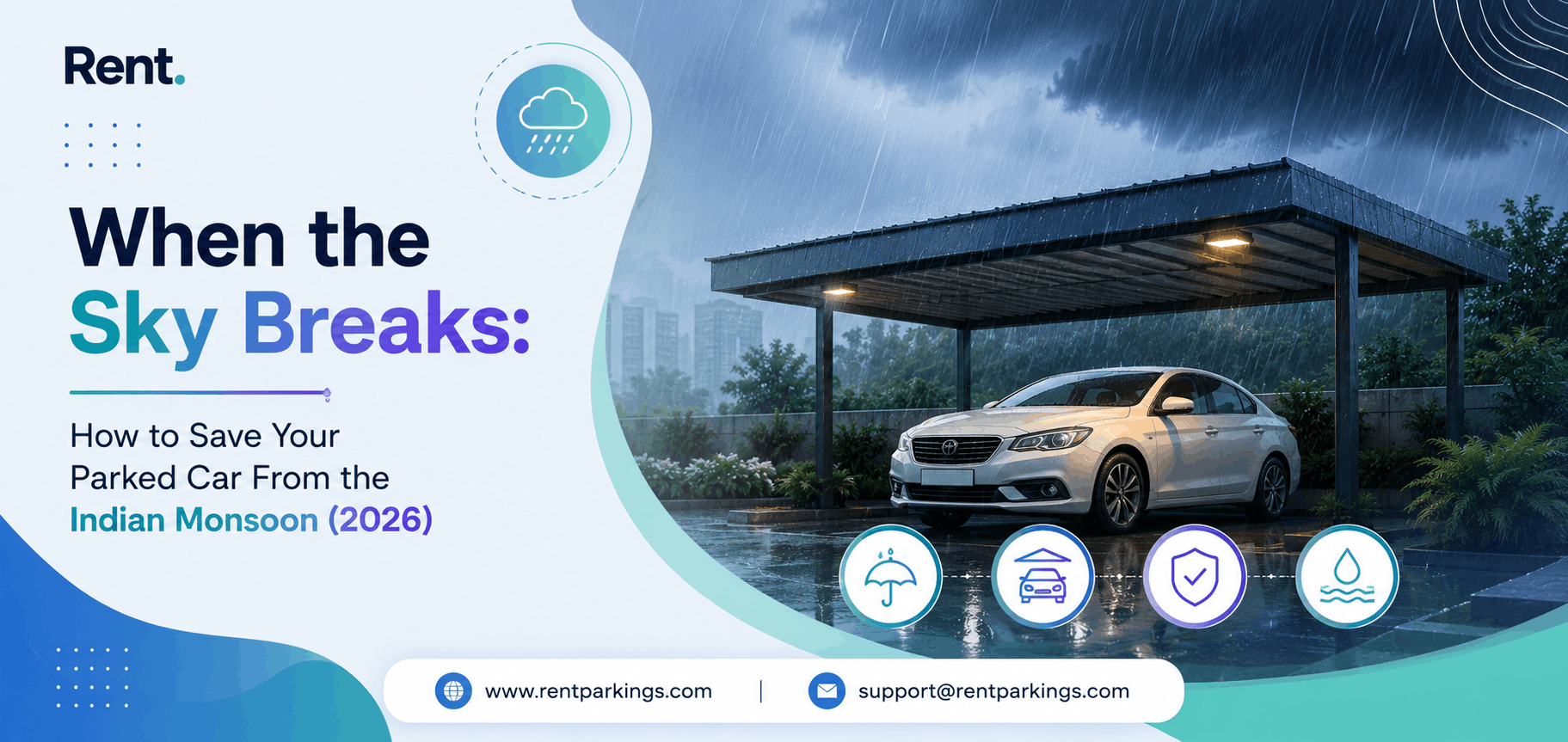
When the Sky Breaks: How to Save Your Parked Car From the Indian Monsoon (2026)
Here's a sentence that should bother every vehicle owner in India: your car can be wrecked by the monsoon without ever leaving its parking spot.
Picture the usual sequence. It's a weekday evening. The clouds that were "just drizzle" in the morning open up properly around 6 pm. Inside twenty minutes, the gentle slope at the end of your lane is a fast-moving stream, the colony gate is ankle-deep, and the corner of the compound where you always park — because it's shaded and close to the lift — is filling like a bathtub. Your car hasn't moved. It doesn't need to. The water comes to it.
That, not the dramatic flooded-underpass video, is how most monsoon vehicle damage actually happens in India: quietly, to a parked car or scooter, in the wrong corner of the wrong compound. And here's the part worth holding on to — almost every rupee of that damage traces back to choices you make before the first drop falls. Where you park. Whether your seals are sound. What's written in your insurance policy. And one reflex you must train yourself to resist the moment water surrounds your wheels.
Let's walk through all of it, because once you understand the pattern, the monsoon stops being a gamble and becomes something you simply manage.
Why the Parked Car Is the Sitting Duck
We instinctively worry about driving in the rain. But a moving car has a driver who can turn around, reroute, or climb to higher ground. A parked car has none of that. It sits in one fixed spot for hours while the water decides what to do — and in an Indian city, the water usually decides to rise.
The reason is plumbing the country largely outgrew years ago. Storm drains in most of our cities were sized for a different era of rainfall, so when a modern cloudburst dumps its load, the water has nowhere to go fast. It pools at the lowest available point and sits there. If the lowest available point happens to be where your vehicle is resting, your vehicle becomes part of the flood.
And water is patient and thorough. It rots carpets and seat foam into a smell no air-freshener ever beats. It seeps into wiring looms and quietly corrodes the connectors that run everything electronic in a modern car. And if it climbs high enough to reach the engine's air intake, it sets up the single most expensive failure a flooded car can suffer — the one we'll name and disarm later in this guide.
Rule One: The Spot Beats Everything
If you remember nothing else, remember this — the most powerful protection in the entire monsoon playbook is also the cheapest. It is where you leave the car. Get the location right and most of the other steps become insurance you rarely need to claim.
Chase elevation, always
Water answers only to gravity, so height is your ally. If your building or neighbourhood offers parking at more than one level, the higher one wins on a heavy rain day — every single time. We're not talking about hills; even a difference of a couple of feet can decide whether you wake up to damp tyres or a soaked cabin. If your building's options are limited, RentParkings lists verified covered and open slots across Indian cities, so you can lock in a safer spot nearby before the season starts.
The basement trap
This one catches people because it feels counter-intuitive. Basement and stilt parking is the prize in most Indian high-rises — covered, shaded, secure, no bird droppings, no sun-faded dashboard. For ten months of the year, it's the best slot in the building. But a basement is, by its very definition, the lowest point of the structure, and on the day a cloudburst overwhelms the society's sump pumps — or the power trips and the pumps simply stop — that low point becomes a collection tank. Water sheets down the entry ramp and gathers exactly where your car is parked, with no drain quick enough to save it. The lesson isn't "never use the basement." It's this: when the weather department flags an orange or red rain warning, treat your basement slot as a place to leave temporarily and move the car to open higher ground, if you can do it safely.
Learn your locality's water map
Give the monsoon one season of your attention and it will teach you your own neighbourhood: the precise corner that always pools, the road that floods before any other, the gate that turns into a canal. That mental map is worth more than any accessory you can buy. Steer clear of parking beside storm drains that tend to back up, under big old trees that shed heavy limbs in a squall, and at the foot of any ramp or dip where runoff naturally collects.
When you're out of town
Going away while it's pouring? Don't surrender the car to a low-lying public lot or a street you already know floods, and then forget about it for a week. A spot that's slightly less convenient but sits higher — or a covered slot booked through RentParkings with a verified host — is a tiny price against the alternative of coming home to a waterline across your doors.
Rule Two: Prep the Vehicle Before June Gets Serious
A short pre-season once-over saves a long post-season repair.
On the car, focus on the ways water sneaks in. Door and window rubber seals should be supple and unbroken, because perished rubber is an open invitation to a wet cabin. If you have a sunroof, clear its drain channels — a clogged sunroof drain doesn't keep water out, it funnels it straight into your roof lining. Confirm the wipers actually clear instead of smear, that every light works, and that the battery is healthy, because a soggy monsoon morning is precisely when a tired battery gives up. Parking in the open? A breathable, well-fitted cover keeps water from pooling on the body and the cabin drier — just never smother the car under a cheap plastic sheet that traps moisture against the paint and does its own kind of damage.
On the two-wheeler, the exposure is different but just as real. A scooter or motorcycle left in the open takes the rain full in the face — on its electronics, brakes, and chain. Park under shelter whenever you can; when you can't, a snug cover protects the seat, the instrument console, and the silencer. After a heavy soaking, dry and oil the chain so it doesn't flower with rust, and don't shrug off brakes that squeal when wet. If you ride an electric two-wheeler, keep the charging port and connectors dry and resist the urge to plug in a wet vehicle until it has properly dried.
Tying all of this together is one habit that quietly does the heavy lifting: respect the forecast. India's weather alerts have come a long way, and a yellow, orange, or red rain warning is your signal to relocate a vulnerable vehicle to safe ground ahead of the downpour rather than scrambling once it's already coming down.
Rule Three: Read the Insurance Fine Print Before You Need It
Now the part that ambushes people at claim time. A standard comprehensive policy is not the full shield most owners assume it is when it comes to flooding. It covers plenty — but two of the priciest water failures usually sit outside it unless you've specifically added cover. The time to discover that is at renewal, on a dry afternoon, not while you're standing in front of a garage manager doing mental maths on an engine rebuild.
Engine protection — the monsoon add-on. Ordinary policies generally exclude damage from water getting into the engine and the seizure that follows. An engine-protection add-on is what picks up exactly those costs, and since the engine is the most expensive single thing a flood can ruin, this is the cover to put first if you live or commute anywhere water tends to gather.
Zero-depreciation — keep more of your claim. On a normal claim, the insurer knocks off depreciation on the very materials water loves to wreck: plastics, rubber, fibre. Zero-depreciation (you'll also hear "bumper-to-bumper") cancels that deduction, so when a flood damages a long list of small parts, you recover far more of the bill instead of eating the gap yourself.
Roadside assistance — because you can't drive it out. A flooded car must be towed, not driven or restarted (you'll see why in a moment). A roadside-assistance add-on gets it lifted onto a flatbed and delivered to an authorised garage, which is exactly what you want instead of an improvised push that causes fresh damage.
Consumables cover, where offered, mops up the odds and ends — oils, lubricants, nuts and bolts — that quietly inflate a water-damage repair.
A simple rule for anyone in India's rain belt: if renewal falls before the season, treat engine-protection and zero-depreciation as near-mandatory, and make sure roadside assistance is on the policy. The extra premium is small change next to the bills these covers absorb.
The 60 Seconds That Decide Everything: If Your Car Floods

This is the section to tattoo on your memory, because a single instinct here separates a car that's repaired from a car that's written off.
If your car has stalled in water, or sat in deep water — do not turn the key. Do not "just check if it starts." That reflex is what kills engines. Once water has reached the air intake, cranking the engine draws that water into the cylinders. Air compresses; water does not. The engine tries anyway, something has to give, and what gives are the internals — bent connecting rods, a seized block. This is hydrostatic lock, the failure we've been circling, and it is as expensive as it sounds. It gets worse: most insurers read a restart attempt as owner negligence, which hands them a reason to trim or refuse your claim. A car that flooded and was left alone is often perfectly recoverable. The same car after a hopeful twist of the key frequently isn't.
So, if you find your parked car standing in water, work this sequence:
- Leave the engine off. No starting, no cranking, no exceptions.
- Disconnect the battery if you can reach it safely, to limit short-circuit damage to the electricals.
- Stay out of a submerged cabin and don't fiddle with power windows or locks.
- Document it. The instant it's safe, photograph and film the water level against the car, the surroundings, and the number plate. This footage is the backbone of a smooth claim.
- Call the insurer and roadside assistance. Get it towed to an authorised garage, and loop in the insurer before any real work starts.
- Don't let the garage start or "test" the engine until the insurer's surveyor has seen the car.
For a two-wheeler that's gone under or stalled in deep water, the rule is identical: don't try to fire it up. Walk it to dry ground and have it checked before anyone attempts a start.
Nail this in the first minute and you've protected the machine and your payout. Fumble it — by treating the ignition as a quick diagnostic — and you can turn an insurable mishap into a bill that's entirely yours.
How This Plays Out City by City
Every Indian city has its own monsoon personality, and understanding where your city's flood risk concentrates is the sharpest tool in your prevention kit. Our city-by-city parking guide maps out which neighbourhoods carry the highest demand for safe, elevated parking — useful context for finding a better long-term spot.
Chennai doesn't need a reminder of how quickly low neighbourhoods can vanish under water; the memory keeps residents serious about flood-smart parking, especially at ground and basement levels.
Bengaluru has turned into the cautionary tale of the decade — construction over old tanks and choked drains means tech-corridor layouts and low pockets can waterlog with startling speed, which is exactly why guaranteed high-and-dry parking carries real value here now.
Hyderabad, Pune, Kolkata, Kochi, and Ahmedabad each guard their own flood-prone pockets, usually anchored to a lake, a river, or a drain that gives up under pressure. And in Tier-2 and Tier-3 cities, where drainage tends to be thinnest and basement pumping least dependable, one violent cloudburst can do outsized harm to parked vehicles — so the higher-ground habit is every bit as vital there as in the metros.
The common thread is uncomfortable but clarifying: somewhere in your city, the drains will be beaten this monsoon. The one variable you fully own is where your vehicle is sitting when it happens.
Your One-Page Pre-Monsoon Drill
- Find the highest, safest parking you can reach — search verified covered spots on RentParkings if your building's options are thin — and use it on heavy-rain-alert days.
- Treat basement and stilt slots as relocate-if-possible on orange and red alerts.
- Before the season: service door seals, sunroof drains, wipers, lights, and battery.
- Keep a proper cover for the car and the two-wheeler if you park in the open.
- At renewal, add engine-protection and zero-depreciation, and confirm roadside assistance.
- Save your insurer's claim line and roadside-assistance number in your phone today.
- Burn in the golden rule: a flooded vehicle is never restarted.
The Bottom Line
The monsoon will lean on every vehicle owner in India, and it does its costliest work on the cars and scooters that simply happened to be parked in the wrong place at the wrong hour. But "wrong place, wrong hour" isn't fate — it's a set of decisions. Where you leave the car when the sky turns grey. Whether your seals and drains were cleared in May. Whether the engine-protection box was ticked at renewal. And whether your hand stays off the ignition when the water is lapping at the sills.
None of that demands money or gadgets. It demands a routine: read the forecast, climb to higher ground, prep the vehicle early, hold the right cover, and obey the one rule that rescues engines. Build that routine, and the season that frightens most owners becomes one you watch from your window — coffee in hand, car exactly where it should be, dry and waiting for a clear morning.
FAQs
How do I protect my car when it's parked during the monsoon in India?
Start with location: park on the highest, safest ground you can reach and move out of low basements on heavy-rain-alert days. Keep door seals and sunroof drains clear, maintain a healthy battery, throw a breathable cover over an open-parked car, and carry engine-protection and zero-depreciation insurance. The spot you choose on a stormy day protects you more than anything else.
Is basement parking actually risky in heavy monsoon rain?
For most of the year it's the best slot — covered and secure. But in a cloudburst it can flood quickly because it's the lowest point of the building and relies on sump pumps that may be swamped or knocked out by a power cut. On orange or red rain alerts, shift a basement-parked vehicle to higher, open ground if you safely can.
What exactly is hydrostatic lock?
It's when water gets into the engine's cylinders and the engine tries to compress it. Water won't compress like air, so the engine seizes and can suffer permanent internal damage such as bent connecting rods. It's almost always triggered by starting or restarting a flooded engine — and it's the most costly failure a waterlogged car can have.
My parked car was sitting in water — can I start it to check?
No. Never crank an engine that stalled in or sat in deep water, because starting it pulls water into the cylinders and causes hydrostatic lock. A restart attempt can also be treated as negligence and shrink or void your claim. Leave it off, disconnect the battery if it's safe, and get it towed.
Doesn't comprehensive insurance already cover flood damage?
It covers a lot, but it usually excludes water entering the engine and the resulting hydrostatic lock unless you've added engine-protection cover. For real monsoon protection, add engine-protection, and ideally zero-depreciation and roadside assistance, when you renew.
Which insurance add-ons matter most for the rains?
Three stand out: engine-protection (for water ingress and hydrostatic lock), zero-depreciation (so you recover more on water-damaged parts instead of losing it to depreciation), and roadside assistance (to tow a stalled car to an authorised garage). Consumables cover is a handy extra where it's offered.
What do I do in the first minutes after my parked car floods?
Don't start it. Disconnect the battery if safe, stay out of a submerged cabin, and immediately photograph and film the water level, surroundings, and number plate for your claim. Then call your insurer and roadside assistance for a tow to an authorised garage, and don't let anyone start or test the engine before the surveyor inspects it.
How should I look after my two-wheeler in the monsoon?
Park under cover where you can, and use a fitted cover when you can't. After heavy rain, dry and oil the chain to stop rust and check the brakes. If it's been submerged or stalled in deep water, don't try to start it — wheel it to dry ground and have it inspected first. For electric two-wheelers, keep the charging port dry.
Why do insurers reject flood claims, and how do I avoid it?
The two usual reasons are restarting a flooded engine (read as negligence) and not having the right add-on cover. Protect yourself by never restarting a flooded vehicle, documenting everything with photos and video, telling the insurer before any major repair, and carrying engine-protection cover for water-related engine damage.
Which Indian cities see the worst monsoon parking floods?
Mumbai, Chennai, Bengaluru, Hyderabad, Pune, Kolkata, Kochi, and Ahmedabad all have notorious flood-prone pockets, usually linked to overwhelmed drains, lakes, or rivers. Tier-2 and Tier-3 cities can suffer badly too, since drainage and pumping are often weaker. Everywhere, parking on higher ground during heavy-rain alerts is the best defence.
Share This post
Search
Recent Post

Parking Space vs. Renting Out a Room to...
05 Oct, 2026

Think Parking Rental Only Pays in Mumbai...
02 Oct, 2026

Your Mumbai Parking Space Is Worth More...
01 Oct, 2026

Hyderabad's Real Estate Boom Left One As...
30 Sep, 2026

What Your Parking Space in Chennai Could...
29 Sep, 2026

Your Plans Changed After Listing Your Pa...
28 Sep, 2026

Parking Space vs SIP: Which Idle Asset A...
25 Sep, 2026
What Your Parking Space in Pune Could Ac...
24 Sep, 2026