

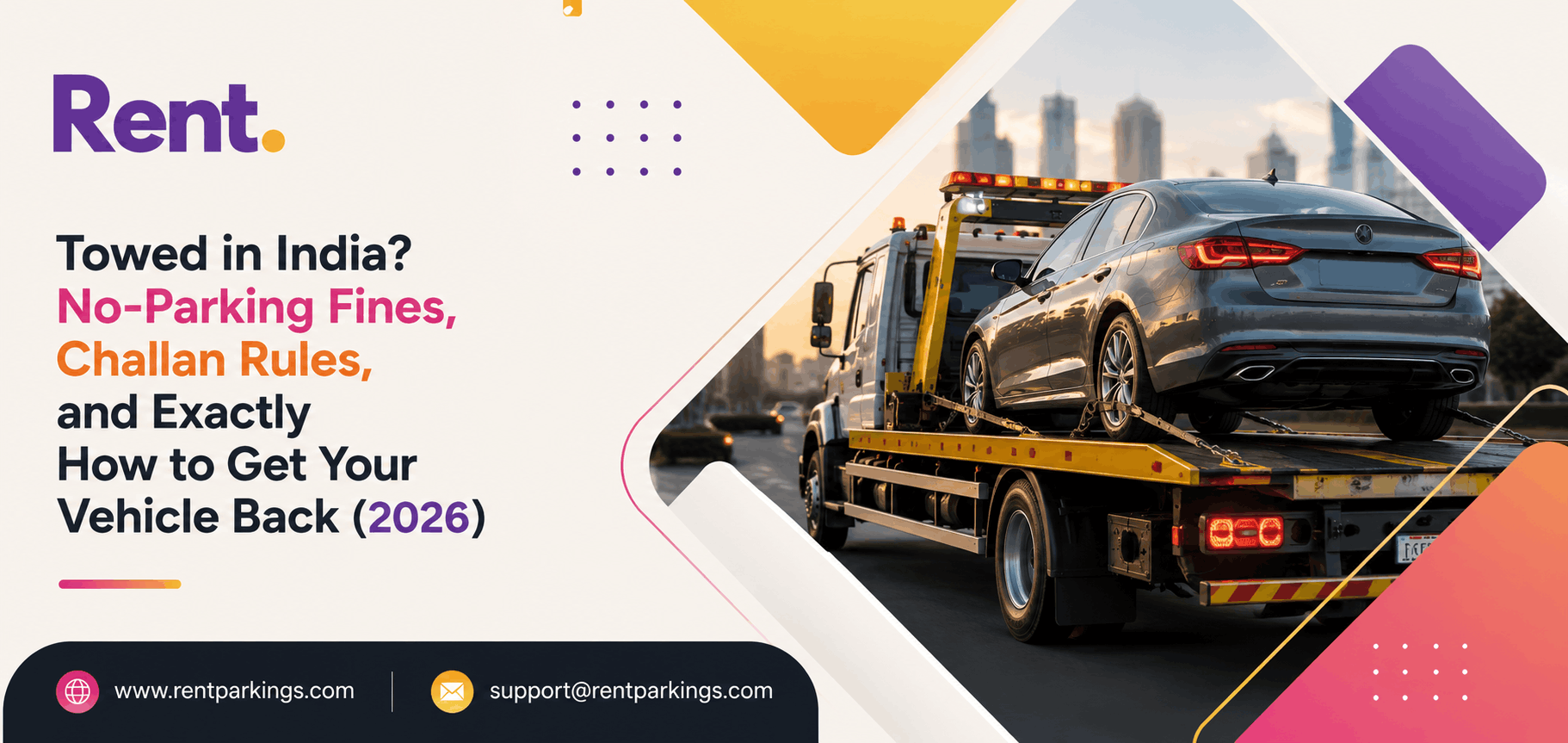
Towed in India? No-Parking Fines, Challan Rules, and Exactly How to Get Your Vehicle Back (2026)
You walk back to the spot where you left your scooter twenty minutes ago, and it is gone. For a few seconds your brain runs through theft, then you notice the freshly painted "No Parking" line under your feet and the small yellow board you never looked at on the way in. The vehicle has not been stolen. It has been towed. And somewhere across the city, in a dusty municipal yard behind a police station, your two-wheeler is now accumulating charges by the hour.
If you drive in any Indian city, this is no longer a rare event. It is a routine cost of urban life. As private vehicle registrations have crossed the staggering figures we now see, with India adding millions of new cars and tens of millions of two-wheelers every year while road and parking supply barely moves, enforcement has become aggressive, digital, and revenue-conscious. Traffic departments in Delhi, Mumbai, Bengaluru, Hyderabad, Chennai, Pune and Ahmedabad now run dedicated towing fleets, app-based challan systems, and CCTV-fed e-challans that reach your phone before you reach your car.
Yet most vehicle owners have no idea what they actually owe, what the police are legally allowed to do, or how to get their vehicle back without losing half a day. This guide fixes that. It walks through what counts as wrong parking under Indian law, what the fines and towing charges really are city by city in 2026, the exact recovery procedure, your rights during a tow, and how to stop this from happening again. Everything here is India-specific, because Indian parking enforcement does not work the way it does anywhere else.
What Counts as Wrong Parking in India
The rule that drives almost all enforcement is simple: a vehicle must never be left where it causes danger, obstruction or inconvenience to other road users. That single principle covers most of what traffic police act on, from a car blocking a turning to a scooter eating into a footpath. The standard penalty for parking where you should not is ₹500 for a first offence and ₹1,500 for a repeat offence, and most states use these figures as the baseline for no-parking fines.
That is the floor, not the ceiling. Parking enforcement in India is handled locally: states and city traffic police issue their own notifications, fix their own towing charges, and decide where towing is even permitted. This is why the "no parking fine" is not one number across India but a patchwork: sometimes ₹500, sometimes far higher, sometimes bundled with a separate towing fee. Knowing your own city's number is the only number that matters.
It also matters what kind of wrong parking you committed. Parking that merely overstays a permitted bay is treated very differently from parking on a footpath, at a bus stop, on a corner that blocks visibility, in front of a hospital or fire exit, or in a marked tow-away zone. The last category is where vehicles disappear. A tow-away zone is not the same as an ordinary no-parking stretch; it is a specifically notified area where the traffic police are authorised to lift and remove vehicles, and these are the stretches where your car is most likely to vanish.
The 2026 No-Parking Fines, City by City
Because the amounts are set locally, here is how the most-searched cities compare in 2026. Treat these as current-practice figures; traffic departments revise them by circular, so always confirm the live amount on your e-challan. If you also want to understand what a legal monthly bay costs in each of these cities, RentParkings' city-by-city parking rate guide is a useful companion to the penalty figures below.
Delhi NCR
In Delhi, wrong parking typically attracts ₹500 for the first offence and ₹1,000 for the subsequent offence. Towing is charged on top of the challan, and the towing rates are vehicle-class based: roughly ₹100 for two-wheelers, ₹200 for four-wheelers, ₹300 for an empty LMV or truck, and ₹400 for buses or loaded LMVs. Gurugram, Noida and Ghaziabad broadly mirror this structure under their own commissionerates, which matters because so much of NCR commuting crosses state lines.
Mumbai
Mumbai is the outlier that scares people, and for good reason. For parking in a notified no-parking area, the penalties cited under the city's enforcement framework run dramatically higher than the national baseline. Figures of ₹10,000 (with provisions that reference imprisonment for serious or obstructive violations), rising further for repeat offences, reflect Mumbai's acute road-space scarcity and its hard line on obstruction. In practice many ordinary tickets are smaller, but Mumbai is the city where you least want to test the upper limit.
Bengaluru
Bengaluru pairs a standard no-parking challan with some of the steepest towing charges in the country: up to ₹750 for two-wheelers and up to ₹1,100 for four-wheelers. With the city's chronic congestion and a traffic police force that leans heavily on towing as a deterrent, the towing fee often exceeds the parking fine itself.
Hyderabad
Hyderabad publishes a clean, vehicle-class towing schedule: roughly ₹150 for a two-wheeler, ₹200 for a car, jeep, auto or rickshaw, ₹300 for a light motor vehicle, and ₹600 for a heavy motor vehicle, layered on top of the no-parking challan. The Telangana e-challan system makes these easy to look up and pay online.
Chennai
Chennai's no-parking fines generally sit between ₹500 and ₹1,500 for four-wheelers and ₹300 to ₹500 for two-wheelers, with towing applied separately in notified zones across the city's dense central corridors.
Pune, Ahmedabad, Kolkata, Kochi and Tier-2 cities
Pune and Ahmedabad follow the ₹500 first-offence baseline with locally fixed towing fees and increasingly camera-based enforcement. Kolkata and Kochi enforce in their congested core areas, while Tier-2 and Tier-3 cities such as Coimbatore, Indore, Visakhapatnam, Mysuru, Nagpur and Surat are catching up fast as they roll out Smart Cities Mission infrastructure, paid-parking pilots and towing contracts. The trend everywhere is the same direction: more zones notified, more cameras, more towing.
The single takeaway from this table is that the towing charge is a separate, often larger cost than the fine, and the total you pay to recover a vehicle is fine plus towing plus, sometimes, a daily storage fee. People budget for the ₹500 and are shocked by the ₹1,100. It is also worth remembering that these are current-practice numbers in a moving system: commissionerates revise towing slabs by circular, often upward, and a fee that is ₹200 today in one zone can be reclassified tomorrow. Treat any figure you read, including the ones here, as a guide to the order of magnitude, and let your live e-challan be the final word on what you actually owe.
What To Do The Moment You Realise Your Vehicle Is Gone
Panic wastes the most valuable resource you have, which is the first hour. Work the problem in order.
First, confirm it was towed, not stolen. Look for a board, a freshly marked no-parking line, or a chalk mark on the road. Most city traffic departments are now required to display a board near tow-away zones stating the address of the yard to which vehicles are taken. Bengaluru explicitly instructs jurisdictional police to put up such boards. If there is any genuine doubt, file a police complaint immediately, because reporting a theft late hurts you.
Second, call the city traffic control room. This is the fastest way to locate your vehicle. In Bengaluru, the traffic control room number is 080-2294-3131, and the staff can tell you which yard your vehicle was taken to. Every metro has an equivalent helpline; saving your own city's number in your phone today is the cheapest insurance you will ever buy.
Third, check your e-challan status online. Many tows now generate a digital challan tied to your registration number. The national echallan.parivahan.gov.in portal and your state traffic police app (Bengaluru's, Hyderabad's TS e-challan, Delhi's, Mumbai's) let you see the violation, the amount, and sometimes the yard, using just your vehicle number. This also tells you whether the charge is a simple challan or a full tow.
Fourth, gather your documents before you travel to the yard. You will need your driving licence and the vehicle's Registration Certificate (RC), and ideally proof that you are the owner or an authorised driver. Going once with the right papers beats two trips across the city.
The Recovery Procedure, Step by Step
Once you know the yard, the process is fairly standard nationwide, with local variation.
Reach the designated yard or the nearest police station handling towed vehicles. Present your driving licence and RC. The officer will confirm the violation and generate or retrieve the challan. You then pay two distinct amounts: the no-parking penalty (the challan) and the towing charge for your vehicle class. Many yards now accept UPI and card payments alongside cash, and you should always insist on an official receipt for both components, a printed challan receipt and a towing receipt. Keep them. They are your proof of payment and your protection if the same challan resurfaces in the system later.
Be aware of the 60-day rule. Across cities, you generally have 60 days to clear a challan. Ignore it, and the matter can escalate to a court summons requiring your physical appearance, and prolonged non-payment can lead to action against your driving licence. The towed vehicle itself may also accrue storage or parking charges for each day it sits in the yard, so a tow you ignore for a week can cost several times the original fine. Recover the vehicle quickly; argue the merits later if you must.
If your two-wheeler was towed, the same logic applies but the numbers are friendlier, with lower towing charges, lower storage, and faster release, which is precisely why two-wheeler owners often treat tows casually and then lose the vehicle to mounting yard charges.
Your Rights While Being Towed: Most People Don't Know This One
Here is the rule that saves money and almost nobody invokes. In several cities, traffic departments adopted a procedure requiring an announcement on a loudspeaker before a vehicle is lifted. The logic is fairness: give the owner a chance to return. The crucial consequence is that if you arrive while your vehicle is still being towed, before it has left, the vehicle should be released and you pay only the no-parking fine, not the towing charge. That can mean the difference between paying ₹500 and paying ₹500 plus ₹1,100.
So if you see your car halfway onto the tow truck, do not stand back politely. Approach the officer, identify yourself as the owner, and ask for release on payment of the parking fine alone. You are within your rights to do so.
You also have rights when a tow looks improper. If you believe your vehicle was towed unlawfully, for example from a spot with no valid no-parking notification, or with damage caused during lifting, you can file a complaint with the local police station or the municipal authority responsible for towing and request immediate release, and you can document vehicle damage with photographs at the yard before taking delivery. Towing contractors are not immune from liability for negligent handling.
None of this is licence to obstruct an officer; it is simply knowing where the line sits. Calm, documented assertion of a clear rule works far better than an argument.
Why This Keeps Happening: India's Structural Parking Deficit
It is tempting to read a tow as personal bad luck. It is closer to mathematics. Indian cities were planned, where they were planned at all, for a fraction of today's vehicle population. The urban vehicle base has multiplied while kerb space, off-street lots and building parking have stayed almost flat. When demand for parking massively exceeds legal supply, three things follow automatically: drivers park wherever they can, footpaths and corners fill up, and enforcement turns to towing as the only visible lever. This is the same crunch that pushes residents and apartment owners toward creative solutions, a shift RentParkings examined in its piece on how apartment owners are responding to India's parking crisis.
Building bye-laws made this worse for years. Many older residential and commercial buildings were sanctioned with Equivalent Car Space (ECS) norms far below what their occupants would eventually own, so a flat that now houses two cars was designed for less than one. Stilt and basement parking ran out, cars spilled onto society roads and then public roads, and the overflow became someone's daily challan. The Smart Cities Mission and newer state building rules have started tightening parking provision and pricing on-street parking to reflect its real value, but retrofitting supply into already-dense neighbourhoods of Mumbai, Bengaluru or old Delhi is slow, expensive work.
Two forces will reshape this over the next few years. The first is technology: Smart Cities are deploying sensor-based parking, app bookings, FASTag-linked parking payments and dynamic pricing that nudges drivers toward legal bays and away from the kerb. The second is electric mobility: as EV adoption accelerates, parking and charging are merging into a single problem, and the buildings and lots that solve both will pull demand off the street. If you own an EV, the related challenge of getting a charger approved in your housing society is fast becoming as important as finding a legal bay in the first place. Until that supply arrives, towing remains the city's blunt instrument, and the rational individual response is simply to never give them the opportunity.
The Quiet Shift to Digital Enforcement
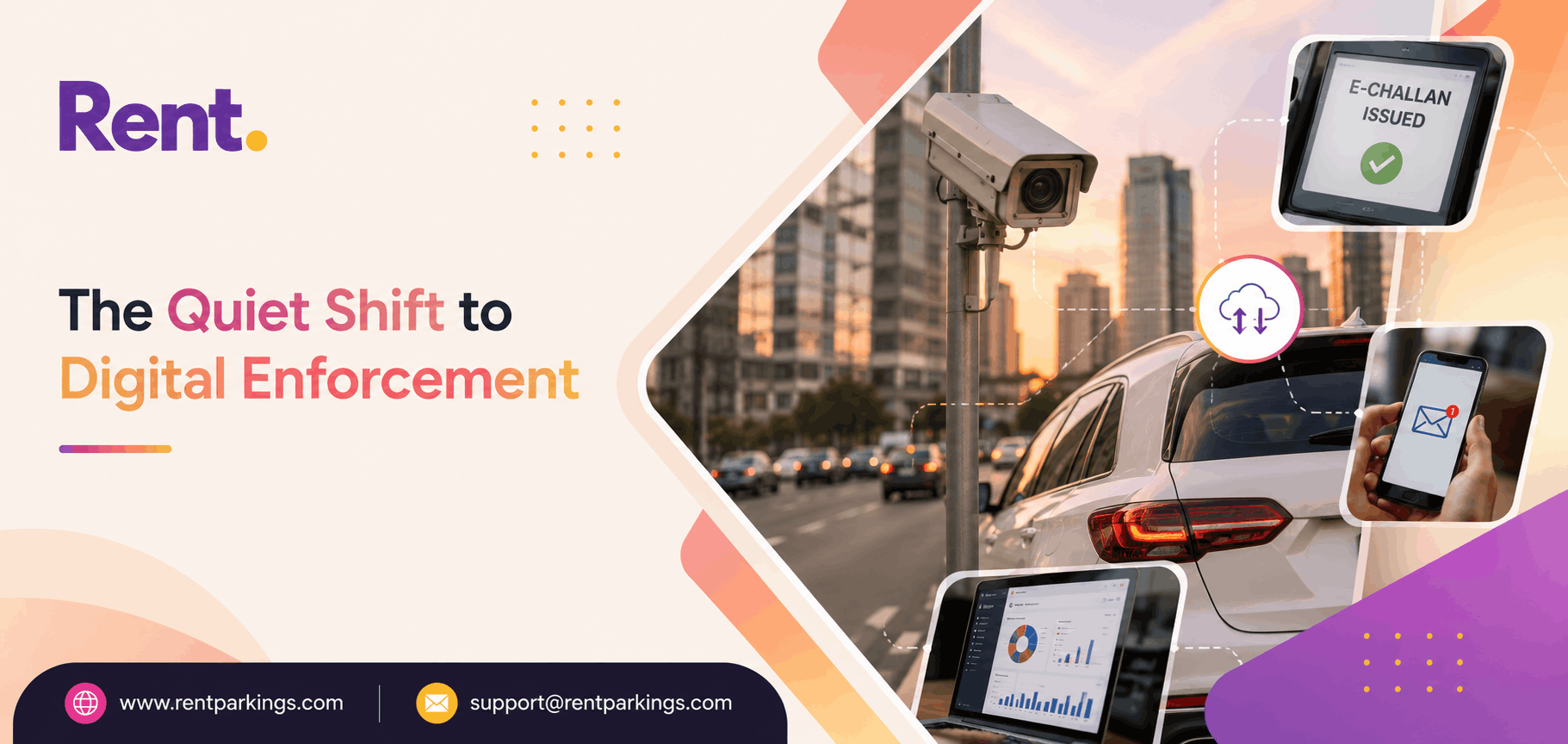
A decade ago, a parking ticket meant a constable, a paper book and a chance to talk your way out. That world is closing. Indian traffic departments have moved decisively to e-challan systems, and it changes the maths of getting caught. CCTV networks, body cameras, and traffic-junction cameras now capture violations and auto-generate challans linked to your registration number, which arrive by SMS and sit on the echallan.parivahan.gov.in portal whether or not anyone physically stopped you. A no-parking violation photographed by a camera in Hyderabad or Delhi can reach your phone before you have driven home.
This has three practical consequences. First, you can no longer assume you got away with it, because an unpaid challan you never saw can surface when you sell the vehicle, renew insurance, or pass an RTO check, and it compounds quietly in the background. Second, payment has become frictionless, which is genuinely good news: most states accept UPI, net banking and cards on their portals and apps, so clearing a challan no longer means a queue at a police station. Third, enforcement has become cheaper for the city to scale, which means more of it, not less. The rational assumption in 2026 is that any wrong-parking event in a monitored zone will eventually generate a charge.
A linked trend is FASTag-based parking. The same tag that pays your highway toll is increasingly accepted at malls, airports, and municipal lots, and Smart Cities are piloting FASTag and app-based payment for on-street bays. As this spreads, the line between "legal paid parking" and "free street parking you might get towed from" gets sharper, and the convenience gap pushes more drivers toward booked, legal spaces. Checking your e-challan status once a month, the way you check a bank statement, is now a basic part of vehicle ownership in India.
How To Never Get Towed Again
The cheapest challan is the one that never gets written. A few habits remove almost all of your risk.
Read the kerb before you read your phone. Indian no-parking signals come in several forms, including the standard red-and-blue "No Parking" sign, yellow lines or cross-hatching on the road, and tow-away-zone boards, and they are frequently faded or half-hidden behind a tree or a vendor. Two seconds of looking up saves the afternoon. Never park at a bus stop, on a footpath, within the splay of a junction, in front of a gate, hospital, fire station or fire exit, or in any stretch where every other vehicle has conspicuously left a gap; that gap is usually a tow-away zone the locals already know about.
Prefer a paid, legal space to a free, risky one. A ₹30 multi-level or app-booked bay is cheaper than a ₹500 fine plus ₹1,100 towing plus the lost hours, and far cheaper than the dent a tow truck can leave. In congested commercial cores, factor parking into the trip the way you factor fuel, as a known cost, not an afterthought. Around metro stations, use the official park-and-ride lots rather than the lane outside them, which is precisely where enforcement concentrates; RentParkings' guide on parking near metro stations to save money shows how commuters are already doing this. If you are leaving a car parked for long stretches, the same logic that protects it from a tow also protects it from the weather, which RentParkings covered in its monsoon car-protection guide.
For residents, the durable fix is securing a legal, dedicated off-street space, in your own building, a neighbour's unused stilt, or a nearby private lot, so the question of where to park is settled before you set out. This is where RentParkings solves the parking problem directly: you can find and book a verified off-street space near you, turning an open-ended towing risk into a fixed, predictable monthly arrangement. And if you have a spare spot, you can list it for free on RentParkings so it reaches a neighbour who needs it instead of sitting locked and empty.
Conclusion
Getting towed in India feels like an ambush, but it follows entirely knowable rules. The fine is usually ₹500 for a first offence and more for a repeat; the towing charge is a separate cost that runs from about ₹150 for a two-wheeler to ₹1,100 for a car depending on the city; and recovery is a fast, document-driven process if you locate the yard quickly, carry your licence and RC, pay both components, keep the receipts, and act inside the 60-day window. Know the two rights that matter, which are release on the parking fine alone if you reach the vehicle before it leaves, and the right to challenge a genuinely improper tow, and a tow becomes an inconvenience rather than a disaster.
The deeper lesson is structural. Towing is a symptom of a country with far more vehicles than legal parking, and the individual cure is the same as the civic one: get off the contested kerb and into a legal, dedicated space. Do that, and the tow truck simply never has a reason to stop. Save your city's traffic helpline now, learn your local fine and towing numbers, and let RentParkings handle the parking itself: find and book a secure off-street bay near home or work, or list your own empty spot for free so it solves the same problem for someone else. A settled parking spot is the one fix that takes the whole towing risk off the table.
FAQs
What is the fine for parking in a no-parking zone in India?
The standard no-parking penalty is ₹500 for a first offence and ₹1,500 for a repeat offence, but states and cities set their own amounts. For example, Delhi commonly charges ₹500 first and ₹1,000 for a subsequent offence, while Mumbai's notified penalties for obstructive no-parking can run far higher. Always confirm the live amount on your e-challan.
How much are towing charges in India?
Towing is charged separately from the fine and varies by city and vehicle class. Two-wheelers typically cost ₹100 to ₹750 (about ₹150 in Hyderabad, up to ₹750 in Bengaluru), and cars typically cost ₹200 to ₹1,100 (₹200 in Delhi, up to ₹1,100 in Bengaluru). Heavy vehicles cost more.
My car has been towed. How do I find out where it is?
Call your city traffic control room (in Bengaluru, 080-2294-3131), look for the tow-away-zone board that lists the designated yard address, or check your vehicle number on echallan.parivahan.gov.in or your state traffic police app, which often shows the violation and location.
What documents do I need to get my towed vehicle back?
Carry your driving licence and the vehicle's Registration Certificate (RC), and ideally proof that you are the owner or an authorised driver. With these you can pay the challan and towing charge and take delivery in one trip.
Do I have to pay the towing charge if I reach my vehicle before it is taken away?
In several cities the rule is that if you arrive while the vehicle is still being towed and has not yet left, it should be released on payment of only the no-parking fine, not the towing charge. Identify yourself to the officer as the owner and request release on the parking fine alone.
How long do I have to pay a parking challan in India?
Generally 60 days from issuance. If you do not pay within this window, the matter can escalate to a court summons requiring your appearance, and continued non-payment can lead to action against your driving licence.
Are there extra storage charges if I leave my vehicle in the yard?
Yes. Many yards levy daily storage or parking charges while the vehicle sits there, so a tow you ignore for several days can cost much more than the original fine plus towing. Recover the vehicle quickly.
Can I challenge a tow I believe was illegal?
Yes. If your vehicle was towed from a spot with no valid no-parking notification, or was damaged during lifting, you can file a complaint with the local police station or the municipal authority responsible for towing and request immediate release, and you should photograph any damage at the yard before taking delivery.
Is the no-parking fine the same for two-wheelers and cars?
The base challan is often similar, but towing charges are clearly lower for two-wheelers than for cars and heavy vehicles. In Hyderabad, for instance, a two-wheeler tow is around ₹150 versus ₹200 for a car, and in Bengaluru it is up to ₹750 versus up to ₹1,100.
How can I avoid getting towed in Indian cities?
Read kerb signs and road markings before parking, never park at bus stops, footpaths, junctions, gates or in front of hospitals and fire exits, prefer paid legal or app-booked parking to free risky spots, use official park-and-ride lots near metros, and for daily needs secure a dedicated off-street space so your vehicle is never on the street to be lifted.
Share This post
Search
Recent Post
Parking Space vs. Renting Out a Room to...
05 Oct, 2026
Think Parking Rental Only Pays in Mumbai...
02 Oct, 2026
Your Mumbai Parking Space Is Worth More...
01 Oct, 2026
Hyderabad's Real Estate Boom Left One As...
30 Sep, 2026
What Your Parking Space in Chennai Could...
29 Sep, 2026
Your Plans Changed After Listing Your Pa...
28 Sep, 2026
Parking Space vs SIP: Which Idle Asset A...
25 Sep, 2026
What Your Parking Space in Pune Could Ac...
24 Sep, 2026