

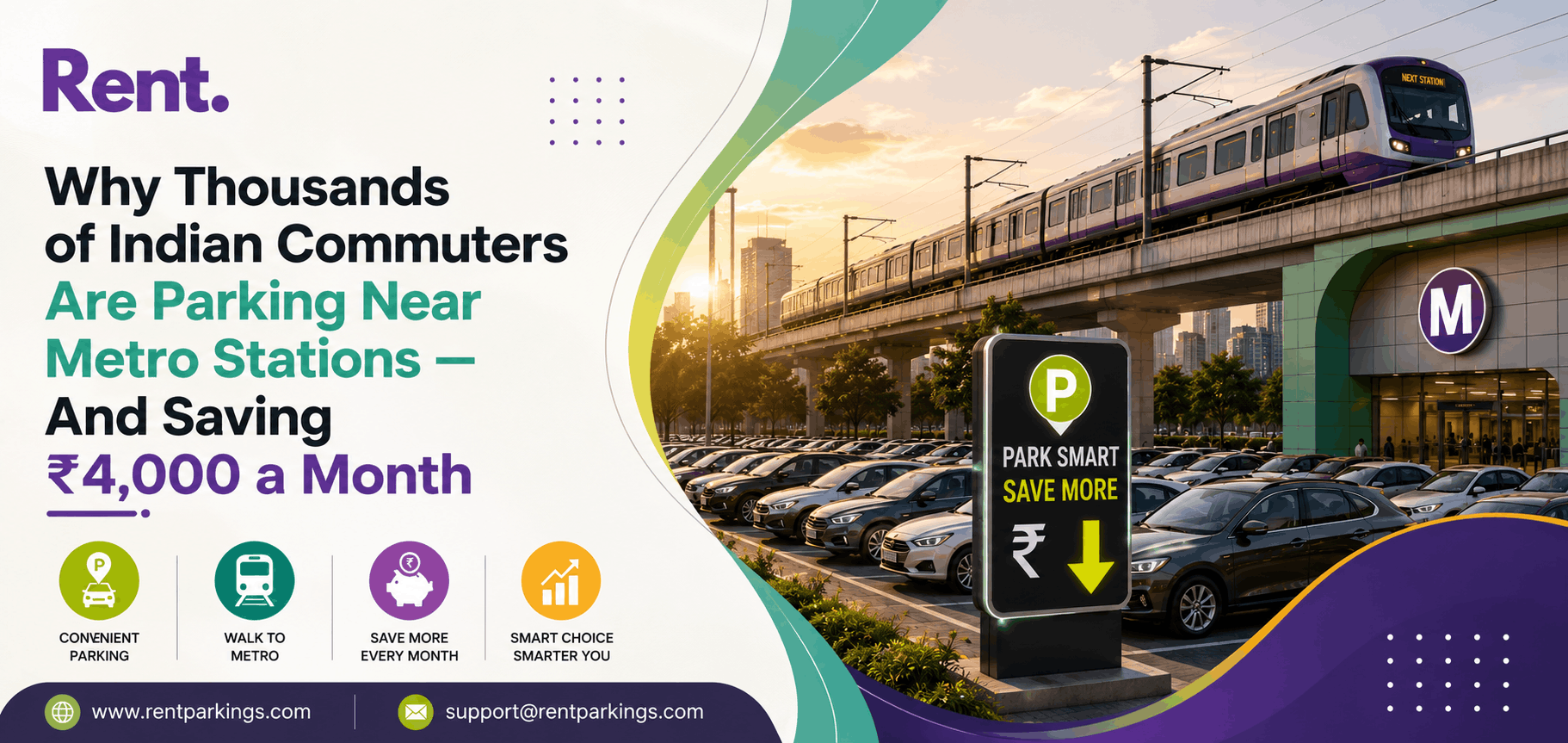
Why Thousands of Indian Commuters Are Parking Near Metro Stations — And Saving ₹4,000 a Month
There's usually no announcement, no dramatic decision. It's just a Tuesday — maybe Silk Board at 8:45 AM, or the Andheri flyover on a wet September morning, or a forty-minute standstill somewhere on NH-48 near Gurgaon — and something quietly snaps. The person ahead of you hasn't moved in seven minutes. Your fuel gauge has inched down another notch. And you realise, with a clarity that should have arrived much sooner, that you are spending real money, real time, and a genuinely unreasonable amount of cortisol to do something that has a much cheaper, faster, calmer alternative sitting three kilometres behind you.
That alternative is the metro station you just drove past.
This is not a lecture about using public transport. Indian metros are not perfect, last-mile connections can be maddening, and nobody who has been wedged into a Yellow Line coach at 9 AM is going to pretend it's relaxing. But here's what the commuters who have quietly figured this out already know: you don't have to choose between your vehicle and the metro. You can use both. Drive to the station, park there, ride the rest of the way. Done. That's the entire idea behind Park-and-Ride — and in Indian cities in 2026, it works better than most people realise. Platforms like RentParkings have made it even easier to find and book a spot near your nearest metro station before you even leave home.
The Problem Nobody Quantifies (Until They Do)
Ask a typical Bengaluru professional how much their daily commute costs and most of them guess around ₹150–₹200. Ask them to actually calculate it — fuel consumption in stop-start traffic, destination parking, vehicle depreciation from city driving, the inevitable scratched bumper in a tight basement — and the real number is often closer to ₹350–₹450 a day.
That's ₹7,000–₹9,000 a month. For commuting.
Delhi is not different. Hyderabad IT workers driving from Kondapur to Gachibowli face the same arithmetic. Pune professionals crawling from Wakad to Hinjewadi have done this math and found the same answer: the car is costing far more than they mentally accounted for.
Park-and-Ride doesn't eliminate the car. It just shortens the leg where it bleeds money the fastest — the long city-centre crawl through the densest, slowest, most congestion-tax-heavy part of the route. You drive the easy part (from your neighbourhood to the nearest metro station, usually 3–8 kilometres with manageable traffic), park there cheaply, and let the metro handle the painful part.
The numbers genuinely shift when you do this. Not marginally. Substantially.
How This Actually Works in Indian Cities
Delhi and NCR: The Most Developed Setup in the Country
Delhi Metro has been running for over two decades and has the most mature commuter ecosystem of any metro in India. What most Delhiites don't fully exploit is that DMRC has built substantial parking infrastructure at dozens of stations across all nine lines — and monthly parking passes here are underpriced relative to what you'd pay for destination parking in Connaught Place, Nehru Place, or Cyber City Gurgaon.
Dwarka Sector 21 is a good place to start thinking about this. If you live anywhere in Dwarka — any of the 14 sectors — driving to Sector 21 and taking the Blue Line or Airport Express into central Delhi beats driving in. The parking lot is large, covered bays are available, and monthly passes for cars hover around ₹1,800–₹2,200. Compare that to a day's destination parking in Connaught Place, which runs ₹80–₹200 depending on duration, and the math writes itself.
Kashmere Gate is the busiest interchange station in the system. Commuters from Shahdara, North Delhi, and areas of East Delhi who drive to Kashmere Gate can access Lines 1, 5, and 9 from there — meaning most of the city is reachable. Parking here fills up early on weekdays; if you're starting after 9 AM you'll find the lot near capacity.
The Blue Line corridor into Noida has become a genuine park-and-ride route for thousands of Greater Noida and Noida Extension residents. Driving to Noida City Centre or Botanical Garden — where the parking is cheaper and the trains less crowded than Rajiv Chowk — and then taking the metro to a central Delhi office is a commute pattern that a significant number of NCR workers have quietly adopted.
One practical detail that most online guides skip: DMRC's app lets you check parking availability and buy monthly passes. A lot of commuters don't know this and show up hoping for a spot instead of securing one in advance. You can also check RentParkings for private parking options near any Delhi Metro station when the official lot is full.
Bengaluru: Highest Potential, Most Inconsistent Execution
There are days when Outer Ring Road moves at the speed of refrigerated yoghurt. Bengaluru's traffic reputation is not exaggerated — the TomTom Traffic Index has placed the city among the five worst globally for several consecutive years, with average peak-hour speeds in key corridors dropping below 10 km/h.
Namma Metro now spans the Purple Line from Whitefield in the east to Challaghatta in the west, and the Green Line from Nagasandra in the north to Silk Institute in the south. For the first time in the city's modern history, you can get from Whitefield to Majestic in under 45 minutes. By road, on a bad morning, that same journey can take two hours.
Whitefield station has become the anchor of a quiet park-and-ride revolution in the eastern tech corridor. Engineers and product managers from ITPL, Varthur Road, and Marathahalli-adjacent areas drive to Whitefield, park in either the BMRCL facility or one of the private covered spaces that have sprung up in the adjacent residential streets, and metro into the central business district. The parking options immediately around Whitefield station range from ₹40–₹80/day for open slots to ₹100–₹150/day for covered spots.
Nagasandra serves North Bengaluru commuters from Jalahalli, Hesaraghatta Road, and Yelahanka who want access to the Green Line. The station has parking and bus connections, making it the natural entry point for a wide residential catchment.
Silk Institute, at the southern end of the Green Line, works well for residents of Banashankari, JP Nagar, and Padmanabhanagar. The Electronics City corridor is accessible from here, and BMTC feeder buses extend the reach further.
The honest caveat: BMRCL's parking infrastructure hasn't kept pace with ridership growth. At popular stations like Indiranagar, Jayanagar, and MG Road, there simply isn't enough official parking. This is exactly where private spaces in adjacent residential buildings and commercial basements fill the gap — and where finding a parking spot within a 5-minute walk of the station entrance can transform a frustrating morning into a genuinely comfortable one. RentParkings lists vetted private spots near Bengaluru Metro stations so you can book in advance rather than hunt on arrival.
Hyderabad: The Metro That Actually Thought About Parking
When L&T designed and built the Hyderabad Metro, they embedded retail, hospitality, and parking directly into the station structures. The result is that stations here feel more like small urban nodes than just transit stops — and the parking situation at key stations reflects that integrated thinking.
Miyapur is the western terminus of Corridor 1 and the clearest example of park-and-ride working as intended in Hyderabad. The multi-level parking structure at Miyapur handles several hundred vehicles a day. Residents from Bachupally, KPHB, Kukatpally, and the broader western residential belt drive to Miyapur, leave their vehicles, and take the metro into Hitech City, Raidurgam, or further east to LB Nagar. Journey time from Miyapur to Hitech City by metro is roughly 18–22 minutes. By road during peak hours, the same stretch can eat 50–75 minutes.
LB Nagar, the eastern terminus, serves the Dilsukhnagar and Saroornagar commuter base in the same way. Nagole on Corridor 2 has been growing its park-and-ride usage as awareness builds.
What Hyderabad does well that Bengaluru still struggles with: adequate official parking at the right stations, reasonably priced (₹40–₹60/day for cars), and private operators near stations who have spotted the demand and filled the overflow capacity.
Chennai: Steady Progress on a Well-Planned Route
Chennai Metro runs the Blue Line (northern to Airport/Wimco Nagar direction) and the Green Line across the central business and residential grid. The Phase 2 expansion under active construction will eventually create a much more comprehensive network.
Wimco Nagar at the northern end and Chennai Airport at the southern end of the Blue Line both have parking facilities and are used by commuters from those catchment areas who take the metro into Anna Nagar, Egmore, or connecting further to the bus terminus at Koyambedu.
Koyambedu itself is perhaps the most important multimodal node in Chennai — connecting metro, CMBT long-distance buses, and CMRL within walking distance. Western Chennai residents who drive to Koyambedu can park and have access to the full metro network without entering the congestion of Anna Nagar or the city centre.
St. Thomas Mount is increasingly used by commuters from Pallavaram, Chromepet, and Tambaram who drive to the southern edge of the metro line and take it north into central Chennai.
CMRL has been explicit in communications about wanting to grow park-and-ride ridership, and Phase 2 station designs have incorporated parking from the blueprint stage rather than as an afterthought.
Mumbai: Different History, New Possibilities
Mumbai's relationship with Park-and-Ride is complicated by its own history. The suburban rail network — Central, Western, Harbour lines — has been the city's mobility backbone for 150+ years. But P&R in the traditional sense (drive to station, park car) was never the model there because Mumbai's rail network was built in an era when private car ownership was minimal, and the land around stations was too dense and too valuable for large parking lots.
The Mumbai Metro, now expanding across a dozen lines in various stages of completion, changes the equation somewhat.
Ghatkopar (Metro Line 1, eastern terminus) is the most established P&R point, also connecting to the Central suburban line. The density of private parking options within a 10-minute walk of the station has grown considerably as commuters have realised the combination works.
Metro 2A and 7 — covering the western suburbs from Dahisar to Andheri — have opened P&R possibilities for residents of Borivali, Kandivali, Malad, and Goregaon who want to avoid the Western Express Highway entirely for the central part of their commute.
Mumbai's constraint is straightforward: real estate near metro stations is among the most expensive anywhere in Asia. Purpose-built parking lots don't make economic sense for most developers. This makes private residential parking spaces — flats in towers adjacent to metro stations that have an extra spot to rent — disproportionately valuable here compared to other cities. RentParkings aggregates exactly these kinds of private spots near Mumbai Metro stations, often at rates well below what commercial parking commands in the same neighbourhoods.
Kochi: Small City, Surprisingly Complete Thinking
Kochi Metro punches well above its weight in terms of multimodal integration. The KMRL connects to water metro services — electric ferries on Vembanad Lake — which means some commuters here have a car-to-metro-to-boat chain that is genuinely one of the more interesting commute options in the country.
Aluva, the northern terminus, has significant parking and handles a large feeder catchment from Perumbavoor, Kalady, Angamaly, and the Ernakulam district's northern belt. Residents from these areas who work in the city proper have adopted the drive-to-Aluva-and-metro model in considerable numbers. KSRTC bus connections to Aluva further expand the catchment.
Kochi's relatively flat terrain also makes bicycle-to-metro the most viable combination of any Indian city. For residents within 3–5 km of a metro station, cycling there and locking up at the station is a realistic and pleasant option in a way that it simply isn't in most other Indian metros.
Pune: Early Stage, Fast Trajectory
Pune Metro's Vanaz-to-Ramwadi and Pimpri-to-Swargate corridors are still relatively young. Ridership is growing but P&R behaviour hasn't fully crystallised yet.
What makes Pune interesting is the upcoming Hinjewadi extension — connecting the massive IT hub at Hinjewadi Phase 1, 2, and 3 to the metro network. When that corridor opens, the park-and-ride dynamic in Pune will shift considerably. Workers driving from Wakad, Tathawade, Baner, and Aundh toward Hinjewadi will have the option of driving partway and riding the rest — significantly cutting the Wakad-to-Hinjewadi crawl that currently accounts for a substantial portion of Pune's peak-hour congestion.
At Pimpri and Chinchwad termini, parking availability is currently reasonable, and monthly passes are available. Early adopters in Pune are already using these stations.
The Two-Wheeler Angle Nobody Talks About
Every article about Park-and-Ride in India focuses on cars. This makes little sense given that India has over 210 million registered two-wheelers — more than any other country on the planet.
For a scooter or motorcycle commuter, the calculation is a little different but the conclusion is often the same. Fuel costs are lower, yes. But destination parking in congested commercial areas is frequently difficult — finding a legal, secure motorcycle spot near a mall, hospital, or office block can add 10–15 minutes each way and still result in a bike parked on the pavement in the sun for eight hours.
Metro stations almost universally have large, dedicated two-wheeler sections. The cost is a fraction of what car parking runs: ₹10–₹30 per day in most cities, or ₹200–₹500 for a monthly pass. A motorcycle parked in a monitored, CCTV-covered lot at a metro station for eight hours is also objectively safer than one left on a residential street or a crowded office-area footpath.
For the Bengaluru software professional on a scooter who currently rides 22 km each way into town, riding instead to Whitefield or Nagasandra and taking the metro could shave ₹1,200–₹2,000 off monthly fuel costs while also eliminating the destination parking problem entirely.
It's a real option. It just needs more people to actually try it. For city-by-city guides on two-wheeler parking near metro stations, the RentParkings blog is a useful starting point.
What a Real Savings Calculation Looks Like
Take Arjun, a marketing manager in Hyderabad who lives in Bachupally and works in Hitech City. The distance is about 18 km each way, almost entirely through KPHB, Kukatpally, and the Hitech City arterial.
Driving all the way:
- Fuel: roughly ₹240/day for a petrol sedan doing city mileage
- Hitech City parking: ₹80–₹120/day at most office parks
- Time: 55–80 minutes each way depending on the day
- Monthly total (22 days): ₹7,040–₹7,920 in fuel and parking alone
Driving to Miyapur, metro to Hitech City:
- Fuel: Bachupally to Miyapur is about 4 km — roughly ₹25/day
- Miyapur parking: ₹50/day (or ₹900/month on a pass, ~₹41/day amortised)
- Metro fare: Miyapur to Hitech City roughly ₹55 each way, ₹110 return
- Time: Drive 10 minutes to Miyapur, metro 22 minutes to Hitech City — total 32 minutes each way
- Monthly total (22 days): ₹3,894–₹4,114
Monthly saving: roughly ₹3,500–₹4,000. Time saved: 25–50 minutes a day.
That's not a rounding error. That's real money and real time, every month, just by changing where you park.
The Honest Barriers (And What Actually Helps)
"The parking is full by the time I get there." At popular stations — Miyapur, Whitefield, Dwarka Sector 21 — the official lot can be at capacity by 8:45 AM on weekdays. The fix isn't complicated: a monthly pass at most stations locks in your spot or gives you priority access. Alternatively, private parking spaces within a 7–10 minute walk of the station entrance — in the surrounding residential colony or a small commercial building — fill the overflow and are often available even when the official lot isn't. RentParkings makes it straightforward to locate and pre-book these private spots so you never have to arrive and hope.
"Peak-hour metro coaches are too crowded." True at certain stations during the 8:30–9:30 AM window. Shifting departure by 20–25 minutes — 8:05 AM instead of 8:30 AM — often results in noticeably less crowded trains, since the peak is relatively sharp. The extra time at the destination can be used productively in a way that traffic time cannot.
"I need my vehicle during the day for client visits." Completely valid for some roles. The practical answer isn't an all-or-nothing switch — it's a partial one. Three days a week by park-and-ride, two days driving. Even that split produces meaningful monthly savings and lets you maintain flexibility when you need it.
"I'm not sure my vehicle is safe." Official metro parking is CCTV-monitored with security staff. Damage and theft rates are generally lower than at unguarded street parking in commercial zones. A GPS tracker on a two-wheeler — available for under ₹2,000 — adds real-time visibility if you want it.
"The last mile from the metro station to my office is awkward." This is the most legitimate objection and also the most city-specific. In corridors where the destination station is genuinely far from the office, feeder buses (BMTC in Bengaluru, DTC feeders in Delhi), app-based two-wheeler taxis, and auto-rickshaws handle the gap. In dense commercial zones — Hitech City, Connaught Place, Koramangala, Anna Salai — the destination station is often walkable from the actual office for many employees.
Where Tier-2 Cities Are Heading
Nagpur Metro has been building with park-and-ride in mind from the start. Stations at Khapri (near the airport), Automotive Square, and Prajapati Nagar have parking built into their designs rather than added later.
Lucknow Metro, covering the CCS Airport to Munshi Pulia corridor and the Charbagh-Vasant Kunj east-west route, has parking at terminal stations and benefits from Lucknow's lower real estate density compared to Mumbai or Bengaluru — meaning more space for cars near stations.
Jaipur Metro's Mansarovar terminus has reasonable parking for the residential southern belt. As the system extends, P&R behaviour will follow.
In each of these cities, the pattern tracks the same arc: metro opens, ridership builds slowly, commuters who figure out the parking-plus-metro combination start spreading the idea through offices and residential communities, and the habit scales. The difference in Tier-2 cities is that the congestion is already serious enough in some corridors — Lucknow's Hazratganj, Jaipur's MI Road, Nagpur's Sitabuldi — that the motivation to find an alternative is already there. The RentParkings blog covers emerging park-and-ride options in Tier-2 cities as new metro corridors open.
How to Find the Right Parking Near Your Station
Start with the official metro app. Every major metro system — DMRC, BMRCL, HMRL, CMRL, KMRL, Maha-Metro — has an app or website listing parking facilities, capacities, and monthly pass rates. This is always the first stop.
Scout the surroundings before you commit. Go to the station on a Tuesday or Wednesday morning — not a weekend — at your intended departure time. Walk the parking area. See how full it is. Time the walk from the farthest spot to the platform. Thirty minutes of reconnaissance prevents weeks of frustration.
Think beyond the official lot. Private parking spaces in residential buildings and small commercial properties within 500–800 metres of a metro station entrance are frequently available and can be booked through RentParkings. For many commuters, a covered spot in an apartment building three minutes' walk from the station is better than an open spot in the official lot right next to the entrance.
Buy a monthly pass, not a daily ticket. If you're committing to a P&R routine even three days a week, the monthly pass math almost always wins. You pay less per day, you save time at the payment counter each morning, and at many stations the pass provides guaranteed access or priority entry.
Build in ten minutes the first week. Your first park-and-ride morning will be slightly slower than it will become once the routine is established. Give yourself a buffer the first few days while you figure out exactly where to park, the fastest walking route to the platform, and which coach stops at the most convenient exit at your destination.
Conclusion
Indian cities are congested in ways that aren't going to reverse themselves any time soon. Vehicle registration grows year on year, road construction can't keep pace, and destination parking in every major commercial district has become genuinely scarce and expensive. These are structural conditions, not temporary inconveniences.
But the metro — in Delhi, Bengaluru, Hyderabad, Chennai, Kochi, Mumbai, and Pune — is real infrastructure that is running, expanding, and, in most corridors, meaningfully faster than road travel during peak hours. Park-and-Ride is simply the recognition that you don't have to choose between your vehicle and the train. You can use the vehicle for the easy part of the journey and the train for the hard part.
Commuters who have made this switch don't tend to go back. The money saved is real, the time saved is real, and the reduction in daily stress — which has its own value that doesn't show up in fuel receipts — is probably the part they notice most.
The station is already there. The parking is cheaper than you think. The metro leaves on schedule.
The traffic, on the other hand, will keep doing exactly what it always does.
FAQs
What exactly is Park-and-Ride, and does it exist in Indian cities?
Park-and-Ride means driving your vehicle to a parking facility near a metro or rail station, leaving it there, and completing your commute by public transport. Yes — Delhi, Bengaluru, Hyderabad, Chennai, Kochi, and Pune all have official park-and-ride facilities at select metro stations, with more being built as networks expand.
How much does it cost to park at a metro station in India?
Two-wheelers typically pay ₹10–₹30 per day or ₹200–₹600 for a monthly pass. Cars pay ₹50–₹100 per day or ₹1,500–₹2,500 per month. Buying a monthly pass saves 40–60% over daily rates and often secures your spot in advance.
Which metro stations in Delhi are best for park-and-ride?
Dwarka Sector 21 (Blue/Airport Express), Kashmere Gate (Lines 1, 5, 9 interchange), Noida City Centre, and Botanical Garden are among the most popular. DMRC's official app shows current parking availability and allows online purchase of monthly passes.
Is Bengaluru's Namma Metro good for park-and-ride commuting?
Yes — particularly Whitefield (Purple Line east terminus) for IT corridor workers, Nagasandra (Green Line north terminus) for North Bengaluru residents, and Silk Institute (Green Line south terminus) for the JP Nagar and Banashankari belt. Private parking near popular stations like Indiranagar supplements limited official capacity.
Which Hyderabad Metro station has the best parking?
Miyapur, the western terminus of Corridor 1, has a purpose-built multi-level parking structure and is the primary park-and-ride hub in the city. LB Nagar (eastern terminus) and Nagole also have parking. Rates at Hyderabad Metro stations are generally ₹40–₹60 per day for cars.
Can two-wheeler owners use park-and-ride at Indian metro stations?
Absolutely — and it is often more financially logical for them than for car owners. Two-wheeler parking at most metro stations costs ₹10–₹30 per day. Monthly passes run ₹200–₹500. This is significantly cheaper than destination parking in most commercial areas, and the vehicle is in a monitored, secure lot for the day.
What if the official parking lot at my station is always full?
Arrive earlier, or buy a monthly pass that provides guaranteed access. If the official lot is consistently full, look for private parking spaces in nearby residential buildings or small commercial properties within walking distance. Platforms like RentParkings list verified private spots near metro stations across major Indian cities, often with online booking available.
How much can I realistically save per month by switching to park-and-ride?
A typical commuter driving 20+ km each way in Bengaluru, Hyderabad, or Delhi can save ₹3,000–₹5,000 per month in fuel and destination parking. The saving is highest for those currently paying for expensive destination parking in premium commercial zones.
Is my vehicle safe overnight or all day at a metro station parking facility?
Official metro parking has CCTV monitoring and on-site security staff. Theft and damage rates at these facilities are generally lower than at unguarded street parking in congested areas. For additional peace of mind, GPS trackers for two-wheelers are available from under ₹2,000.
Are Tier-2 cities in India developing park-and-ride infrastructure?
Yes. Nagpur Metro stations were designed with parking in mind from day one. Lucknow Metro and Jaipur Metro have parking at terminal stations. Under India's Smart Cities Mission, cities including Indore, Bhopal, and Surat are incorporating park-and-ride into their integrated mobility plans, and new metro routes in Tier-2 cities are building parking capacity into station designs rather than retrofitting it later.
Share This post
Search
Recent Post
Parking Space vs. Renting Out a Room to...
05 Oct, 2026
Think Parking Rental Only Pays in Mumbai...
02 Oct, 2026
Your Mumbai Parking Space Is Worth More...
01 Oct, 2026
Hyderabad's Real Estate Boom Left One As...
30 Sep, 2026
What Your Parking Space in Chennai Could...
29 Sep, 2026
Your Plans Changed After Listing Your Pa...
28 Sep, 2026
Parking Space vs SIP: Which Idle Asset A...
25 Sep, 2026
What Your Parking Space in Pune Could Ac...
24 Sep, 2026