

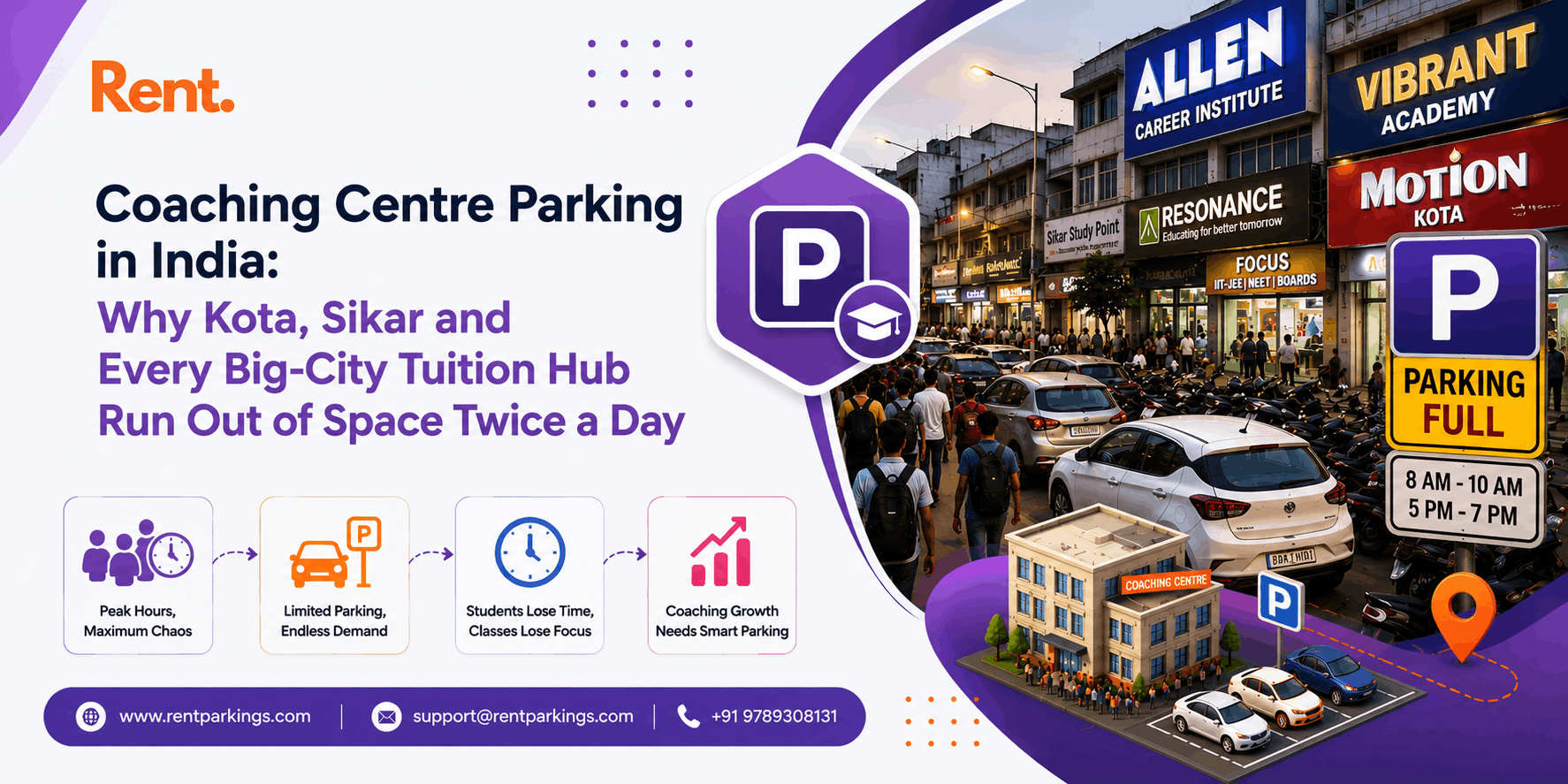
Coaching Centre Parking in India: Why Kota, Sikar and Every Big-City Tuition Hub Run Out of Space Twice a Day
Every year, lakhs of teenagers leave home for a city they've never lived in before, chasing a rank in NEET, JEE, UPSC or one of a dozen other exams that will quietly decide the next twenty years of their life. Their parents follow soon after, at least for admission week, the first PTM, or the emergency visit when hostel food and home food turn out to be nothing alike.
Nobody plans for where all those scooters and cars are going to sit while class is in session. Coaching institutes plan syllabi, test series and faculty rosters down to the hour. Parking is the one line item that almost never makes it onto that spreadsheet.
On RentParkings, India's trusted parking marketplace, property owners near these coaching clusters are starting to notice something interesting: a plot they've ignored for years is worth more during coaching season than it earns the rest of the year put together.
A Business Built Around a Plot Nobody Priced Correctly
Kota didn't become India's most famous coaching town by accident. Sikar followed, positioning itself as the lower-cost alternative for NEET and JEE aspirants from smaller towns in Rajasthan and neighbouring states. Delhi's Old Rajinder Nagar and Mukherjee Nagar built an entire micro-economy around UPSC preparation. Hyderabad's Ameerpet does the same for banking, SSC and IT certification coaching.
Property owners and coaching centre administrators we've spoken with describe scenes that would be unthinkable in a regular residential lane. A single coaching stretch in Kota's Talwandi area or Sikar's core coaching belt can see several hundred two-wheelers converge within a twenty-minute window the moment a batch lets out, and then empty just as fast when the next one begins.
That's not a one-time rush like a wedding or a festival. It repeats every single working day, sometimes six days a week, for months at a stretch.
Two Rush Hours a Day, Every Single Day
Most urban parking demand follows a predictable pattern: one spike in the morning, one in the evening, and relative calm in between. Coaching hubs don't work that way.
A serious coaching institute in a competitive-exam city runs multiple batches a day, often four to six of them, each ending fifteen or twenty minutes apart from the next one starting. That means the same short stretch of road sees a fresh wave of arrivals and departures every couple of hours, not once or twice a day.
This overlapping-batch pattern is a cousin of what we covered in our piece on why the streets outside every test centre turn into gridlock on exam day, except in a coaching hub it isn't a once-a-year event. It's the daily operating rhythm of the entire neighbourhood.
The Cities Carrying This Load
Kota remains the reference point, but it's far from the only place where this plays out. Sikar has grown into a genuine second hub for medical and engineering entrance coaching. Delhi NCR carries the UPSC and law coaching crowd across Old Rajinder Nagar, Mukherjee Nagar and Laxmi Nagar. Hyderabad's Ameerpet handles IT training and competitive government-exam coaching at serious scale.
Smaller but fast-growing coaching pockets are showing up in Lucknow, Indore, Patna, Chennai and Coimbatore too, usually clustered around a handful of well-known institute names rather than spread evenly across the city. Wherever a coaching brand puts down roots, the surrounding two or three streets end up absorbing traffic the original layout was never built to handle.
Why Nearby Property Owners Are Sitting on an Underpriced Asset
Most owners near a coaching belt think of their spare plot, terrace, or unused garage the way they'd think of any other patch of land: nice to have, not worth the hassle of renting out. Coaching season changes that math completely.
We've written before about how much a parking space can realistically earn across different Indian cities, and coaching hubs consistently sit at the higher end of that range for one simple reason: demand doesn't fluctuate gently through the day, it spikes hard and repeatedly, and students and parents will pay a premium to avoid circling a packed lane looking for a spot before class starts.
Owners near Kota and Sikar's coaching lanes we've spoken with report monthly two-wheeler parking going for roughly ₹500 to ₹1,200 depending on how close the plot sits to the main coaching stretch, climbing noticeably higher during peak admission weeks in April, May and June. Four-wheeler spots, which are scarcer because the lanes are so narrow, tend to command a meaningfully bigger premium.
What Happens When Nobody Owns the Problem
Coaching institutes rarely build their own parking. Most operate out of rented commercial floors in buildings that were never designed with vehicle parking in mind, so the burden quietly shifts onto whoever owns land nearby, whether they signed up for it or not.
A few larger coaching towns have experimented with stacked or automated structures to squeeze more vehicles into the same footprint, an approach we explored in our look at why India built hundreds of multi-level parking towers that are still sitting half empty. The irony is that these structures tend to go up in commercial districts and IT corridors, not in the dense, older neighbourhoods where most coaching institutes actually operate. The demand and the infrastructure keep missing each other.
The dynamic isn't entirely new. It echoes what happens around any large student population, similar to what we found when we looked into where India's college students actually park and how that gap has quietly turned into a neighbourhood business of its own. Coaching hubs just compress the same pressure into a smaller radius and a longer academic calendar.
Setting Your Space Up for Coaching-Hub Renters
Renting to students and parents near a coaching belt is a different crowd from renting to office commuters, and it pays to plan for that difference rather than copy a generic listing.
- Expect mostly two-wheelers. Coaching-hub traffic skews heavily toward scooters and bikes, since most students either walk from nearby hostels or ride short distances from paying-guest accommodation.
- Plan for early-morning and late-evening arrivals. Batches often start before 7 AM and run past 8 PM, so lighting and basic visibility matter more here than in a typical residential parking listing.
- Factor in parent visits. Many families travel in for admission counselling, fee payment, or a weekend check-in, which means occasional four-wheeler demand even in a mostly two-wheeler lane.
- Keep contracts simple and month-to-month where possible, since coaching batches run in cycles and renters may only need the space for a specific exam season.
- Accept UPI and digital payments by default. Students and parents in these hubs are used to paying for everything, from hostel mess bills to library seats, through UPI, and expect the same convenience for parking.
If you own a flat or an independent house in a housing society near a coaching belt, it's worth checking your society's stance before listing a stilt or open parking slot commercially. We've covered this in detail in our piece on who actually owns the parking in an Indian apartment and what rights stilt, covered and open parking allotments carry, since some RWAs restrict renting allotted spots to outside vehicles even when the owner technically has the right to use the space as they wish.
Pricing It Right for a Seasonal, Not Permanent, Crowd
Coaching demand isn't flat across the year. Admission season, typically April through June, brings the sharpest spike as new batches enrol and families are still scouting hostels and PGs. A second, quieter bump shows up around October to December, when revision batches and test series intensify ahead of exam dates.
Smart pricing accounts for that rhythm instead of locking in one flat rate. Consider a slightly lower base rate for the lean months, an admission-season premium, and a simple loyalty discount for renters who commit to a full academic term rather than month by month. It keeps your space consistently occupied instead of empty for weeks between coaching cycles.
Frequently Asked Questions
1. Is renting out parking near a coaching institute actually profitable, or is the demand overstated?
It's genuinely one of the higher-earning parking niches in India precisely because demand repeats several times a day rather than once. Owners near established coaching belts in Kota, Sikar and Delhi's UPSC hubs consistently report stronger and steadier returns than owners in ordinary residential lanes nearby.
2. What kind of vehicles should I expect if my space is near a coaching hub?
Mostly two-wheelers. Students commuting from hostels or PG accommodation almost always use scooters or bikes for short distances, so your space should be laid out with narrower, quicker-turnover slots rather than a handful of large car bays.
3. How much can I realistically charge for parking near a coaching centre?
Rates vary by city and proximity to the main coaching stretch, but owners in Kota and Sikar's core lanes commonly charge somewhere between ₹500 and ₹1,200 a month for two-wheeler parking, with four-wheeler spots priced meaningfully higher given how limited that space usually is.
4. Should I sign long-term contracts with coaching-hub renters?
Month-to-month agreements usually work better here than long leases, since coaching batches run in cycles tied to specific exams and academic terms, and demand naturally rises and falls with the admission calendar.
5. Is coaching-hub parking demand only strong in Kota and Sikar?
No. Similar patterns show up around Delhi's Old Rajinder Nagar and Mukherjee Nagar for UPSC coaching, Hyderabad's Ameerpet for IT and banking exam prep, and smaller but growing coaching clusters in Lucknow, Indore, Patna and parts of Chennai and Coimbatore.
6. Do coaching institutes ever pay for parking arrangements themselves?
Occasionally larger institutes negotiate informal arrangements with nearby landowners during peak admission weeks, but this is far from standard practice. Most of the parking burden lands on individual property owners near the institute rather than the institute itself.
7. What safety measures matter most for parking spaces catering to students and parents?
Basic lighting for early-morning and late-evening batches, a visible boundary or barrier, and clear signage go a long way. Many renters are parents visiting from out of town or students commuting alone after dark, so visible safety cues matter as much as the rate you're charging.
8. Can I rent out my society-allotted parking space near a coaching hub?
It depends on your housing society's rules. Some RWAs permit owners to rent allotted stilt, covered or open parking to outside vehicles, while others restrict it, so it's worth checking your society bylaws before listing the space commercially.
9. When is peak season for coaching-hub parking demand?
April through June sees the sharpest spike as new academic batches enrol, followed by a second, somewhat quieter rise between October and December as revision batches and pre-exam test series ramp up.
10. How do I list my parking space for coaching-hub renters?
You can list your space directly on RentParkings with your preferred rate, hours and vehicle type, and set it up for hourly, daily or monthly rental depending on how coaching-season demand behaves in your specific lane.
Conclusion
Coaching hubs are one of the few places in urban India where parking demand isn't a mystery. It shows up on a predictable calendar, repeats several times a day, and keeps growing as more students travel further from home to chase a rank. For property owners sitting on unused space near one of these belts, that predictability is exactly what makes the opportunity worth taking seriously.
If you own land, a terrace, a garage or even a modest strip near a coaching cluster in your city, there's a strong chance it's worth more as parking than it currently earns sitting idle. List your parking space on RentParkings and start turning that daily batch rush into a steady, season-after-season income stream.
Share This post
Search
Recent Post
Parking Space vs. Renting Out a Room to...
05 Oct, 2026

Think Parking Rental Only Pays in Mumbai...
02 Oct, 2026
Your Mumbai Parking Space Is Worth More...
01 Oct, 2026

Hyderabad's Real Estate Boom Left One As...
30 Sep, 2026

What Your Parking Space in Chennai Could...
29 Sep, 2026
Your Plans Changed After Listing Your Pa...
28 Sep, 2026
Parking Space vs SIP: Which Idle Asset A...
25 Sep, 2026

What Your Parking Space in Pune Could Ac...
24 Sep, 2026