

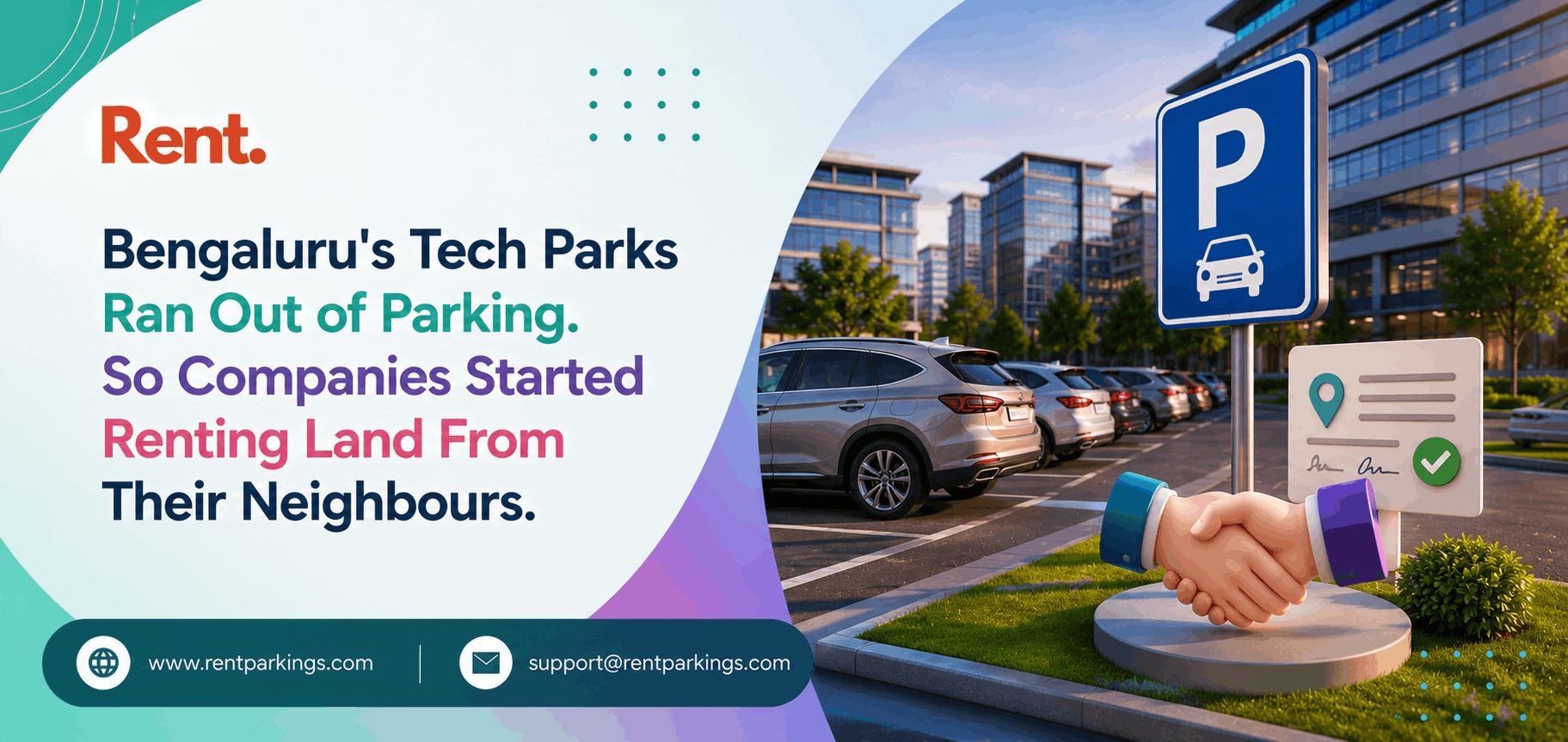
Bengaluru's Tech Parks Ran Out of Parking. So Companies Started Renting Land From Their Neighbours.
A facilities manager at a mid-sized tech campus on Bengaluru's Outer Ring Road told us something that stuck: her team spends more time each quarter negotiating parking than negotiating the office lease itself.
That sentence sounds like an exaggeration until you look at the underlying math. Office towers went up assuming a certain ratio of cars to floor space. Employees showed up in far greater numbers behind the wheel than that ratio ever anticipated. Nobody built more concrete to fix it, because nobody could; the land around most campuses was already spoken for.
So a quieter fix has taken hold over the last couple of years. Instead of building, companies are renting. Not desks, not offices. Land. A vacant plot two streets from the gate, a half-used compound behind a warehouse, an open yard that used to sit idle on weekdays. Facility teams are now signing multi-year leases directly with the owners of that land to guarantee parking for their staff.
It's a genuinely different transaction from the one most Indian property owners assume is available to them through a site like RentParkings, where the standard pitch is a single spare bay earning from a single commuter. This is bulk, contracted, and recurring, and the owners who've figured that out first are the ones getting the better terms.
Why the Shortage Isn't Going Away on Its Own
Parking norms baked into most business-park approvals date back to when a much larger share of the workforce arrived by shared cab, bike, or bus. That assumption has aged badly.
Hybrid schedules pushed people back into their own cars for the days everyone's expected in. Rising incomes across dual-earning households in Pune, Hyderabad, and Noida meant more employees driving solo than the original parking count ever budgeted for.
Multi-storey parking structures were supposed to be the release valve. In practice, a good number of them sit half-empty, a pattern we unpacked when we looked at why India's parking towers keep missing the mark, largely down to bad siting and clunky entry gates that push people right back onto the street. The demand these towers were meant to absorb hasn't gone anywhere. It just moved to whoever owns the land closest to the office gate.
What This Kind of Lease Actually Looks Like
Strip away the jargon and it's simple: a company signs a fixed-term agreement, usually somewhere between 11 months and three years, with whoever owns a usable patch of land near the office. In exchange for a flat monthly payment, that owner sets aside a specific number of bays, and the company handles who gets a spot internally, a badge system, a booking app, or in smaller offices, a printed list at the security desk.
Compare that with the numbers in our breakdown of realistic rental income figures for parking spaces across Indian cities, which are built around one owner renting to one driver at a time. A bulk arrangement scales that logic up, thirty or forty bays under a single contract, filled on every working day, with no advertising, no daily churn, and no gaps to fill between renters.
The Real Reason Companies Prefer Renting Land Over Building
Adding structured parking capacity is expensive, slow to approve, and on a lot of campuses simply impossible, there's no adjacent land the company itself controls. Leasing sidesteps all three problems in a matter of weeks. That's exactly why facility teams around Chennai's OMR belt, Hyderabad's HITEC City, and Pune's Hinjawadi have quietly started approaching plot owners directly instead of waiting on a construction sanction that may never come.
There's a budget angle too. Every rupee a company reimburses for an employee's private parking, or loses to people arriving late after circling for a spot, is money already being spent on the shortage, just scattered and invisible on the books. A bulk lease converts that mess into one predictable monthly line, which is usually an easy sell to finance.
Where the Local Middleman Fits, and Why Owners Are Cutting Him Out
Until fairly recently, this whole arrangement ran through informal local fixers, someone who knew the facility manager, knew two or three plot owners nearby, and stitched a deal together for a cut, then vanished the moment anything needed renegotiating. If access hours shifted or the company wanted five extra bays six months in, there was nobody left to sort it out.
It's the same gap we flagged in our piece on the legal and tax side of renting out parking space in India: a handshake deal protects nobody once something actually goes wrong. Owners who insist on paperwork upfront, even a short, plain-language contract, are the ones who don't end up arguing about damage or notice periods a year later.
What This Is Actually Worth to a Plot Owner
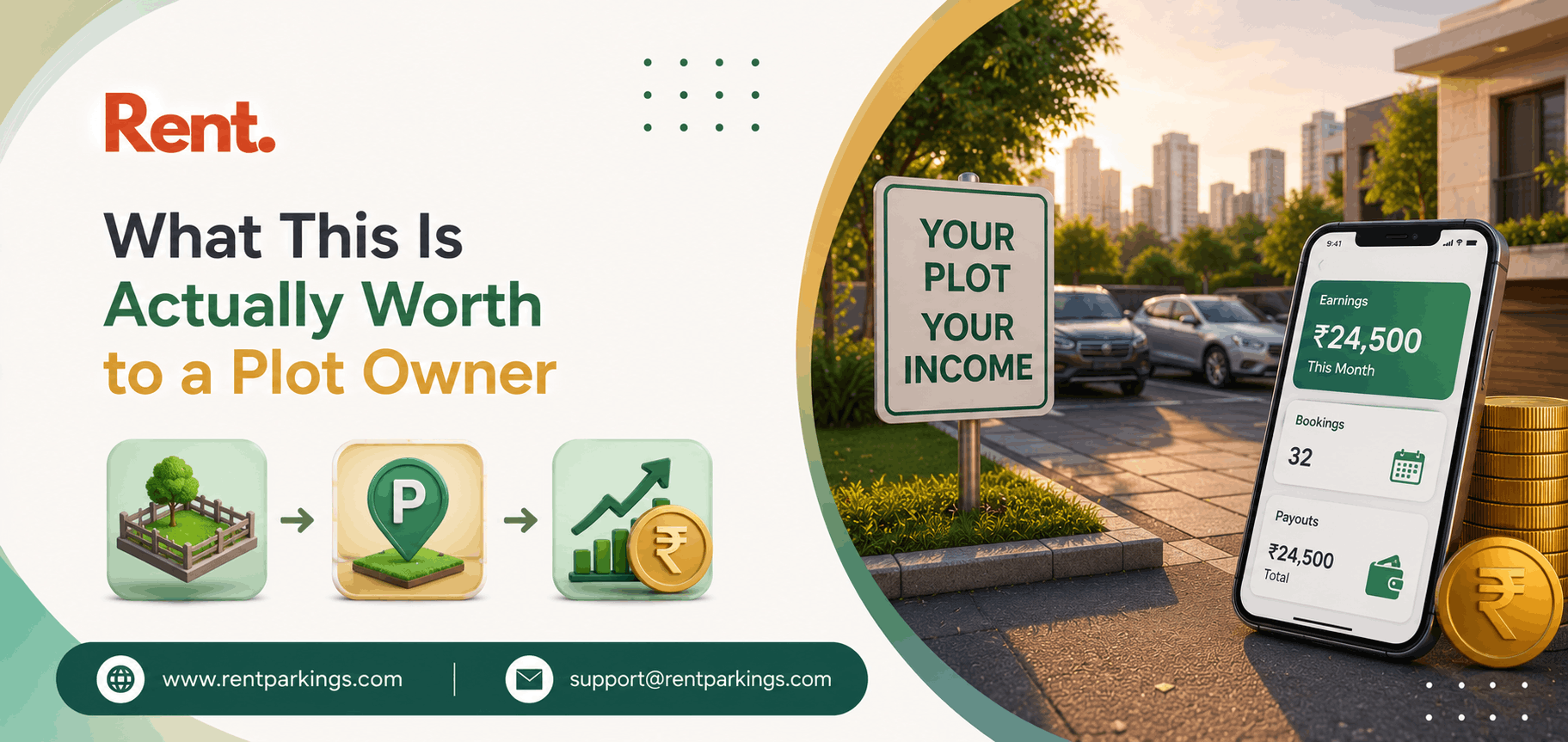
Per-bay pricing on a bulk contract usually runs lower than what one driver would pay for a single day's parking, the company is buying certainty and volume, not a premium spot. But the math still tends to favour the owner overall, because every bay stays filled on every working day, with none of the dead Sundays or slow off-season weeks that hit an individually listed spot.
Rough figures owners have shared with us, for a covered or semi-covered bay within a five-minute walk of a business-park gate, look something like this:
- Bengaluru's Outer Ring Road and Whitefield stretch: roughly ₹3,000–₹4,500 a bay each month on a bulk deal
- Gurugram and Noida's tech sectors: around ₹2,800–₹4,000 a bay each month
- Hyderabad's Gachibowli-HITEC City belt: closer to ₹2,200–₹3,200 a bay each month
- Pune's Hinjawadi-Kharadi corridor: typically ₹2,000–₹3,000 a bay each month
- Chennai's OMR-Ambattur stretch: around ₹1,800–₹2,800 a bay each month
Even at the modest end of those numbers, a plot that fits two dozen-odd cars in a Tier-2 tech corridor can out-earn comparable residential rent in the same neighbourhood, from one tenant, one monthly invoice, without the back-and-forth that comes from managing a dozen separate daily renters.
The Fine Print Owners Learn to Ask For
Owners who've been through this more than once don't sign without a handful of specific protections built in:
- A guaranteed minimum occupancy clause, so payment doesn't shrink just because fewer employees show up on a slow week.
- Plain liability language spelling out who's responsible if a car is damaged or something goes wrong on the property.
- Clear access-hour boundaries, particularly if the land does double duty for something else outside office hours, the same logic behind why a plot near a temple earns very differently depending on the festival calendar applies just as much to a corporate lease running alongside a weekend function hall.
- A defined notice period for renewal or exit, typically two to three months, so nobody's caught off guard.
- A clear answer to who issues access tags or stickers, and who's on the hook if an unauthorised vehicle slips through.
Bigger corporate tenants are increasingly asking for CCTV and a boom barrier as table stakes before they'll even discuss a rate, worth budgeting for before you quote a number.
Check Your Own Ownership Before You Pitch Anyone
Before knocking on a facility manager's door, make sure you actually hold the right to lease that space in the first place, this trips up apartment-adjacent owners more often than you'd expect. As covered in our explainer on who really controls apartment parking in India, stilt, covered, and open bays inside housing societies follow different ownership rules depending on the state and how the society is registered. Signing a corporate lease on a bay you don't fully control is a fight waiting to happen, usually right around renewal time.
Where This Is Already Happening
The pattern shows up wherever three things line up at once: a packed office corridor, parking that's genuinely scarce, and enough land nearby still in private hands rather than already built over. Right now that's Bengaluru's Outer Ring Road, Gurugram's Golf Course Extension Road, the Gachibowli-Financial District stretch in Hyderabad, and increasingly Pune's newer Hinjawadi phases, where towers are filling up faster than parking around them is catching up. Coimbatore and Kochi's smaller IT belts are starting to see early versions too, usually pushed by one large anchor tenant rather than a whole park at once.
Ten Questions Owners Keep Asking About This
Does leasing to a company work differently, legally, than renting to one person?
Not in principle. Both are a licence to use space and both deserve a proper written agreement. What changes is scale, and the fact that you're now dealing with a registered entity rather than an individual, which usually makes payment and enforcement simpler rather than harder.
Do I need to set up a business entity to sign a lease like this?
Most individual owners don't, plain rental income covers it. GST registration only becomes relevant once your total taxable turnover crosses the prescribed threshold, so it's worth a five-minute call with a CA once you're juggling more than one corporate tenant.
What if the company suddenly needs fewer bays than the contract says?
That's precisely why a guaranteed-minimum clause matters, without one, you're exposed to swings in demand that have nothing to do with how much space you actually set aside.
Can a housing society lease its spare parking to a company nearby?
Only where the society's bye-laws and the relevant state's cooperative housing rules allow third-party commercial use of shared parking, and typically only after the managing committee or general body passes a formal resolution. Rules differ enough by state that it's worth confirming locally first.
How long do these leases usually run?
Most sit between 11 months and three years, mainly to stay inside standard documentation norms. Longer terms tend to follow once both sides have a track record together, starting shorter with a renewal option is the lower-risk way in.
What paperwork should I have ready before signing?
Proof you actually control the space, a written contract covering rent, notice period, liability, and access hours, and ideally a short handover note describing the plot's condition before the company's cars start using it.
Do I owe GST on income from a corporate parking lease?
It depends on your total taxable turnover across everything you earn, not this lease alone. Cross the registration threshold and parking income is generally treated as a taxable supply, worth confirming your exact position with a CA rather than guessing.
What happens if the company vacates the office early?
A solid contract spells out an early-exit notice period and, ideally, some kind of shortfall compensation, so a sudden relocation doesn't leave you with zero notice and zero income overnight.
Is CCTV and a boom barrier really necessary before I approach anyone?
It's becoming close to standard. Bigger corporate tenants increasingly expect basic access control and camera coverage as a baseline, and having it ready before you pitch tends to speed up negotiations and support a stronger rate.
Can the same plot be leased to more than one company at once?
Yes, provided the bay counts and access windows are separately documented for each tenant. It's fairly common near mixed-use corridors, splitting a bigger plot across two or three smaller corporate contracts instead of one.
What This Means If You Own Land Near a Business Corridor
Business parks in India aren't shrinking, and pouring more concrete isn't a quick fix for most of them. That leaves a real opening for anyone holding land, a plot, or an underused compound near an office corridor, not a one-off booking, but an arrangement that can run for years once it's set up properly.
If that describes what you own, the practical next step is listing it somewhere companies and verified drivers are actually searching, deciding your own rate, and picking whether daily, monthly, or a longer corporate arrangement suits you best. Publish your parking space on RentParkings and put that unused ground to work as steady monthly income instead of dead space.
Share This post
Search
Recent Post
Parking Space vs. Renting Out a Room to...
05 Oct, 2026
Think Parking Rental Only Pays in Mumbai...
02 Oct, 2026
Your Mumbai Parking Space Is Worth More...
01 Oct, 2026
Hyderabad's Real Estate Boom Left One As...
30 Sep, 2026
What Your Parking Space in Chennai Could...
29 Sep, 2026
Your Plans Changed After Listing Your Pa...
28 Sep, 2026
Parking Space vs SIP: Which Idle Asset A...
25 Sep, 2026
What Your Parking Space in Pune Could Ac...
24 Sep, 2026