

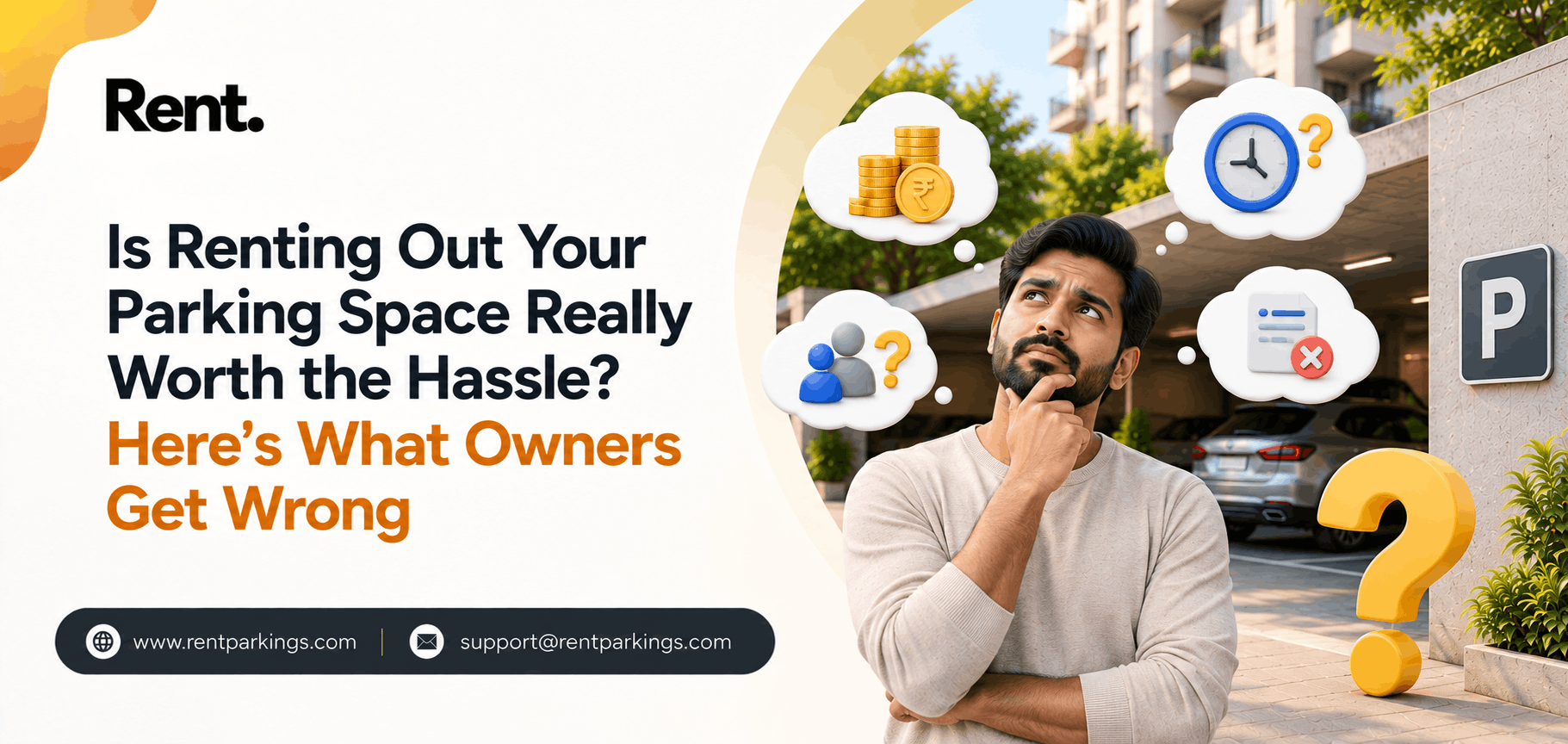
Is Renting Out Your Parking Space Really Worth the Hassle? Here's What Owners Get Wrong
Rekha runs a small tailoring shop in a Coimbatore market lane. Behind her shop sits a strip of forecourt space, just wide enough for two cars, that she has used exactly never in eleven years of business. A neighbour once suggested she rent it out. Her answer, without missing a beat, was "and then what, I chase people for money every evening? I don't have time for that."
That single sentence, in one form or another, is probably the biggest reason unused parking space in Indian cities stays unused. Not the fear of damage. Not confusion about pricing. Just a vague, unexamined belief that renting out a spot means signing up for a second job.
It's worth actually testing that belief against what listing a parking space involves in 2026, because for most owners it turns out to be one of the lowest-effort ways to earn money from something they already own. RentParkings, India's parking marketplace, exists precisely because that gap between perceived hassle and actual hassle is so wide, and closing it is often the only thing standing between an empty spot and a monthly income.
The Excuse That Keeps Thousands of Parking Spaces Empty
Ask ten property owners in Chennai, Pune, or Lucknow why they haven't rented out a spare parking spot, and at least six will give some version of the hassle argument. It's rarely about the money being too small. It's about the imagined admin: negotiating with strangers, collecting cash, worrying about who has the keys, fielding calls at odd hours.
Most of that imagined workload comes from comparing parking rental to something else entirely, usually a residential tenancy. Renting out a flat does involve deposits, maintenance calls, and long negotiations. Renting out a parking space does not carry any of that baggage, and conflating the two is where the hassle myth starts.
The Job Owners Picture in Their Head
In most owners' minds, listing a parking space looks like this: post an ad somewhere, take twenty phone calls from confused strangers, negotiate a price from scratch each time, collect cash by hand every single day, and hope nobody argues about a scratch on their bumper. None of that description matches how a listing marketplace actually functions today, and that mismatch is the entire reason the myth survives.
Where the Real Time Goes (And Why It's Less Than You Think)
Strip away the imagined version and look at what listing a space on a platform actually asks of an owner. Creating a listing takes roughly the same time as posting a property photo on any classifieds app: a few pictures, the size and access details, and the hours you're willing to rent it out. That's the entire upfront commitment.
After that, the ongoing work is closer to occasional than daily. A renter finds the listing, sends a request, you approve or decline it, and the booking is confirmed. There's no daily haggling because the price is already set by you when you create the listing. There's no cash collection because payments move through the platform. Verification of who's actually parking has moved from "trust a stranger's word" to structured identity checks, which is part of why newer parking technology built around sensors and automated tracking has quietly taken over a job that used to fall entirely on the owner's shoulders.
Put differently: the two things owners fear most, unpredictable strangers and constant back-and-forth, are exactly the two things a structured listing system was built to remove.
Money vs Minutes: Doing the Actual Math
A parking spot in a mid-sized Indian city typically earns somewhere between ₹1,500 and ₹6,000 a month depending on the city, the location, and whether it's hourly, daily, or monthly rental. Owners in high-demand pockets near metro stations, IT corridors, or commercial districts often see figures well above that range.
Now weigh that against the actual time cost. Creating the listing: perhaps fifteen minutes, once. Approving a booking request: under a minute, whenever one arrives. Responding to an occasional message: a few minutes a week at most. There is no scenario in that math where the hourly return isn't excellent, because there simply aren't enough hours being spent for the comparison to even be close.
The owners who assume otherwise are usually running the comparison against a tenancy, a shop, or a side business, none of which resemble what a parking listing actually demands.
Three Owners Who Tested the Myth Themselves
Consider a few realistic composites drawn from the kind of situations we hear about regularly from Indian hosts.
A homeowner in Ahmedabad had a covered basement slot that sat empty because his own car had been sold two years earlier. He assumed managing a renter would eat into his weekends. In practice, once the listing went up, most bookings came in as monthly arrangements with the same renter, meaning there was almost nothing to manage after the first month. Owners in a similar spot with garages and basements often describe the exact same pattern: heavy on the setup, nearly silent afterward, which is a big part of why unused garage and basement space has become such a steady earner for people who assumed it would be a headache.
A retired schoolteacher in Coimbatore owned a small vacant plot she'd been meaning to sell for years. Rather than let it sit fenced off and idle while she waited for the right buyer, she listed part of it as open parking. The land didn't stop being an asset she could sell later; it simply stopped being dead weight in the meantime, which lines up with how owners of idle land have found ways to make that land pay for itself without touching their long-term plans for the property.
A Bengaluru apartment owner with a stilt parking slot he wasn't using worried most about the mechanics: how do you even set this up without a broker or a middleman calling the shots? The actual process turned out to be closer to filling out a short form than negotiating a contract, which tracks with how the listing process has been simplified for first-time hosts who have never rented anything out before.
What You're Actually Signing Up For
Strip the myth away and here's what listing a parking space in India genuinely requires from an owner:
- A one-time listing setup with basic photos and access details, taking well under half an hour for most spaces.
- The freedom to set your own price and rental terms, whether that's an hourly rate for daytime commuters or a fixed monthly rate for a long-term renter.
- Occasional approval of booking requests, which can be done from a phone in seconds.
- Payments that arrive through the platform via UPI or net banking, removing the awkwardness of asking someone for cash in person.
- The option to pause or remove the listing whenever you need the space back for your own vehicle or a family member's.
That's a materially different picture from the version most owners have in their head before they ever try it, and the free part matters more than it sounds: there is no fee to create a listing on RentParkings, so testing the idea costs an owner nothing but a few minutes.
When the Hassle Excuse Actually Has a Point
To be fair to the skeptics, there are situations where renting out a space does take more attention than usual. A spot with awkward, shared access that requires coordinating with neighbours will always need a bit more communication. A space rented out hourly to a rotating set of different people will naturally need more approvals than one rented monthly to a single tenant.
Even then, the fix is usually to adjust your own terms rather than avoid listing altogether. An owner who doesn't want frequent turnover can simply set the listing to monthly only. Someone worried about needing the space back on short notice can build that flexibility into the terms from day one, which is exactly the kind of control covered in our guide on what happens when you need your parking space back after renting it out. The owner decides the rules going in, not the renter, and not the platform.
Frequently Asked Questions
1. Does listing a parking space on RentParkings cost anything?
No. Creating a listing is completely free, with no signup fee, no listing fee, and no hidden charge for putting your space up. You only ever deal with money when a renter actually books your space and pays you.
2. How much time does managing a listing actually take each week?
For most owners it's a matter of minutes, not hours. Once a listing is live, the main task is approving booking requests as they come in, which takes seconds on a phone. There's no daily negotiation or manual cash collection involved.
3. Can I set my own price instead of using a fixed platform rate?
Yes, entirely. You decide whether to charge hourly, daily, or monthly, and you set the actual rupee figure based on your area and your comfort level. Nobody assigns a price to your space on your behalf.
4. What if I need my parking space back suddenly, say for a visiting relative?
You stay in control of your own availability calendar, so you can block out dates or pause the listing whenever you need the space for yourself. Existing bookings are handled through clear terms set at the time of listing, so there's no ambiguity about notice periods.
5. Is it really passive income, or does it need constant attention?
For the large majority of hosts, it functions as passive income once the listing is set up. The bulk of the effort happens upfront, in creating the listing itself, and the ongoing involvement afterward is occasional rather than daily.
6. I only have space for a two-wheeler, not a car. Is that even worth listing?
Absolutely. Two-wheeler and even EV-specific parking spots are in steady demand in Indian cities, particularly near offices, colleges, and transit hubs, and they list on the platform exactly like car spaces do.
7. What happens if a renter overstays or doesn't show up?
Booking terms and duration are agreed upfront, so both sides know what's expected. Because bookings and communication happen through the platform rather than informally, there's a clear record to refer back to if something doesn't go as planned.
8. Do I need to verify who's actually parking in my space?
The platform's structured booking and identity process reduces a lot of the guesswork that used to fall entirely on the owner. You're no longer relying purely on a stranger's word the way informal, word-of-mouth arrangements often did in the past.
9. My society has rules about outsiders. Won't that create a problem?
This depends on your specific society's bylaws, and it's worth checking those before listing space inside a gated complex. Many owners find their society is more flexible than assumed, especially for pre-verified renters rather than random walk-ins.
10. How is this different from just putting up a "Parking Available" sign outside my gate?
A sign attracts whoever happens to walk past, with no verification, no set terms, and no record of the arrangement. Listing on a marketplace puts your space in front of people actively searching for parking in your exact area, with agreed terms and payment handled through the platform instead of an in-person cash exchange.
The Real Cost of Believing the Myth
Every month that a parking space sits empty because an owner assumes renting it out is more trouble than it's worth is a month of income that simply evaporates. Rekha's forecourt in Coimbatore is still empty as of this writing. Somewhere close to her, another shop owner with an identical strip of space has been renting it out for eight months and treats the extra money as background income he barely thinks about.
The difference between those two outcomes was never about the space, the location, or the demand. It was about one person testing whether the hassle was real and the other person deciding not to bother finding out. If you've got a driveway, a basement slot, a stilt parking bay, or a stretch of forecourt that hasn't seen a paying vehicle in months, the fastest way to settle the question for yourself is to try it. List your parking space for free on RentParkings and see within the first few weeks whether the effort matches the excuse, or whether, like most owners who actually test it, you find out the excuse was doing more work than the listing ever will.
Share This post
Search
Recent Post
Parking Space vs. Renting Out a Room to...
05 Oct, 2026
Think Parking Rental Only Pays in Mumbai...
02 Oct, 2026
Your Mumbai Parking Space Is Worth More...
01 Oct, 2026
Hyderabad's Real Estate Boom Left One As...
30 Sep, 2026
What Your Parking Space in Chennai Could...
29 Sep, 2026
Your Plans Changed After Listing Your Pa...
28 Sep, 2026
Parking Space vs SIP: Which Idle Asset A...
25 Sep, 2026
What Your Parking Space in Pune Could Ac...
24 Sep, 2026