

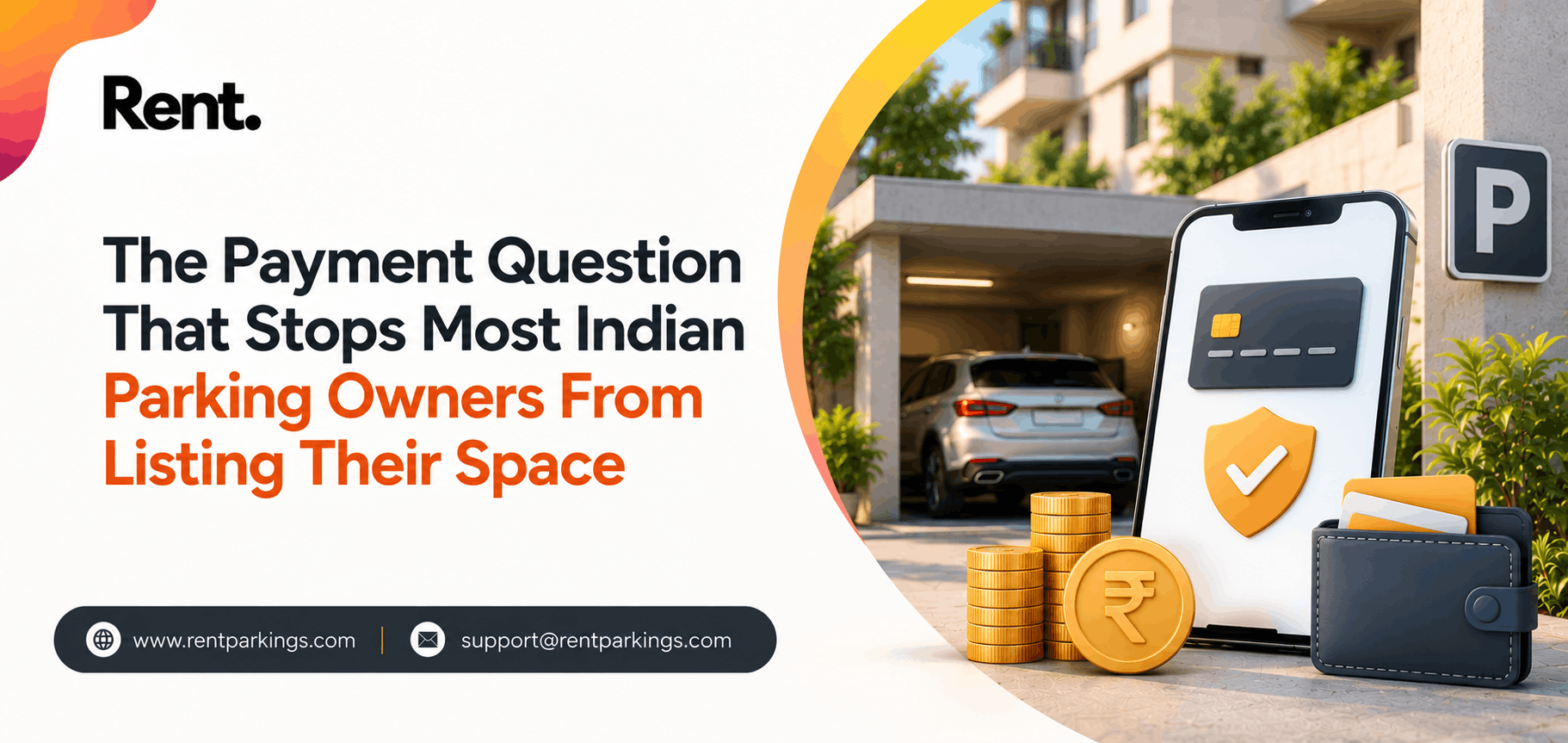
The Payment Question That Stops Most Indian Parking Owners From Listing Their Space
A shopkeeper in Coimbatore once told a RentParkings team member something that stuck: he wasn't worried about strangers parking in his forecourt. He was worried about chasing them for money afterward. That one sentence explains why thousands of empty driveways, basements and vacant plots across India sit unused every single day. Owners aren't unwilling to earn from the space. They just can't picture the money part clearly enough to say yes.
If you own unused parking and you've stalled at the same question, this is for you. Not the theory of "parking rental is a great side income," which you've probably already heard. The actual mechanics: who sets the price, how the rupees move from a renter's phone to your bank account, and what happens on the days something doesn't go as planned.
Why the money question feels bigger than it is
Most first-time hosts have never rented anything to a stranger before. Renting out a spare room or a flat comes with decades of familiar patterns: a broker, a deposit, a rent agreement. Parking has none of that cultural shorthand yet, so owners fill the gap with worst-case imagination.
Will the renter pay in cash and vanish without a receipt? Or will a two-hour booking quietly turn into a four-hour one with no extra charge collected? Owners picture a dozen small headaches like these before they've even listed their space, and most of them turn out to be far simpler than expected once the actual system is laid out.
You decide the price, not a platform algorithm
On RentParkings, India's own parking marketplace, the owner sets the rent. Not RentParkings, not a bidding system, not some formula pulled from an app. You look at your locality, your competition, and what you think a fair price is, and you set it.
Pricing is usually simpler than owners expect once they see what similar spots nearby are charging. A resource like Parking Rental Rates Across India: A City-by-City Guide is worth a look before you fix your first number, mainly so you're not guessing blind. Most owners land somewhere between a modest hourly rate for short-stay parking and a flat monthly figure for someone who wants the spot every working day.
- Hourly rate, useful for spots near hospitals, coaching centres, courts or markets where people need a spot for a few hours.
- Daily rate, common for locations near railway stations, airports or event venues.
- Monthly rate, the most predictable option, popular with commuters who need the same spot every weekday.
You can run all three at once if your space suits it, or stick to just one. Nobody at RentParkings tells you which. And if a rate isn't working after a few weeks, you can revise it. Nothing is locked in.
How the payment itself actually reaches you
This is usually the part owners assume will be complicated. It isn't. Bookings and payments on RentParkings move through UPI and Net Banking, the same rails most Indians already use for every other daily transaction, from splitting a restaurant bill to paying an electrician.
A renter books your slot, pays for it digitally before or at the point of use, and the amount is tracked against your listing. There's no cash handover standing in your doorway, no counting notes, no "I'll pay you next week" conversation. The transaction record also gives you something a handshake never did: a timestamped digital trail of exactly who parked, when, and what they paid.
Owners who compare this to older, informal arrangements, the kind where a neighbour's driver used your space for a "small monthly amount" nobody ever wrote down, tend to notice the difference fast. Digital payments don't just move money. They remove the awkward job of asking for it.
What happens when something goes off-script
No system is perfect, and pretending otherwise would be dishonest. A renter might occasionally run late with a booking, or a payment might need a follow-up. RentParkings' verification steps mean you're not renting to a completely unknown vehicle and unknown driver, which already removes a large share of the risk owners worry about most.
The bigger point is that these situations are the exception, not the pattern. Most bookings complete exactly as expected, hourly slots end on time, monthly renters pay monthly, and the digital record means there's rarely any ambiguity about who owes what. Owners who've been renting for a few months usually say the payment side stopped feeling like a concern within the first couple of weeks.
The free-listing part, said plainly
Here's the detail that surprises new hosts the most: listing your parking space on RentParkings costs nothing. Not a signup fee, not a percentage skimmed off your first month, not a "premium visibility" charge hiding in the fine print. You list a driveway, a basement bay, a vacant plot or a covered stilt spot, and it's free from the first day to the last.
Compare that to what happens when property owners look at other passive-income options. In our piece on Parking Space vs Fixed Deposit: The Idle Asset You Keep Forgetting, we walked through how a fixed deposit locks up capital and returns a modest, taxed interest rate over years. A parking spot needs no deposit at all. It's an asset you already own, sitting there today, earning nothing.
What realistic monthly numbers actually look like
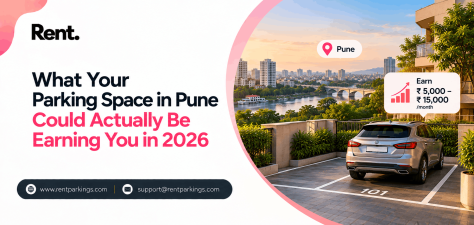
Every city is different, and nobody serious should promise you a fixed number without knowing your locality. But a covered spot in a busy residential pocket of Bengaluru, Pune or Gurugram renting monthly to a commuter can often bring in a few thousand rupees a month, sometimes touching five figures in high-demand micro-markets near IT corridors or metro corridors.
Hourly and daily rentals near courts, hospitals, coaching hubs or wedding venues in cities like Jaipur, Lucknow or Madurai can add up differently, smaller amounts per booking, but stacked across a busy week. The honest way to think about it: this is not a business that replaces your salary. It's money your space was never going to earn any other way, arriving with almost no effort on your part once the listing is live.
Owners who track their earnings sometimes find that parking rental quietly outperforms options they'd assumed were smarter. We covered that comparison directly in Why Renting Your Parking Space Beats Most Side Hustles, which looks at how little ongoing effort a listed spot actually demands once it's set up.
Myths that keep good spots sitting empty
A few beliefs come up again and again in conversations with hesitant owners, and most don't survive contact with how the system actually works.
- "Nobody will pay properly for a random spot." Renters using the platform are looking for exactly what you're offering. The booking and payment happen before or at check-in, so there's no ambiguity to argue about.
- "I'll need to chase people for money." Digital payment through UPI or Net Banking removes this almost entirely. You're not standing at your gate collecting cash.
- "It's too much admin for the money involved." Setting a monthly rate for a commuter spot, for instance, takes minutes and then largely runs itself. A budget-friendly monthly listing described in Budget-Friendly Monthly Parking shows how straightforward a recurring monthly rental can be once it's set up correctly.
- "My space is too small or oddly shaped to be worth listing." Two-wheeler bays, EV-ready spots and even small event-day spaces have real demand. We explored some of that range in Beyond Car Parking: How Bike, EV and Event Spaces Earn, which is worth a look if your space isn't a standard four-wheeler bay.
Frequently Asked Questions
1. Is listing my parking space on RentParkings actually free?
Yes, completely, and it stays that way whether your spot gets booked in the first week or takes a month to find its first renter. You can list a driveway, basement, plot or covered bay without paying anything upfront or handing over a cut of what you earn later.
2. Who decides how much I charge for my parking space?
You do, entirely. RentParkings doesn't set prices or push you toward a particular rate. Most owners check what similar spots in their area are charging, then set an hourly, daily or monthly rate that feels fair to them.
3. How does the payment actually reach my bank account?
Renters pay through UPI or Net Banking when they book your spot, so the money moves digitally rather than as cash handed over in person. There's a clear record of every transaction, which removes the guesswork around who paid and when.
4. What if a renter is late with payment or overstays their booking?
These situations are uncommon, and the digital booking trail makes them easy to sort out when they do happen. Because renters are verified before they can book, you're not dealing with a completely anonymous vehicle or driver.
5. Can I offer hourly, daily and monthly rentals from the same listing?
Yes. Many owners run all three simultaneously if their location supports it, an hourly rate for short visits, a daily rate for travellers or event-goers, and a monthly rate for regular commuters. You can also stick to just one format if that suits your space better.
6. Do I need a lawyer or a written contract to rent out my parking space?
No formal legal paperwork is required to get started. The booking itself, along with the digital payment record, functions as your proof of the arrangement for each rental period.
7. What if I set a price and later realise it's too low or too high?
You can revise your listed rate whenever you want. Nothing about your original price is locked in, so it's common for owners to adjust once they see how quickly (or slowly) their spot gets booked.
8. Does RentParkings take a commission or cut from what I earn?
No. Listing and using RentParkings to rent out your space is free for property owners, and there's no commission quietly deducted from your payouts. What you set as your rate is what you're working toward earning.
9. How is my bank and personal information kept safe when I get paid?
Payments move through standard UPI and Net Banking channels rather than being handled as informal cash transfers, which keeps the process transparent and trackable for both sides of the booking.
10. Can I pause or stop my listing if my plans change?
Yes. If you need the space back for your own vehicle, or you simply want a break from renting it out, you're free to pause or edit your listing whenever it suits you. Nothing about listing your space commits you to renting it out forever.
The space is already yours. The income just needs a system.
None of this requires you to become a landlord in any formal sense, or to learn a new skill, or to take on risk you can't picture clearly. It requires an empty driveway, basement, plot or covered bay you already own, and a system that handles pricing flexibility and payment collection so you don't have to think about either one very often.
The shopkeeper in Coimbatore eventually listed his forecourt. What changed his mind wasn't a sales pitch. It was seeing, in plain terms, that the money question he'd been avoiding had a straightforward answer all along. If your space has been sitting idle for the same reason, list your parking space for free on RentParkings and let it start earning on your terms, at your price, whenever you're ready.
Share This post
Search
Recent Post
Parking Space vs. Renting Out a Room to...
05 Oct, 2026
Think Parking Rental Only Pays in Mumbai...
02 Oct, 2026
Your Mumbai Parking Space Is Worth More...
01 Oct, 2026
Hyderabad's Real Estate Boom Left One As...
30 Sep, 2026
What Your Parking Space in Chennai Could...
29 Sep, 2026
Your Plans Changed After Listing Your Pa...
28 Sep, 2026
Parking Space vs SIP: Which Idle Asset A...
25 Sep, 2026
What Your Parking Space in Pune Could Ac...
24 Sep, 2026