

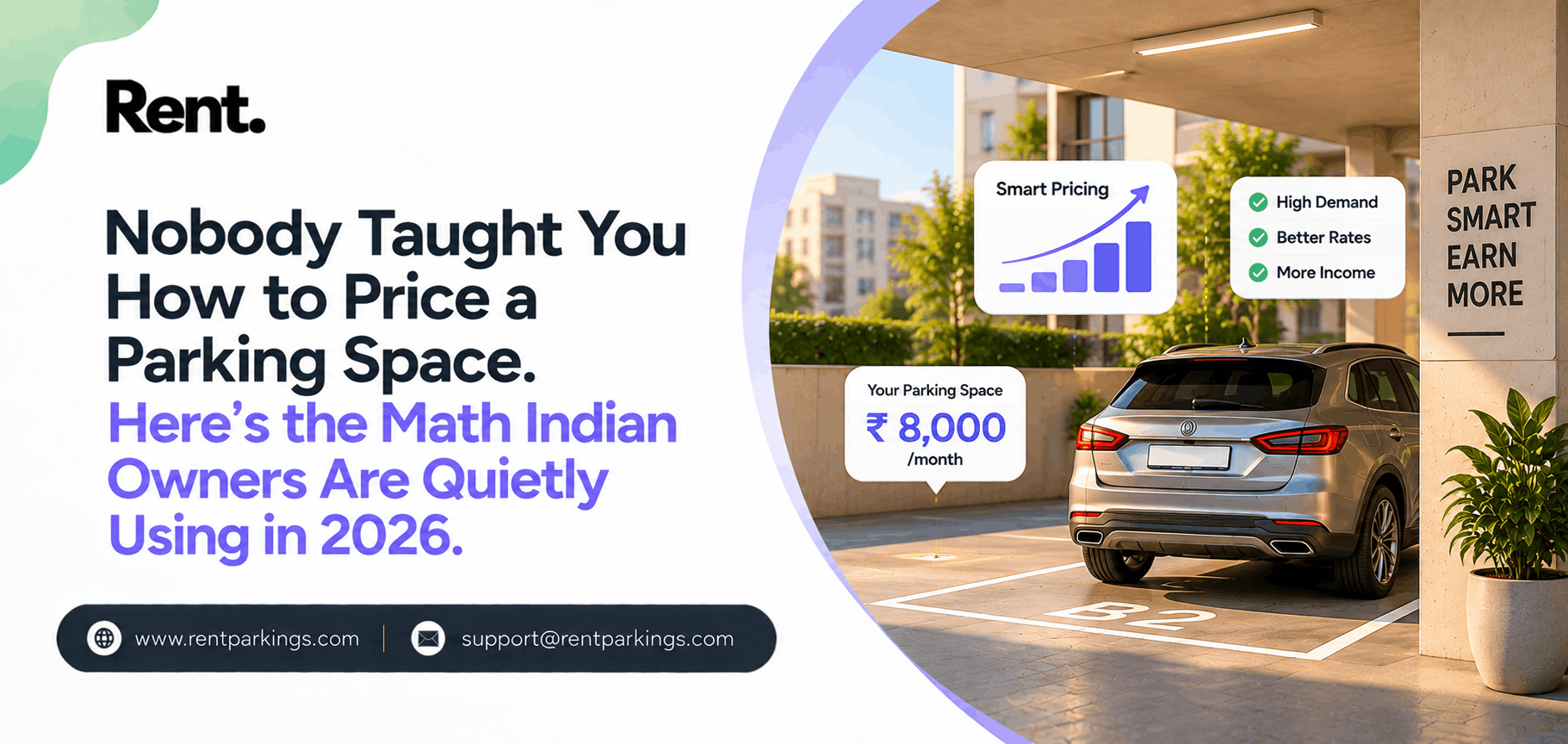
Nobody Taught You How to Price a Parking Space. Here's the Math Indian Owners Are Quietly Using in 2026
Ask ten parking space owners in India what they charge, and nine of them will give you the same kind of answer: whatever a relative guessed, whatever the last person paid two years ago, or a flat number picked because it sounded reasonable at the time.
Almost none of them arrived at that number by actually looking at what their space is worth. And that gap, more than location or luck, is usually why one owner's parking spot earns comfortably while an identical one two streets away sits empty half the month.
Pricing is the one part of renting out a parking space that owners tend to treat as an afterthought. It shouldn't be. Get it right and a spare patch of concrete turns into dependable monthly income. Get it wrong and you either scare away bookings or leave money sitting on the table every single month.
This guide walks through how owners across Indian cities are actually setting their rates in 2026, what changes the number up or down, and how to land on a price that fills your space without underselling it. If you haven't listed yet, doing it costs nothing on RentParkings, India's parking marketplace, and you decide the price from day one, not the platform.
Why Guessing Is the Default, and Why It's Costing You
Most first-time hosts price out of nervousness rather than strategy. They worry that charging too much means no bookings, so they go low. Or they hear about a neighbour's flat monthly rate and copy it without checking whether their own space actually compares.
The problem is that parking demand in India isn't uniform even within the same colony. A covered spot fifty metres from a metro exit is worth more than an open one behind three other cars. A slot near a hospital or a coaching hub can carry a premium that a similar spot in a quiet residential lane never will.
Owners who treat pricing as a one-time decision, set once and never revisited, tend to plateau. The ones earning more tend to check in on their rate every few months and adjust based on how quickly bookings come in, not on guesswork.
What Actually Moves the Number
Location and local demand
This is the biggest factor by a wide margin. A spot near a business district, a railway station, a hospital, or a cluster of offices will command more than the same size spot in a low-footfall residential pocket, even within the same city.
Demand can shift block by block. When Bengaluru's tech parks ran out of internal parking, companies started paying nearby property owners directly to lease land for employee vehicles, sometimes at rates the owners hadn't imagined their idle plot could fetch. That kind of demand pressure exists in pockets around most major Indian cities, not just Bengaluru, and it's worth checking what's nearby before settling on a number.
Type and condition of the space
A covered or stilt parking slot generally earns more than an open one, since it protects the vehicle from sun and rain. A basement or gated space with restricted entry can justify a further premium because it reads as safer. A rough, uneven, or hard-to-access spot, on the other hand, usually needs a lower price to attract bookings at all.
Duration: hourly, daily, or monthly
Hourly and daily rates are almost always higher per hour than a monthly rate, because you're trading convenience for a shorter, less certain commitment. Monthly renters pay less per day but give you steady, predictable income and far less turnover to manage.
Many owners on RentParkings run both models side by side: a monthly rate for a regular commuter, and a higher hourly or daily rate for occasional visitors, event traffic, or short-term parkers. There's no rule that says you have to pick one.
Extras that add value
On-site security, CCTV coverage, a nearby EV charging point, or even an entry wide enough to make parking effortless can each justify a higher price. None of these are mandatory, but each one gives you a legitimate reason to charge more than a bare, unmonitored spot down the road.
Realistic Rate Ranges Owners Are Setting in 2026
These are broad, indicative ranges based on what hosts have reported across different city tiers, not fixed numbers. Your actual rate should still reflect your specific location and space type. For a fuller, city-wise breakdown, RentParkings has covered what owners across major Indian cities are currently earning in more detail.
- Metro cities (Mumbai, Delhi NCR, Bengaluru, Hyderabad, Chennai): monthly rates for a covered slot in a high-demand pocket often land somewhere in the ₹2,500 to ₹6,000 range, with premium commercial-area spots going higher. Hourly rates near business districts can run ₹20 to ₹50 an hour.
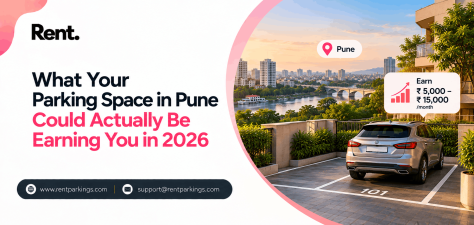
- Tier-2 hubs (Pune, Ahmedabad, Kochi, Coimbatore, Jaipur, Lucknow): monthly rates typically sit lower, often ₹1,200 to ₹3,000 for a decent covered spot, with hourly rates around ₹10 to ₹30 depending on the locality.
- High-footfall pockets regardless of city: spots near railway stations, hospitals, exam centres, or wedding venues can temporarily command a noticeable premium during peak windows, sometimes double the area's usual rate.
Treat these as a starting point for comparison, not a script. The only way to know your real number is to list, watch how quickly enquiries come in, and adjust from there.
Hourly, Daily, or Monthly: How to Decide
If your area has steady office-goers, students, or residents looking for a regular spot, monthly pricing usually wins on reliability. You get one booking that runs for weeks instead of chasing a new renter every few days.
If you're near a market, a hospital, a court, a wedding hall, or anywhere with unpredictable footfall, hourly or daily pricing tends to earn more per square foot of space, simply because short-term demand is willing to pay a premium for convenience.
A number of owners split their week: monthly bookings on weekdays when a commuter needs the spot, and hourly or daily bookings on weekends when footfall in the area picks up for other reasons. It takes a little more attention, but it can noticeably lift what an otherwise idle weekend spot brings in.
Testing and Adjusting Your Price Without Scaring Off Bookings
Set an initial rate based on what similar spots nearby are charging, then watch what happens over the first two to three weeks. If enquiries come in fast and bookings fill up easily, you likely priced conservatively and have room to raise it slightly.
If your listing sits with no bookings for weeks while similar spots nearby are filling up, that's usually a signal to bring the price down rather than wait it out. A parking space earning something modest every month beats one sitting empty at a number nobody's willing to pay.
Small, gradual adjustments work better than dramatic swings. Moving your rate by ten or fifteen percent and giving it another two weeks tells you more than jumping the price up or down all at once.
What About Taxes on This Income?
Parking rental income is still income, and it's worth understanding how it's treated before you get too far into spending it. RentParkings has put together a plain-language breakdown of how parking rental income is taxed in India, including when GST considerations come into play.
Knowing this upfront helps you price with your actual take-home in mind, rather than being surprised later by how much of your monthly earnings need to be accounted for.
Pricing Mistakes That Quietly Cost Owners Money
The most common one is copying a neighbour's rate without checking whether the comparison actually holds. A covered basement spot and an open driveway three doors down are not the same asset, even if they look similar on a map.
The second is setting a price once and never touching it again, even as demand in the area shifts with a new office opening nearby or a metro line extending closer. Rates that made sense a year ago can be badly out of date today.
The third is undervaluing convenience. Owners often forget that saving someone a twenty-minute daily search for parking, or the stress of circling a crowded street, has real value to a renter, and that value can be reflected in the price without feeling unreasonable.
Listing Is Free. The Price Is Entirely Yours to Set.
None of this pricing work matters if the space never gets listed in the first place, and that's usually where hesitation creeps back in. It shouldn't. Creating a listing on RentParkings costs nothing, there's no commission taken out of your pocket to publish it, and you're never locked into a number the platform hands you.
You choose whether it's hourly, daily, monthly, or all three. You can revise the rate whenever you want, pause the listing during a period you need the space back, or edit the details in a few minutes from your phone.
If you've never listed before, RentParkings has a straightforward first-timer's walkthrough on listing an empty parking space that covers exactly what the process looks like from start to finish. It's shorter than most owners expect.
Renting out a parking space this way is also one of the rare kinds of income that doesn't ask much of your time once it's set up. Compared to most side hustles Indian owners consider, there's no inventory, no delivery, no daily attention required. You list it, you set your price, and it earns quietly in the background.
Frequently Asked Questions
Is there a fixed rate I should charge for parking in India?
No. There's no government-set or platform-set rate for private parking rentals. Pricing depends on your location, the type of space, and local demand, which is why owners in the same city can charge very different amounts for similar spots.
Does RentParkings decide how much I can charge?
No. RentParkings never sets or caps your price. You choose the hourly, daily, or monthly rate yourself when you create the listing, and you can change it whenever you want.
Is listing my parking space on RentParkings really free?
Yes, creating and publishing a listing costs nothing. There's no upfront fee to put your space online, which is exactly why it's a low-risk way to test whether your space attracts demand.
Should I charge more for a covered parking spot?
Generally yes. Covered or stilt parking protects a vehicle from weather and tends to be seen as more secure, so owners typically price it noticeably higher than an equivalent open spot.
How do I know if my price is too high?
If your listing gets very few enquiries over two to three weeks while comparable spots nearby are getting booked, that's usually a sign to lower the rate slightly and see if interest picks up.
Can I charge different rates for hourly and monthly bookings on the same spot?
Yes, and many owners do exactly this. It's common to offer a lower per-day monthly rate for a regular renter and a higher hourly or daily rate for short-term or occasional parkers.
Will I have to pay tax on parking rental income?
Parking rental income is generally treated as taxable income in India, similar to other rental earnings. It's worth reading up on how it's classified so you can price with your actual take-home in mind.
What if I want to stop renting out my space for a while?
You're free to pause or take down your listing whenever you need the space back, whether that's temporary or permanent. Nothing locks you into renting it out continuously.
Do I need to offer amenities like security or CCTV to charge a good rate?
No, they're not required, but they help. A space with visible security features or a watchman on-site can usually justify a somewhat higher price than a similar space without them.
How often should I revisit my pricing?
Checking every few months is a reasonable habit, especially if something changes nearby, like a new office, a metro extension, or a shift in local demand. Rates that made sense a year ago may no longer reflect current interest.
Conclusion
Pricing a parking space isn't guesswork dressed up as a decision, and it isn't something you need a real estate background to get right. It comes down to knowing what your specific spot offers, checking what similar spaces nearby are charging, and being willing to adjust once you see how renters actually respond.
The space sitting unused outside your home, in your basement, or behind your shop isn't doing anything for you right now. Listing it costs nothing, the price is entirely yours to set, and the income, once it starts coming in, tends to keep coming in with very little ongoing effort. Start Earning from Your Parking Space on RentParkings and set your own rate today.
Share This post
Search
Recent Post
Parking Space vs. Renting Out a Room to...
05 Oct, 2026
Think Parking Rental Only Pays in Mumbai...
02 Oct, 2026
Your Mumbai Parking Space Is Worth More...
01 Oct, 2026
Hyderabad's Real Estate Boom Left One As...
30 Sep, 2026
What Your Parking Space in Chennai Could...
29 Sep, 2026
Your Plans Changed After Listing Your Pa...
28 Sep, 2026
Parking Space vs SIP: Which Idle Asset A...
25 Sep, 2026
What Your Parking Space in Pune Could Ac...
24 Sep, 2026