

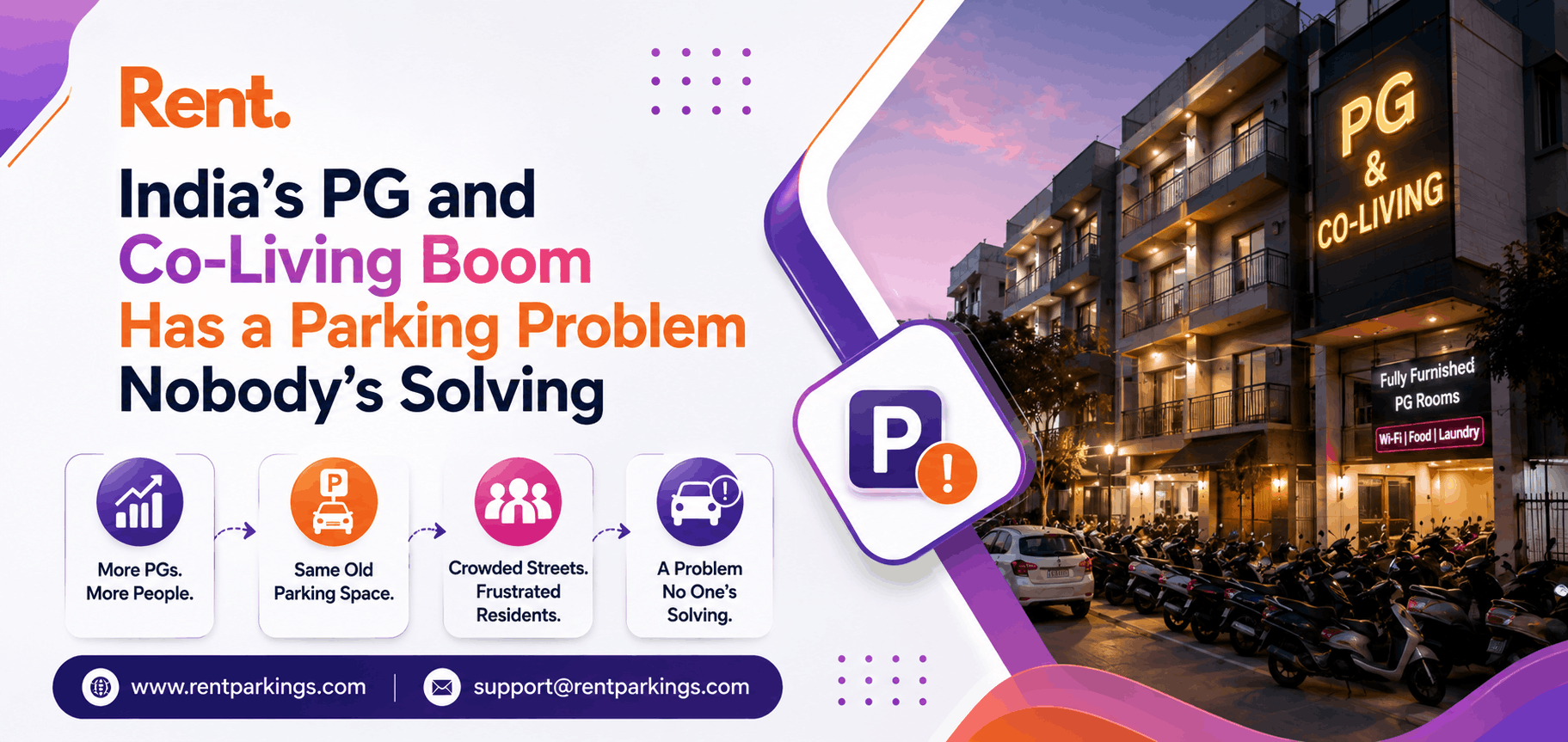
India's PG and Co-Living Boom Has a Parking Problem Nobody's Solving
It's a little past nine on a Tuesday night in HSR Layout, and Ananya has circled the same three streets four times looking for a place to leave her scooter. She works in customer operations, pays for a bed in a PG two lanes away, and has learned the hard way that if she gets home after eight, someone else has already taken the sliver of footpath outside her building's gate.
Multiply Ananya by a few million and you get a fair picture of what's happening outside paying-guest and co-living buildings across Bengaluru, Pune, Gurugram, Hyderabad, Noida and Chennai right now. The PG industry grew up assuming its tenants didn't own vehicles. That assumption quietly stopped being true, and nobody went back and fixed the buildings.
This is a story about that mismatch, and about the property owners near PG clusters who are starting to notice what an empty driveway is actually worth. RentParkings, India's parking marketplace, sits right at that intersection, and understanding the gap is the first step to closing it.
The Math Nobody Ran When PG Housing Took Off
PG operators built their business model around one variable: cost per bed. A converted independent house near a tech park could be split into eight or ten rooms, priced competitively, and rented out faster than a formal apartment complex could ever manage. Parking wasn't part of that spreadsheet because the original tenant, a recent graduate on their first salary, rarely had a vehicle to park.
That tenant has changed. Salary growth in tech, healthcare, BPO and logistics has put a two-wheeler within reach far earlier in someone's career than it used to be, often inside the first six to twelve months of a job. Layer on the number of ride-hailing and delivery drivers who now choose PG-style housing specifically because it's the cheapest way to stay close to demand zones, and the result is a PG population where owning a vehicle is closer to the default than the exception.
Two-wheelers make up the vast majority of the roughly 250 million-plus registered vehicles now on Indian roads, and that ratio shows up in sharp relief right outside PG gates. If you want a fuller picture of how badly Indian cities have under-planned for two-wheeler parking generally, it's worth reading our earlier piece on why India keeps designing parking for cars while most people ride scooters. PG clusters are simply where that mismatch shows up most densely, because you're stacking dozens of vehicle owners into a plot that was zoned for a single family home.
Three Vehicles, One Driveway That Wasn't Built for Any of Them
Even a PG operator who wants to fix this runs straight into geometry. The house was a residential plot before it was a PG, and most residential plots in these neighbourhoods were designed around one family car, not eight to ten working adults' worth of scooters, bikes and the occasional hatchback.
Gates get widened, sure, but the turning radius rarely gets fixed. A driveway that photographs as spacious can still be too tight for a car to back out of once two or three two-wheelers are lined up along the boundary wall. Anyone weighing whether their own gate, plot or basement can genuinely double as usable parking should measure it rather than eyeball it, and that's the exact gap our guide to standard parking dimensions in India was built to close.
The honest conclusion, in most cases, is that the PG building simply cannot absorb the demand it created. Whatever solution exists has to live somewhere nearby, not inside a footprint that was never designed to hold it.
What Tenants Are Quietly Paying to Solve This Themselves
Long before anyone formalises it, tenants and PG wardens work out their own patchwork fixes: a deal with a shopkeeper down the road, a corner of a neighbour's compound, a "arrangement" that can disappear the moment that neighbour decides to sell or renovate. Here's roughly what that patchwork costs across a few major PG corridors, based on figures reported by tenants and small property owners we've spoken with.
| City / Corridor | Two-Wheeler (monthly) | Car (monthly) |
|---|---|---|
| Bengaluru (HSR, Koramangala, Whitefield) | ₹600 – ₹1,200 | ₹2,500 – ₹5,000 |
| Pune (Hinjewadi, Wakad, Baner) | ₹500 – ₹1,000 | ₹2,000 – ₹4,000 |
| Gurugram (Sector 48, Golf Course Road Extn.) | ₹700 – ₹1,300 | ₹3,000 – ₹6,000 |
| Hyderabad (Gachibowli, Madhapur) | ₹500 – ₹1,000 | ₹2,500 – ₹4,500 |
| Noida (Sector 62, Sector 15) | ₹500 – ₹900 | ₹2,000 – ₹4,000 |
| Chennai (OMR, Sholinganallur) | ₹400 – ₹800 | ₹2,000 – ₹3,500 |
These are approximate, not fixed, and they move with how close a PG cluster sits to a tech park or metro line. What matters more than the exact number is where that money is going: almost entirely into cash-in-hand deals that vanish the day either side changes their mind, with nothing written down and nobody accountable if a bike goes missing.
Matching Nearby Owners to PG Demand, Not Building New Parking
The realistic fix was never going to be a PG operator carving a basement out of thin air. It's connecting the owners of unused plots, driveways and basements within a short walk of a PG cluster to the tenants circling the block every evening looking for exactly that space.
That connection already happens, informally, in almost every PG neighbourhood in the country. What's missing is anything that survives a bad month: a booking that doesn't depend on the shopkeeper's mood, a record of who's actually parking there, and a way to end the arrangement cleanly when a tenant's PG lease ends, which happens far more often than it does for a flat owner. A marketplace built for exactly this kind of short-notice, high-turnover matching is what closes that gap, which is the entire reason we built the flow for owners to list a parking space on RentParkings and start taking bookings within days.
There's also a cleaner version of this for PG operators specifically: instead of leaving tenants to negotiate one by one, an operator can lock in a block of slots with a nearby owner and fold the cost into what tenants already pay, the same way many PGs already bundle in food or WiFi.
The Same Pattern Is Repeating a Few Blocks Away, at Work
PG demand didn't grow in a vacuum. The same young professionals filling these buildings are also driving to coworking spaces a few kilometres away, because hybrid schedules and freelancing have made a shared desk more common than a fixed office seat. Those coworking buildings were retrofitted for desks, not vehicles, for exactly the same reason PGs were retrofitted for beds, not cars.
We mapped that overlap in detail in our piece on the parking gap inside India's coworking boom, and the underlying shape is nearly identical: fast tenant growth, a building that was never meant to hold this many vehicles, and an improvised fix nearby. If you own space near both a PG cluster and a coworking hub, you're sitting between two versions of the same unmet demand.
The EV Wrinkle Most PG Buildings Aren't Ready For
A growing slice of PG tenants, especially younger professionals in tech corridors, have switched to electric two-wheelers, partly because the running cost is lower and partly because charging has gotten noticeably easier to find. That turns "find a parking spot" into "find a parking spot with power," which very few PG buildings can offer.
Retrofitting a converted house with a dedicated charging point means electrical work most PG landlords simply haven't budgeted for. A nearby property owner who adds even one charging-enabled slot puts themselves ahead of almost everyone else competing for that tenant's business, and the practical steps for doing that, including society approvals where relevant, are covered in our guide to getting an EV charger installed at a residential spot.
What This Is Actually Worth If You Own Space Nearby
Owning a driveway, plot or basement within walking distance of a PG cluster puts you closer to guaranteed monthly demand than almost any other category of parking owner in the country, because PG tenants aren't occasional visitors, they live there. A few things matter more here than in a typical parking rental:
- Expect odd hours. A meaningful share of PG tenants work shifts or gig hours, so a spot that's only accessible 9-to-6 will lose out to one that isn't.
- Price it simply. Most tenants would rather pay one flat monthly amount than track hourly usage, so keep the billing as close to "set it and forget it" as you can.
- Basic lighting beats fancy security. A well-lit corner with a boundary wall reads as safe enough for a tenant to commit long-term, well before they'd ever ask about CCTV.
- Plan for faster turnover than you'd expect. PG tenants change PGs, change cities, and change jobs more often than flat owners move, so build that churn into how you think about the arrangement rather than treating it like a fixed yearly lease.
None of this needs construction or a big upfront outlay. It needs treating a patch of unused ground as an asset instead of dead space, and putting it in front of tenants who are already out there looking for it every single evening.
Frequently Asked Questions
1. Why didn't PG operators just plan for parking from the start?
Because the PG business model was built around cost-per-bed on a residential plot, and the original tenant base genuinely didn't own vehicles in large numbers. By the time ownership rates climbed, the building's footprint was already fixed, and retrofitting parking into a converted house is far harder than it sounds.
2. Is there anything different about renting my space to a PG tenant versus a regular commuter?
The main difference is turnover speed. PG tenants tend to move on faster than someone renting a flat, so it helps to keep the arrangement flexible on notice period rather than locking in a long fixed term the way you might for a permanent resident.
3. What should I actually charge for a two-wheeler slot near a PG cluster?
Owners near busy PG corridors typically land somewhere between ₹500 and ₹1,300 a month per two-wheeler, with the higher end closer to tech parks and metro corridors. Car slots run considerably higher, often ₹2,000 to ₹6,000 depending on the city.
4. Should I negotiate with the PG operator or with individual tenants directly?
Going through the operator usually means one predictable payment covering several slots at once, with less day-to-day coordination on your end. Dealing with tenants individually can pay slightly more per slot but means managing more relationships and more churn.
5. How do I protect myself if a tenant leaves a vehicle behind after moving out?
Set a clear timeframe upfront, in writing, for how long an unclaimed vehicle can sit before you're entitled to have it removed at the tenant's cost. Keep a copy of their ID and the vehicle's registration when you first hand over access, so you're not stuck guessing whose bike it is months later.
6. My space only fits two or three vehicles, is it even worth listing?
Yes. PG-adjacent demand is dense enough that even a two or three-slot space near a busy corridor can stay consistently booked, especially if it's within a short walk of the PG itself rather than requiring tenants to travel further.
7. Will letting PG tenants park on my property mean more noise or late-night traffic?
It can mean more activity in the evenings and early mornings, since a share of PG tenants work shifts. Setting basic expectations upfront, like where exactly vehicles should be parked and any quiet hours you'd like respected, generally heads off most friction before it starts.
8. Can a PG chain or co-living operator book multiple slots at once instead of one tenant at a time?
Yes, and it's often the simpler arrangement for both sides. An operator booking a block of slots means one point of contact and one monthly payment, rather than you managing a rotating set of individual tenants.
9. Is it worth adding EV charging specifically to attract PG tenants?
It's not essential, but it's a real differentiator right now, since almost no PG building can offer charging itself. Even a single charging-enabled slot tends to command a premium from tenants who've already switched to an electric two-wheeler.
10. How quickly could I realistically start earning from a space like this?
Once your space is listed with clear details, photos and pricing, it's realistic to get your first booking within days rather than weeks, particularly if you're within easy walking distance of an active PG cluster where demand is already constant.
Turning an Empty Driveway Into Ananya's Parking Spot
India's PG and co-living sector isn't slowing down, and the number of tenants showing up with a vehicle already in hand keeps climbing with it. Every evening that a nearby plot, driveway or basement sits empty is another evening that demand goes to whichever informal, unwritten arrangement gets there first.
If you're sitting on space within walking distance of a PG or co-living building, that's a gap worth closing on your own terms. Start Earning from Your Parking Space on RentParkings and turn it into dependable monthly income from tenants you can actually verify, instead of leaving it to whoever asks first.
Share This post
Search
Recent Post
Parking Space vs. Renting Out a Room to...
05 Oct, 2026
Think Parking Rental Only Pays in Mumbai...
02 Oct, 2026
Your Mumbai Parking Space Is Worth More...
01 Oct, 2026
Hyderabad's Real Estate Boom Left One As...
30 Sep, 2026
What Your Parking Space in Chennai Could...
29 Sep, 2026
Your Plans Changed After Listing Your Pa...
28 Sep, 2026
Parking Space vs SIP: Which Idle Asset A...
25 Sep, 2026
What Your Parking Space in Pune Could Ac...
24 Sep, 2026