

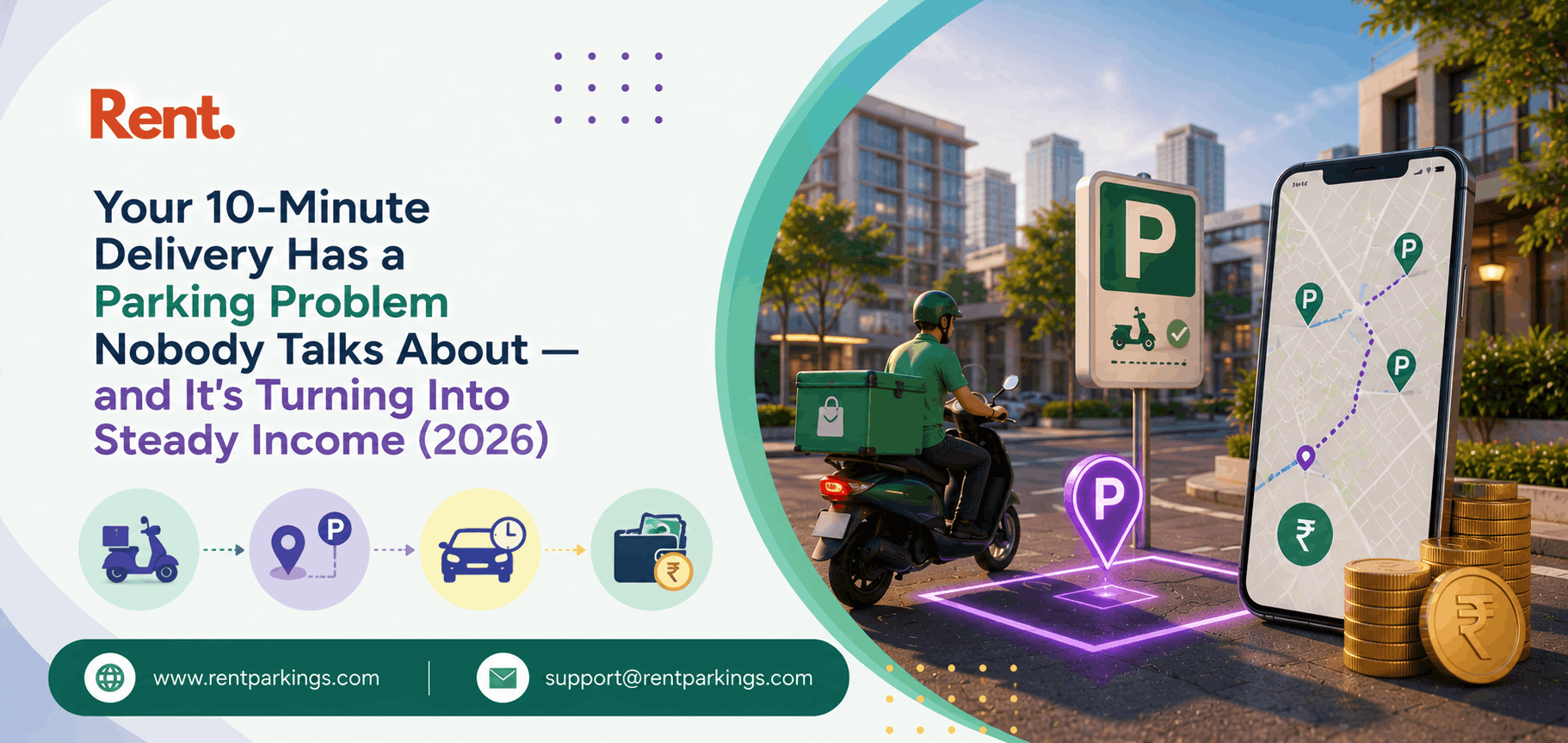
Your 10-Minute Delivery Has a Parking Problem Nobody Talks About — and It's Turning Into Steady Income (2026)
The Delivery Boom Nobody Built Parking For
Everyone in urban India has an opinion about car parking. Housing societies argue over it, RWAs fine people over it, cities build multi-level structures to fix it. But there's a second parking crisis unfolding a few feet lower, on two wheels, several times every minute — and almost nobody is talking about it.
It's the parking problem created by the people delivering your groceries, your dinner, and your last-minute phone charger in under fifteen minutes.
Quick-commerce platforms and food delivery apps have added a genuinely new category of vehicle to Indian streets: the delivery two-wheeler that needs to stop, wait, and restart dozens of times a shift. A rider doesn't park for eight hours like a commuter. They pause for ninety seconds outside a gate, five minutes outside a restaurant, twenty minutes outside a dark store waiting for the next batch of orders to be packed. India's parking systems simply weren't built for this pace — because a few years ago, this kind of demand didn't even exist.
That gap between demand and design is exactly the kind of opportunity RentParkings was built to solve — connecting people with unused space to the people who need somewhere to legally, safely put a vehicle down, even for a few minutes.
Where Riders Are Actually Squeezing In Right Now
Spend twenty minutes outside any busy dark store or restaurant cluster in Bengaluru's HSR Layout, Chennai's Anna Nagar, or Gurugram's Sector 29 during the dinner rush, and you'll see the workaround in real time. Bikes lined up on footpaths. Bikes tucked against compound walls that clearly belong to someone else. Bikes double-parked on service lanes, engines running, riders glued to their phones waiting for the app to buzz.
None of this is because riders enjoy breaking rules. It's because there's genuinely nowhere else to go. Most commercial buildings weren't designed with two-wheeler waiting zones. Most residential societies treat any bike loitering near the gate as a nuisance to be shooed away rather than a business opportunity to be priced.
The result is a strange kind of shortage — not a shortage of parking in general, but a shortage of the right kind of parking: small, short-stay, two-wheeler-friendly space clustered tightly around wherever the orders are coming from. It's a close cousin of the crunch we've already mapped out around India's broader two-wheeler parking crisis, except this version repeats itself in fifteen-minute cycles, all day, every day.
Why This Isn't the Same as the Cab-Driver Problem
It's worth separating this from the parking squeeze that Ola and Uber drivers deal with, since the two often get lumped together. Cab drivers need a spot to idle for ten or twenty minutes between rides, usually near a residential complex or commercial hub. Delivery riders have a tighter, more concentrated version of the same problem — they cluster hard around a small number of points (dark stores, cloud kitchens, restaurant rows). Rather than spreading out across an entire neighborhood, they cluster in one spot — and while each stop is shorter, it happens far more often.
The Overlooked Income Opportunity Sitting Next to Every Dark Store
Here's the part most property owners haven't connected yet. If you own even a small strip of unused space — a gate corner, a basement edge, a vacant plot boundary, a shop frontage that goes quiet after 9 pm — and it happens to sit within a two-minute walk of a quick-commerce dark store or a cluster of cloud kitchens, you're sitting on something riders would gladly pay for.
This isn't the same product as a monthly car parking rental. It's closer to what we've described before as the earning potential of bike, EV, and event-style parking spaces — smaller footprints, faster turnover, and a completely different pricing logic than a single tenant paying you once a month.
Think of it less like renting a room and more like renting a chair by the hour. A single four-foot-by-eight-foot patch of concrete near a busy dark store can, in theory, be used by a dozen different riders across a shift — each paying a small amount for a few minutes of guaranteed, hassle-free space instead of risking a challan on the footpath outside.
What This Kind of Space Actually Looks Like
- Unused gate margins — the strip beside a residential or commercial gate that's too small to be "real" parking but plenty big for two or three bikes.
- Basement corners — underused stilt or basement areas in buildings that sit near restaurant-heavy stretches.
- Vacant plot edges — the kind of idle plot boundary that already earns owners decent money during festival season.
- Shop frontage after hours — retail space that's dead space once the shutters come down but sits right where evening delivery traffic peaks.
None of these need construction, a security guard, or a long-term commitment. Most need little more than a painted boundary, decent lighting, and a clear understanding with the riders or their local hub coordinator about how payment works — typically UPI, since almost every rider is already paying for fuel and recharges that way.
Hourly Pricing Looks Very Different From Monthly Pricing
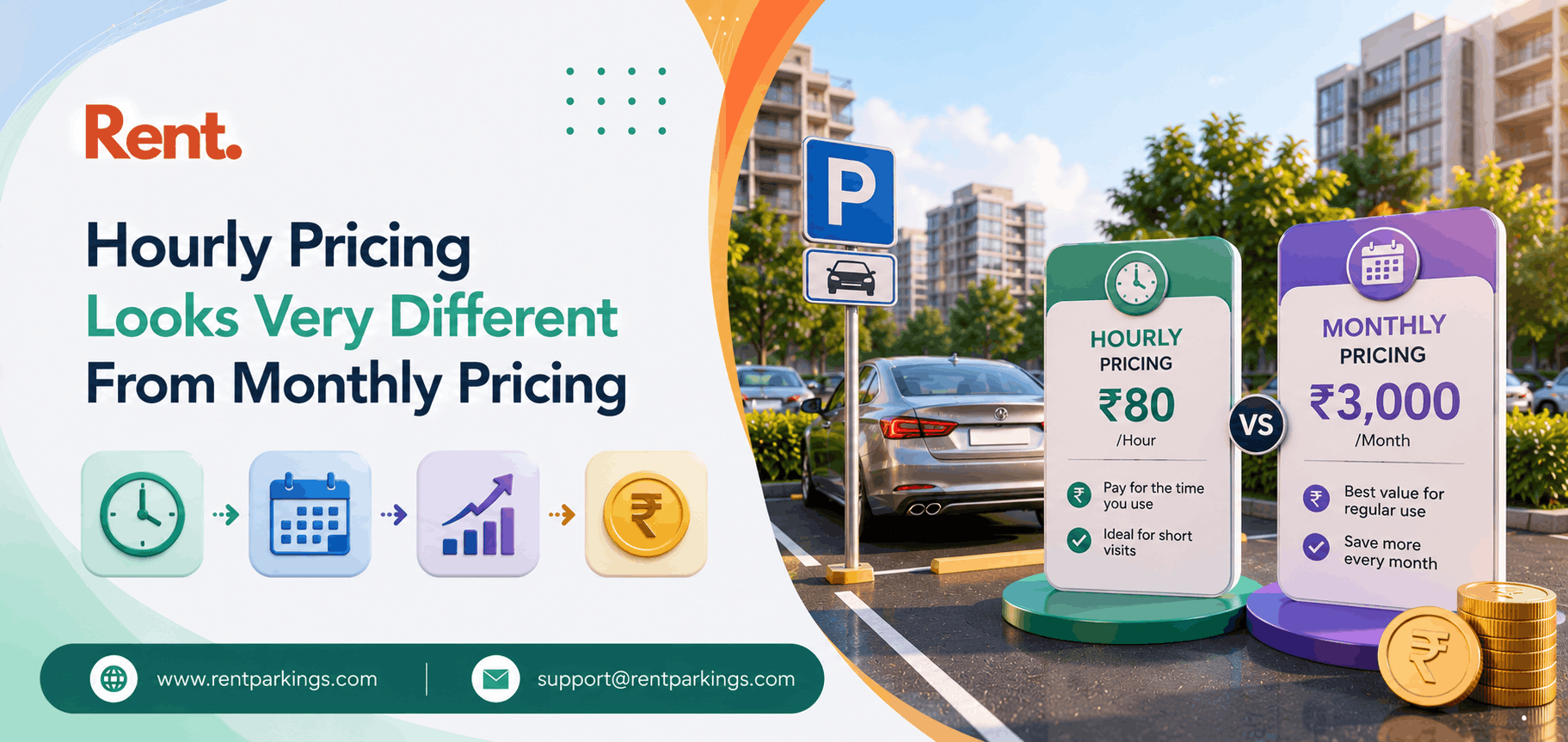
Property owners who've only ever thought about parking in monthly terms are sometimes surprised by how the short-stay economics work out. A single guaranteed two-wheeler spot near a high-traffic dark store has, according to owners and local aggregator coordinators we've spoken with, fetched anywhere from roughly ₹10 to ₹20 per short halt, or a flat daily arrangement in the ₹50 to ₹100 range for riders who pass through the same corridor repeatedly during a shift.
Some owners skip the per-visit approach entirely and strike a monthly deal directly with a delivery hub manager or a cluster of riders who work the same beat — often landing somewhere in the ₹1,500 to ₹3,000 a month range for guaranteed access to two or three marked spots, depending on the city and how competitive the location is.
It's a fundamentally different rhythm from what we laid out in our city-by-city guide to standard parking rental rates, where a single car parking spot typically earns one steady monthly figure from one tenant. Short-stay two-wheeler space earns in small, frequent amounts from many different riders — which can add up to a comparable or better return, provided the location genuinely sees enough delivery traffic to justify it.
How to Tell If Your Space Is Actually in a Hot Zone
Not every street corner qualifies. The whole model only works if you're genuinely close to where quick-commerce and food delivery traffic concentrates — dark stores, cloud kitchen clusters, busy restaurant strips, or residential complexes with a high density of app-based orders.
If you're unsure whether your building sits in one of these pockets, it's worth cross-referencing against the demand patterns we mapped out in our look at India's busiest parking hotspots. Many of the same zones that see heavy car and commuter parking pressure — IT corridors, market areas, dense residential clusters — are also where delivery apps concentrate their dark stores and restaurant partners, simply because that's where the order volume is.
A quick, low-cost way to test the waters: watch your own street for a week. Count how many delivery riders pass through or pause nearby during lunch and dinner hours. If it's a steady stream rather than the occasional bike, you likely have viable demand sitting right outside your gate.
Getting Started as a Property Owner
Once you've confirmed there's real rider traffic nearby, the actual setup is refreshingly simple compared to a long-term rental arrangement.
- Mark out a clearly bounded space — even a few painted lines or a low kerb stone makes a meaningful difference.
- Decide whether you want to charge per visit, per day, or negotiate a flat monthly rate with a local hub or a group of regular riders.
- Set up a simple UPI collection method so payment takes seconds, not minutes.
- Add basic lighting if the space is used after dark, since most dinner-rush and late-night delivery traffic happens well after sunset.
- List the space so nearby riders and hub coordinators actually know it exists — a spot nobody knows about earns nothing, no matter how well located it is.
That last step is where most owners fall short. They have the space, the location, and the demand walking past their gate every evening, but no simple way for riders to discover it. That's precisely the gap a platform like listing your parking space in India through a dedicated marketplace is meant to close, rather than relying on word of mouth alone.
Keeping It Safe and Low-Friction
Because this model involves higher rider turnover than a typical monthly tenant, a little structure goes a long way. Basic CCTV coverage, even a single affordable camera pointed at the space, discourages both petty theft and disputes about who was parked where. Clear boundary markings prevent arguments during busy hours when three or four riders might arrive within minutes of each other.
Most owners running this successfully also keep expectations simple and written down somewhere visible — how long a spot can be held, what happens if a rider overstays, and how payment is expected. None of it needs to be complicated. The riders using these spaces are, for the most part, working professionals trying to hit delivery targets, not looking for trouble.
Frequently Asked Questions
Is renting parking to delivery riders legal in India?
Yes, as long as the space you're renting out is yours to use — owned, leased, or otherwise under your legal control. There's no special licence required to let riders park on private property you control; the same basic property rights that apply to any parking rental apply here.
How is this different from renting a monthly car parking spot?
Monthly car parking usually involves one tenant paying a fixed amount for guaranteed access over weeks or months. Delivery-rider parking is short-stay and high-turnover, with many different riders using the same physical spot across a single day, which changes both the pricing model and the level of day-to-day involvement needed.
What size of space do I need to offer this kind of parking?
A single two-wheeler comfortably needs roughly the same footprint as a standard bike parking bay — enough for the vehicle plus a little clearance to walk around it. Even a modest gate margin or basement corner can accommodate two or three bikes without needing any construction.
Do I need to install CCTV before I start?
It isn't legally mandatory, but most owners running this successfully install at least a basic camera. It reduces disputes over damage or theft and tends to make riders more comfortable using the space repeatedly, which matters when your income depends on repeat visits.
How do I collect payment from riders who only stop for a few minutes?
UPI is the practical answer for almost everyone. A QR code posted at the entrance lets a rider scan and pay in seconds without either party handling cash or needing to coordinate in advance.
Will this work if I'm not near a dark store or cloud kitchen?
It's less likely to generate meaningful volume. The whole model depends on proximity to where delivery traffic actually concentrates, so a location a few streets away from any restaurant cluster or quick-commerce hub probably won't see enough riders to make it worthwhile.
Can I combine this with renting the same space for regular car parking?
Many owners do exactly that, using the space for standard car or bike parking during quieter daytime hours and opening it up specifically for delivery riders during the lunch and dinner rush when demand peaks.
How much can a single spot realistically earn in a month?
It varies significantly by location and rider volume, but owners in busy pockets have reported earnings broadly comparable to a modest monthly bike parking rental, sometimes higher once multiple short-stay payments are added up across a full month.
What happens if a rider's bike is damaged while parked on my property?
It's sensible to set clear expectations upfront — most owners operate on an "at owner's own risk" basis for informal short-stay arrangements, similar to standard practice at most paid parking facilities, and communicate this clearly at the entrance.
Do I need to register with a delivery platform directly to offer this service?
No. You don't need any formal tie-up with Swiggy, Zomato, Blinkit, or similar platforms. Riders and local hub coordinators independently look for nearby parking options, which is exactly why listing your space somewhere they can actually find it makes such a difference.
The Space Outside Your Gate Might Already Be Worth More Than You Think
Most property owners in India still think about parking in one shape only — a monthly tenant, a fixed spot, a single steady cheque. The delivery economy has quietly created a second shape entirely: short, frequent, high-turnover demand clustered tightly around wherever the next order is being packed.
If you own space anywhere near a busy dark store, restaurant row, or cloud kitchen cluster, that gap in the market is sitting right outside your gate, mostly unclaimed. Publish your parking space for free on RentParkings and start putting that overlooked corner to work — set your own rates, choose hourly, daily, or monthly terms, and let verified riders and drivers across India find the space you already have.
Share This post
Search
Recent Post
Parking Space vs. Renting Out a Room to...
05 Oct, 2026
Think Parking Rental Only Pays in Mumbai...
02 Oct, 2026
Your Mumbai Parking Space Is Worth More...
01 Oct, 2026
Hyderabad's Real Estate Boom Left One As...
30 Sep, 2026
What Your Parking Space in Chennai Could...
29 Sep, 2026
Your Plans Changed After Listing Your Pa...
28 Sep, 2026
Parking Space vs SIP: Which Idle Asset A...
25 Sep, 2026
What Your Parking Space in Pune Could Ac...
24 Sep, 2026