

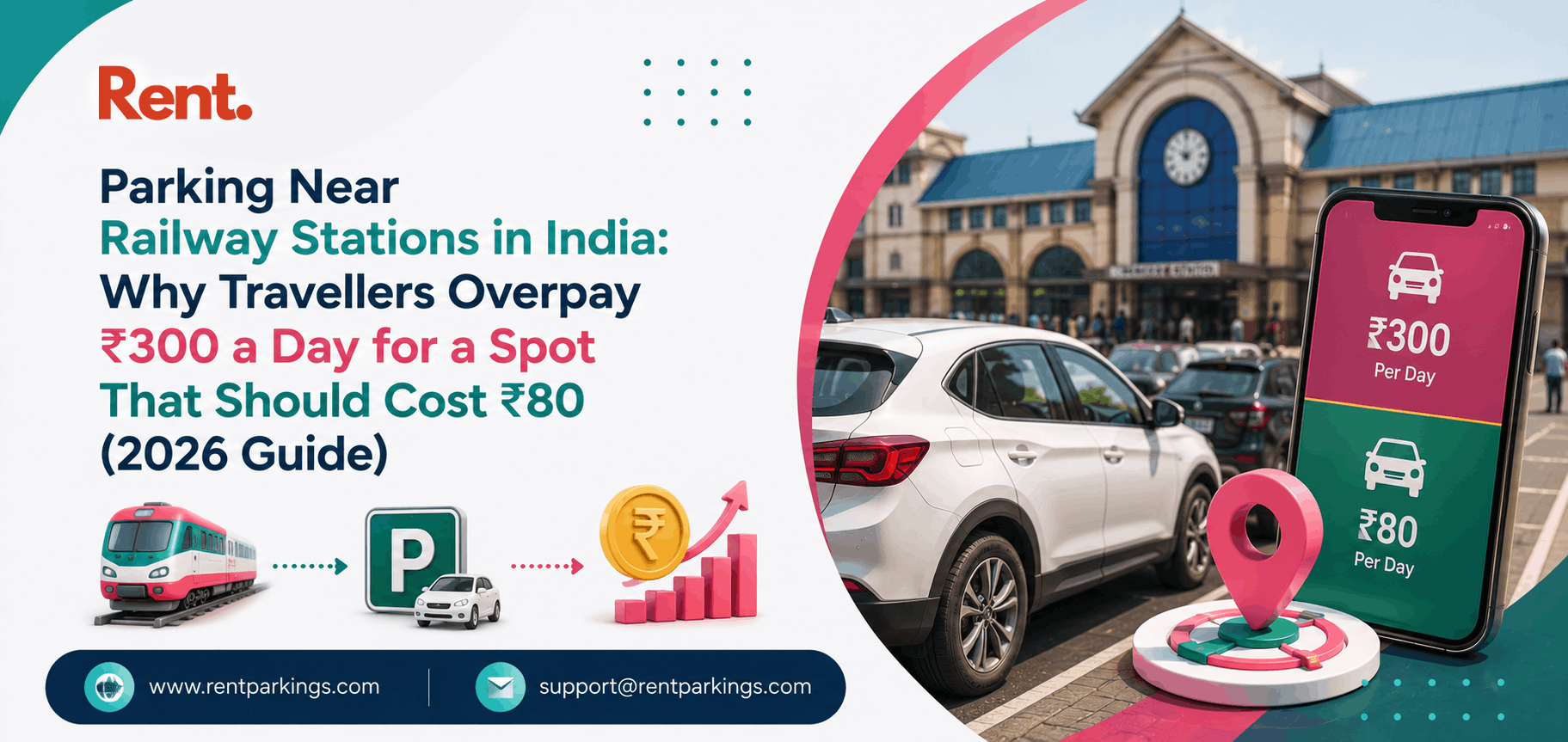
Parking Near Railway Stations in India: Why Travellers Overpay ₹300 a Day for a Spot That Should Cost ₹80 (2026 Guide)
Ask anyone who's ever parked at an Indian railway station for more than a day, and you'll usually get a version of the same story. A colleague of mine left his SUV at the paid lot outside Chennai Central before a nine-day trip to Kolkata for a family wedding. The board at the entrance quoted ₹40 an hour. Nobody mentioned what nine days would actually add up to, and there was no one to ask — the shift had changed twice by the time he got back, and the new attendant simply pointed at a handwritten number scrawled on a slip of paper. No app, no printed multi-day rate, no way to check if it was fair. He paid ₹2,100 and left without a receipt, mostly because it was 6 am and he had a connecting flight to catch.
Multiply that scene across every major station in the country and you start to see how big this problem actually is. Airport parking gets talked about. Metro parking is starting to get app-based fixes. But railway stations — where Indian Railways moves more than 2 crore passengers a day, many of them gone for three, five, or ten days at a stretch — still run mostly on cash, guesswork, and whichever contractor is holding the gate key that week.
Why Station Parking in India Is a Different Animal
Airport parking and metro parking are usually short-duration: a few hours, sometimes overnight. Railway station parking is different because Indian trains carry people on long-distance, multi-day trips. Someone travelling from Chennai to Varanasi isn't back in six hours — they're gone for a week. That single fact changes everything about the risk and the pricing.
Most railway stations in India outsource their parking lots to private contractors through a tender system. The contractor pays the railway division a fixed licence fee and is expected to charge according to a tariff board approved by the Divisional Railway Manager's office. In practice, enforcement is thin, tariff boards go missing, and the person managing the barrier at midnight has little reason to follow a rate card nobody is checking. This isn't true everywhere — well-run stations exist — but it's common enough that "railway parking is a rip-off" is a genuine, recurring complaint across travel forums and city Facebook groups.
What "Official" Station Parking Actually Costs
Rates vary widely by station and are revised often, but here's roughly what four-wheeler parking has looked like at major stations recently, based on posted tariffs and traveller reports:
Chennai Central and MGR Chennai Central — around ₹40 for the first hour, then ₹20 per additional hour, with informal "daily" rates of ₹150–₹250 often quoted verbally for multi-day parking.
At Bengaluru City Railway Station (KSR), the first few hours run about ₹60–₹100, but leave your car for a full day or more and that climbs to roughly ₹200–₹300.
Mumbai CST and LTT — among the steepest, with multi-day parking frequently touching ₹250–₹350 a day in peak season.
New Delhi Railway Station — similarly steep, especially near the Ajmeri Gate and Paharganj side entrances, where private lots outside the official gate charge a premium.
Howrah, Pune, Lucknow, Kochi, Coimbatore, and Madurai — generally cheaper, in the ₹100–₹200-a-day range, but with far less certainty about what you'll actually be charged when you return.
The pattern across almost every city is the same: the posted rate is reasonable, the multi-day rate is negotiable in the worst possible sense, and there's rarely a digital receipt to hold anyone accountable.
The Real Risk Isn't Just the Money
Overpaying by a few hundred rupees is annoying. The bigger issue is what happens to a vehicle sitting untouched in an open-air lot for five to ten days. Car batteries drain. Tyres develop flat spots. Dust and bird droppings sit on the paint through a Chennai summer or a Mumbai monsoon. In lots without CCTV or a fixed attendant roster, there's genuine risk of scratches, mirror theft, or worse — and if something does go wrong, "official" contractor lots are notoriously difficult to hold liable, since most post a disclaimer that they aren't responsible for damage or theft. We've gone deep on exactly how weak that kind of disclaimer actually is in Indian consumer law in this breakdown of parking lot liability rules — worth reading before you sign anything at a gate.
There's also the booking problem. Unlike airport parking, which increasingly allows pre-booking through apps, most railway station lots are first-come, first-served. Arrive during a festival rush — Diwali, Pongal, Onam, wedding season — and there may simply be no space left, forcing a scramble for street parking near the station in areas that are often no-parking zones patrolled aggressively by traffic police.
The Alternative Nobody Talks About: Parking in the Neighbourhood, Not the
Compound
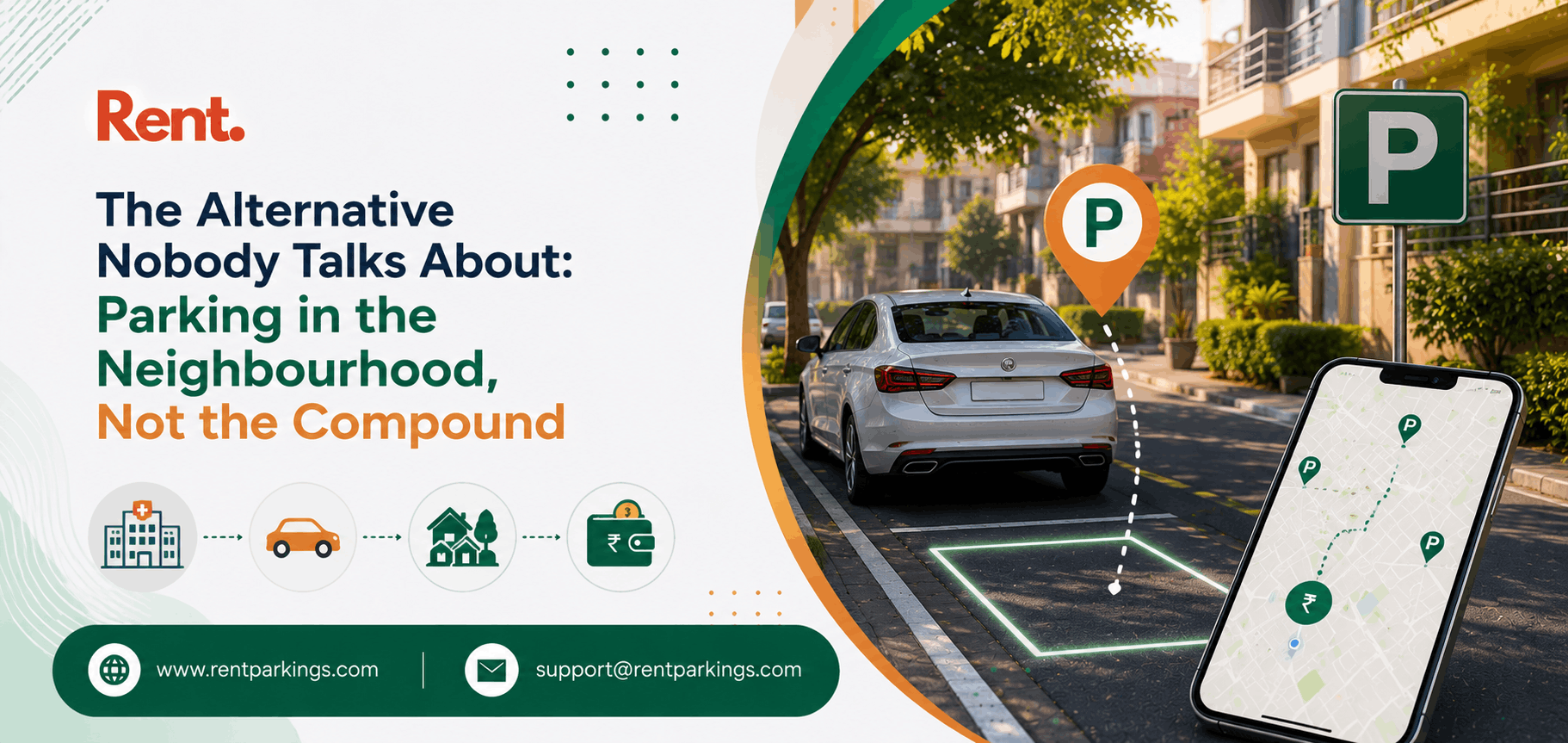
Here's what a growing number of frequent train travellers have figured out: the official station lot is not the only option. Within a five-to-ten-minute walk or auto ride of almost every major station, there are residential streets and apartment complexes with owners sitting on an empty covered or open parking slot they aren't using during the day, or ever. Booking one of these directly — through a marketplace like RentParkings, India's trusted parking marketplace — usually costs less than half the "official" multi-day rate, comes with a fixed price agreed in advance, and puts your car behind a residential society's gate and security guard rather than in an open lot next to a busy station entrance.
It's the same logic that already works well for people flying out of Indian airports. We covered how travellers are increasingly booking private spots near terminals instead of paying airport authority rates in this guide to parking near Indian airports, and the economics nNear railway stations, the math tilts even further in the traveller's favour — residential parking close to the station is rarely full, except during a short stretch of peak hours.
The Other Side of the Story: A Passive Income Opportunity Hiding in Plain Sight
If you own a flat, an independent house, or a commercial plot within walking distance of a busy railway station in Chennai, Bengaluru, Hyderabad, Mumbai, Delhi NCR, Pune, Ahmedabad, Kochi, Coimbatore, Madurai, Jaipur, Lucknow, Kolkata, Noida, or Gurugram, there's a strong chance your unused parking slot is worth more than you think. Long-distance travellers need somewhere to leave a car for three, five, even ten days at a stretch, and they're actively looking for exactly what a residential parking spot offers: predictable pricing, a locked gate, and someone accountable if anything goes wrong. This isn't a hypothetical. We've already seen the same demand pattern play out around metro stations, where owners are earning steady monthly income simply by listing a spot they weren't using — a trend explained in our piece on renting parking near metro stations. Railway stations follow the same principle, except the booking duration is longer, which often means better per-day earnings for the owner. For a wider sense of what parking spaces are actually fetching across Indian cities right now, our city-wise guide to parking rental income is a useful starting point before you set your own price.
How to Choose a Safe Spot Before You Travel
A few habits separate a smooth booking from a stressful one:
- Confirm the exact walking distance to the station entrance you'll actually use — some stations have two or three gates on opposite sides of the platform.
- Check whether the spot is inside a gated society with a security guard, or an open plot on a public road.
- Get the total price for your full travel duration confirmed in writing before you hand over your keys or leave your car.
- Ask whether the owner or society allows overnight and multi-day parking specifically — some residential bylaws restrict guest vehicles to daytime hours only.
- Keep a photo of your car's condition and odometer reading before you leave, the same habit worth using at any unfamiliar parking spot, official or private.
Why This Gap Matters for India's Parking Ecosystem
Airports get the app-based booking treatment. Metro stations are starting to. Railway stations — despite carrying the largest volume of overnight and multi-day parkers in the country — have mostly been left with a contractor system that hasn't modernised. That gap is exactly why a marketplace model works so well here: it doesn't require the railways to fix their tendering process, it simply gives travellers and nearby property owners a direct, transparent way to connect, with pricing set upfront and no midnight renegotiation at the gate.
FAQs
Is it legal to park in a private residential spot near a railway station instead of the official lot?
Yes. There's no rule requiring train travellers to use the railway's contracted parking lot. Parking on private property, with the owner's consent and an agreed fee, is a legitimate private rental arrangement.
How much does railway station parking cost per day in India?
Official contractor lots at major stations typically charge ₹150 to ₹350 per day, depending on the city and season. Private residential parking nearby is often available for less, with the price fixed upfront.
Is my car safe if I leave it parked for a week during a long train journey?
It depends on where you park. A spot inside a gated residential society with a security guard is safer than an open lot with no fixed attendant. Always confirm the actual security measures before booking.
Can I pay for railway station parking using UPI?
Many official lots still expect cash. Private parking booked through a marketplace usually supports UPI, net banking, and card payments, along with a digital confirmation you can refer back to later.
Can I list my parking space near a railway station for rent?
Yes. If you have an unused covered or open parking spot near a busy station, you can list it for free, set your own hourly, daily, or monthly rate, and start earning from travellers.
Can I book railway station parking in advance?
Most official station lots are first-come, first-served with no advance booking. Private parking near the station can usually be reserved ahead of time, which matters most during festival and holiday travel rushes.
What's the difference between official station parking and private parking near a station?
Official lots are contractor-run with inconsistent pricing and little accountability. Private parking near the station offers a fixed price, a specific individual or society responsible for the space, and often better security.
Is overnight and multi-day parking allowed near railway stations in India?
Yes, most private parking spots near stations allow overnight and multi-day parking. It's worth confirming this directly, since some residential societies restrict guest vehicles to daytime hours only.
How far in advance should I book parking near a busy railway station?
Booking two to three days ahead is generally enough, but during Diwali, Pongal, Onam, or wedding season, book as early as a week out since nearby demand rises sharply.
Do private parking spaces near railway stations have CCTV and security?
Many do, especially those inside gated residential societies with a guard on duty. Coverage varies by listing, so it's best to confirm CCTV and security details with the owner before you travel.
The Bottom Line
Railway stations move more people, more often, for longer trips than almost any other transit hub in India — and the parking around them hasn't caught up. For travellers, that means it's worth looking beyond the station gate before assuming the contractor lot is the only choice. For property owners nearby, it means an income opportunity that's been sitting empty in plain sight. If you've got a spare parking spot near a station, don't let it sit idle: List Your Parking Space on RentParkings and start turning it into steady monthly income from verified travellers who need exactly what you have to offer.
Share This post
Search
Recent Post
Parking Space vs. Renting Out a Room to...
05 Oct, 2026
Think Parking Rental Only Pays in Mumbai...
02 Oct, 2026
Your Mumbai Parking Space Is Worth More...
01 Oct, 2026
Hyderabad's Real Estate Boom Left One As...
30 Sep, 2026

What Your Parking Space in Chennai Could...
29 Sep, 2026
Your Plans Changed After Listing Your Pa...
28 Sep, 2026
Parking Space vs SIP: Which Idle Asset A...
25 Sep, 2026
What Your Parking Space in Pune Could Ac...
24 Sep, 2026