

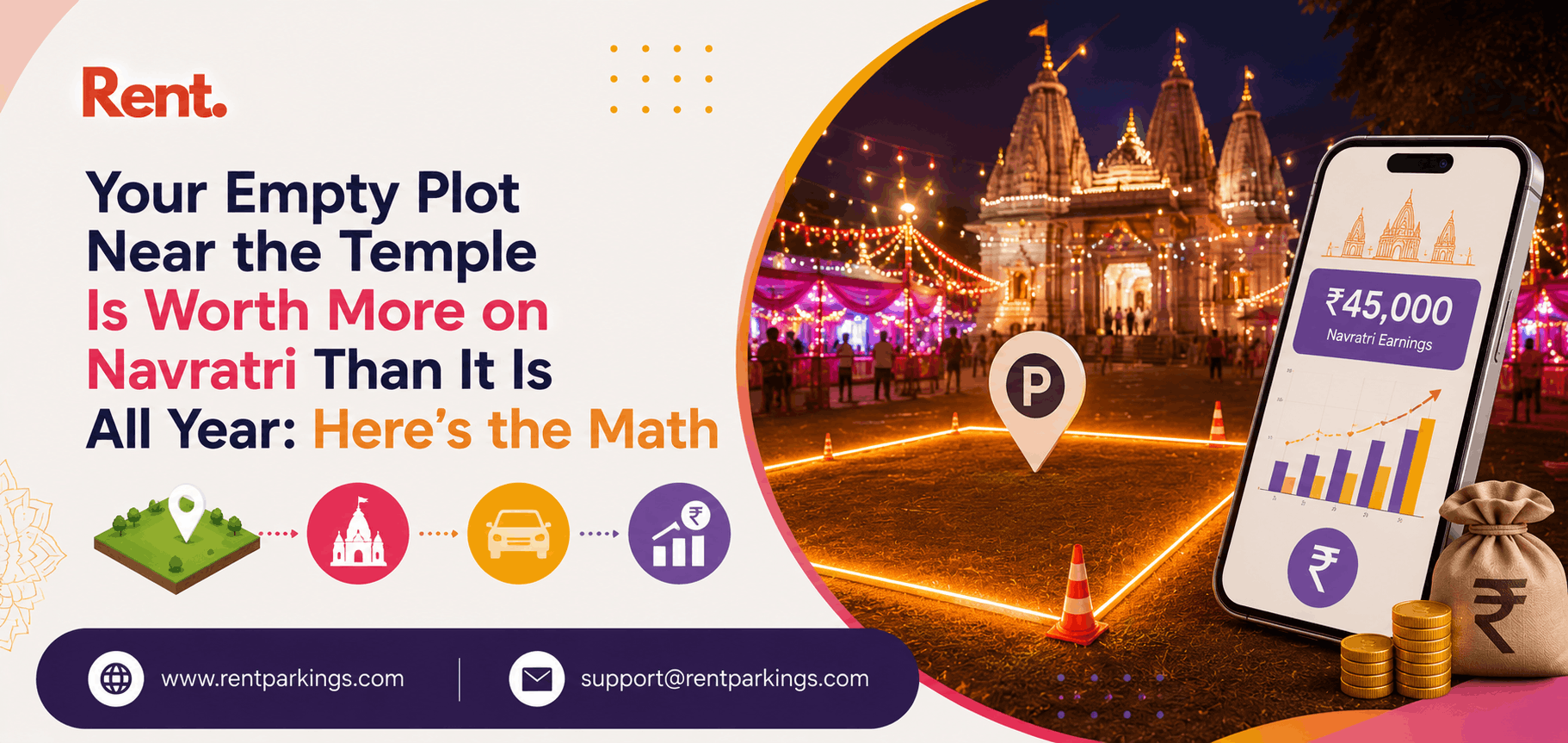
Your Empty Plot Near the Temple Is Worth More on Navratri Than It Is All Year: Here's the Math
If any of that sounds like your There's a particular kind of chaos that happens twice a year in towns like Katra, Tirupati, Shirdi, and Puri. For eleven months, these are quiet temple towns where life moves at its own pace. Then a festival calendar date arrives, and within seventy-two hours, the same narrow lanes are swallowed by tour buses, private cars, two-wheelers, and auto-rickshaws inching forward at walking pace, looking for anywhere flat and legal to stop.
Shri Mata Vaishno Devi alone drew more than 70 lakh pilgrims in 2025, and during a single Chaitra Navratri stretch, over two lakh devotees trekked to the shrine in just a few days. Amritsar's Golden Temple sees the same story every festival season: local papers regularly report devotees circling for a spot while traffic backs up around the complex. Multiply that pattern across Tirumala, Shirdi, Puri's Jagannath Temple, Madurai's Meenakshi Amman Temple, Dwarka, and dozens of smaller regional shrines during their own local jatras, and you get a genuinely enormous, entirely predictable, and almost completely un-monetised parking crisis.
Here's what's strange about it: the shop owner with a side gate, the house two lanes back from the main road, the family running a small dharamshala with a spare stretch of courtyard, almost none of them think of that space as an income asset. They watch the festival crowd from their window every year and never once consider that the empty ground beside their home is worth more for four days in October than it earns them the rest of the year combined. That gap between obvious, recurring demand and completely unused supply is exactly where a smarter, more organised approach to temple parking is starting to take shape, and it's a conversation RentParkings hasn't had with its readers yet, so let's have it properly.
Why Temple Parking Behaves Nothing Like City Parking
Most parking demand in India is steady and predictable: an office crowd from nine to six, a hospital's visitor traffic through the day, a metro station's morning and evening rush. Temple and pilgrimage parking is a completely different animal. It's seasonal, spiky, and often compressed into a handful of dates a year: Navratri, Diwali week, a temple's annual brahmotsavam, a specific ekadashi, a wedding-season weekend when a family combines a pilgrimage with a celebration. Outside those windows, demand can drop to almost nothing.
That volatility is exactly why big commercial operators tend to ignore these towns. Building a permanent, staffed, multi-level structure makes no financial sense in a place where footfall is enormous for two or three weeks and thin for the rest of the year. But that's precisely the shape of opportunity that favours an ordinary property owner with a spare plot, a driveway, or open land near the temple approach road. You don't need a permanent facility. You need a listing that goes live a week before the rush and comes down when it passes, priced for what the day actually demands rather than a flat year-round rate.
The pilgrim isn't looking for the cheapest spot
It helps to understand who you're actually renting to. A family that's driven six or eight hours to reach Shirdi or Tirupati for a once-a-year darshan is not comparison-shopping the way a daily office commuter would. They're tired, often travelling with elderly parents or small children, and carrying prasad, bags, and sometimes bedding for an overnight stay near the shrine. What they want is a spot that's close, safe, and available the moment they arrive, not a bargain three kilometres away that involves a shared auto and a long walk in temple-town heat or monsoon rain. That's why a well-located private spot near a shrine can comfortably out-earn a similarly sized spot in an ordinary residential lane, festival day for festival day.
Who Actually Has Parking to Offer in a Temple Town
You don't need to own commercial land to participate in this. Look around any pilgrimage town and the available supply usually falls into one of these buckets.
Homeowners on the approach roads leading up to the temple, whose front yard or side lane sits empty except during the two or three peak weekends a year. Shopkeepers who close their shutters by evening but have a stretch of frontage or a back lot that goes completely unused after dark, exactly when late-arriving pilgrims are still hunting for a spot. Families running small lodges or dharamshalas who already have overnight guests and a bit of extra courtyard space that could easily take four or five more vehicles for a fee. And landowners holding an undeveloped plot near the temple corridor, waiting for the market to catch up, who could be earning meaningful festival-season income from that idle land in the meantime instead of getting nothing from it for years.
situation, and you've already got a general sense of how private parking rental works, it's worth reading through How to List Your Empty Parking Space for Rent: A First-Timer Walkthrough before your next big festival date. The fundamentals of listing, pricing, and managing bookings are exactly the same whether your spot sees traffic every day or four intense days a year.
Pricing a Spot That Only Gets Busy a Few Times a Year

This is where most first-time temple-town hosts get it wrong. They either price their spot like a regular city space, flat, low, and identical every day, or they guess wildly high during a festival rush and end up empty because nobody trusts the number. Neither approach captures what the space is actually worth.
The better way to think about it is in three tiers.
Peak festival days, Navratri, a major temple's annual festival, Diwali week in temple towns that see a tourism spike, Maha Shivratri at Shiva temples, or a specific jatra date, deserve premium day-rate pricing, because this is genuinely the two or three days a year your spot earns most of its annual income. Don't underprice these; pilgrims travelling long distances for a specific date are not walking away over a reasonable rupee difference.
Weekend and long-weekend traffic outside the major festival calendar, when regional tourists and shorter pilgrimages still bring a steady flow of vehicles, calls for a moderate, still-attractive day rate: enough to be worthwhile, not so high that it looks opportunistic.
Off-season weekdays, when the town is quiet, are where you either price low enough to catch the odd traveller or simply leave the listing paused rather than competing for negligible demand. There's no shame in a seasonal listing; it's honestly a more accurate reflection of how the town itself actually breathes.
If you want a broader sense of how demand-driven pricing plays out elsewhere in India, near stations, markets, and other high-traffic zones, the piece on India's Busiest Parking Hotspots: The Main Areas & Rush Zones Where Parking Runs Out First, and How to List Your Space Free on RentParkings (2026) is a useful companion read, since the underlying logic of charging more where demand spikes hardest is identical.
The Legal and Practical Groundwork Before You List
Before you turn your front yard into a paid parking spot, a few practical questions are worth settling honestly. If you're on an approach road rather than your own compound, check whether you're informally using municipal or panchayat land versus your own registered plot. The rules and reputational risk differ, and it's worth understanding your position the way Can You Reserve the Road Outside Your House in India? The Truth About On-Street Parking (2026) lays out for city driveways, since the same civic logic applies to temple approach roads.
If you're renting out space that belongs to a joint family property, an ancestral home, or a plot with shared ownership, get informal agreement from co-owners before you start collecting money for it. Festival-season disputes over undisclosed income are a genuinely common and avoidable headache. And if you're weighing whether it's even worth formalising a piece of land you've been sitting on for future development, it's worth reading Does a Parking Space Add Value to Your Flat in India? Property Prices, Resale, and the 2026 Buyer's Reality Check, since the same instinct that makes a flat's parking slot valuable applies to raw land near a growing pilgrimage circuit.
Safety is the other half of the groundwork. A festival crowd means strangers' vehicles sitting on your property for hours, sometimes overnight if pilgrims are staying for a multi-day yatra. A basic boundary, visible lighting after dark, and a simple written or digital record of who parked and when go a long way toward preventing disputes later, and they cost far less than the goodwill you'd lose from a single bad experience going around a small town.
Apartment and Society-Owned Land Near Temples Counts Too
It isn't only individual homeowners who sit on this opportunity. Housing societies and apartment complexes built near growing temple towns, increasingly common as pilgrimage circuits attract real estate development, often have visitor parking or unallotted slots that stay empty outside festival weekends. If you're on a managing committee or simply an owner in such a building, it's worth understanding exactly what Who Actually Owns the Parking in Your Apartment? Stilt, Covered & Open Parking Rights in India (2026) explains before assuming the society can simply start renting bays to pilgrims. Stilt and covered parking ownership in India carries its own set of rules that are easy to get wrong with good intentions.
Why This Is a Genuinely Under-Served Market
Every large parking platform in India, RentParkings included, has historically built its content and its host base around cities: office corridors, metro stations, airports, malls. That's where the daily, dependable demand lives, and it's the sensible place to start. But it's left an entire category of India's parking demand almost untouched: the temple towns and pilgrimage corridors that see some of the highest short-burst footfall in the country, several times a year, without a single organised, safety-checked, fairly-priced private parking option in sight.
That gap won't stay open forever. As more pilgrims travel by private vehicle rather than bus or train, and as tier-2 temple towns keep growing their tourism infrastructure, the property owners who list early, before every neighbour on the approach road figures out the same thing, will be the ones who build a genuine annual income stream and a returning base of drivers who book with them, festival after festival, year after year.
Frequently Asked Questions
Is it legal to rent out my private plot for parking near a temple in India?
Renting your own privately owned land or driveway for parking is generally allowed, provided the land is legitimately yours and you aren't obstructing a public road, encroaching on government land, or violating your local municipal or panchayat rules. If you're unsure whether a strip of land near your property is officially yours or technically public, it's worth verifying with local records before listing it commercially.
How much can I realistically earn from temple-town parking?
It depends heavily on your proximity to the shrine, the specific festival dates, and how organised your listing is, but the key difference from city parking is concentration: a handful of peak festival days can out-earn months of ordinary rental income elsewhere, simply because pilgrim demand on those dates is so intense and inelastic.
Do I need to be open year-round to make this worthwhile?
No. Many of the best-performing temple-town hosts list only around known festival dates, yatra seasons, and long weekends, and leave the listing paused the rest of the year. A seasonal approach is often more profitable per hour of effort than trying to compete for thin, off-season demand.
What about safety, since pilgrims may be strangers travelling from far away?
Basic precautions matter: clear boundaries, visible lighting, a simple record of vehicle numbers and timing, and using a platform that verifies users on both sides of the booking. These steps protect you and give travelling pilgrims the confidence to choose a private spot over an unregulated roadside one.
Can shops and small businesses near a temple participate, not just homeowners?
Yes. A shop that closes in the evening but has usable frontage or back space is often ideally placed, since much of the heaviest pilgrim parking demand during festival nights and early-morning darshan queues happens exactly when regular shop hours have ended.
Turn Festival-Season Chaos Into Predictable Income
If you own property, land, or even a modest driveway near a temple, dargah, gurdwara, or pilgrimage route anywhere in India, you're sitting on an asset that thousands of tired, travel-weary pilgrims would happily pay for on the days that matter most. You set your own price for peak dates, choose exactly which days you want to list, and reach verified drivers who are actively searching for somewhere safe and close to leave their vehicle, instead of leaving that seasonal income on the table year after year while cars circle your street looking for a spot that could have been yours to rent out.
List Your Parking Space on RentParkings today and start turning your temple town's busiest weekends into your most profitable ones.
Share This post
Search
Recent Post

Parking Space vs. Renting Out a Room to...
05 Oct, 2026

Think Parking Rental Only Pays in Mumbai...
02 Oct, 2026
Your Mumbai Parking Space Is Worth More...
01 Oct, 2026

Hyderabad's Real Estate Boom Left One As...
30 Sep, 2026

What Your Parking Space in Chennai Could...
29 Sep, 2026

Your Plans Changed After Listing Your Pa...
28 Sep, 2026
Parking Space vs SIP: Which Idle Asset A...
25 Sep, 2026

What Your Parking Space in Pune Could Ac...
24 Sep, 2026